
Erikson Stages of Development Quiz
How the Scales are Structured
Who Usually Takes This Test?
See How You Compare
Below is a preview of how scores are typically distributed across each scale.
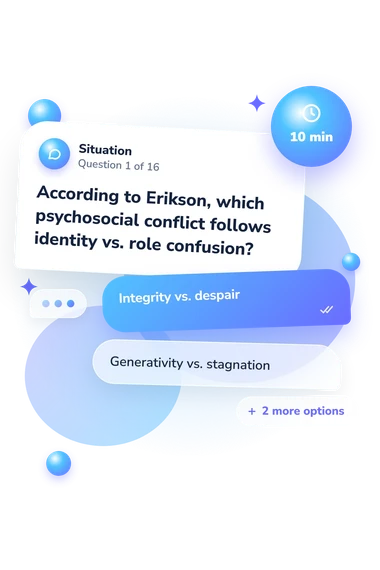
Example Questions From the Test
- Integrity vs. despair
- Generativity vs. stagnation
- Industry vs. inferiority
- Intimacy vs. isolation
- Will
- Hope
- Purpose
- Care
- Identity vs. role confusion
- Industry vs. inferiority
- Intimacy vs. isolation
- Integrity vs. despair
Erikson Stages of Development Quiz - Description and methodology of the test
Students, educators, and curious readers can use the Erikson Stages of Development Quiz when they want to check whether their grasp of the framework is ready for further study or teaching. Its educational role as an Erikson stages quiz is to support a decision about what to review next, while the result concerns knowledge of theory rather than a person’s emotional health or personal development.
What This Assessment Measures
The items cover concepts consistent with Erikson’s eight-stage theory. They test recognition of its eight conflicts, links between situations and stages, developmental order, and positive resolutions with traditional virtues. Erikson’s 1963 account is a conceptual reference, but the online questionnaire tests these concepts rather than reproducing that book or a published instrument.
Brief examples add application: a quiz on Erikson's stages of psychosocial development asks readers to apply ideas to brief examples.
The questions cover:
- Stage sequence shows whether you can place conflicts in order.
- Conflict recognition shows whether you distinguish neighboring psychosocial tasks.
- Virtue matching shows whether you connect resolutions with hope, will, purpose, competence, fidelity, love, care, or wisdom.
- Applied examples show whether you translate theory into situations.
Erikson's Stages of Development Knowledge (0-16) is reported as Foundations to Build (0-6), Developing Knowledge (7-12), or Strong Knowledge (13-16).
Methodology and Evidence Base
The questionnaire uses multiple-choice items with four answer choices. In this developmental-stages quiz associated with Erik Erikson, some items test direct recall, while others ask you to choose the best interpretation of a brief situation or developmental sequence. One point is awarded for each correct answer, so the total reflects matches to the answer key rather than the intensity of a personal characteristic.
Rosenthal, Gurney, and Moore offer a related published 1981 inventory for examining Eriksonian stages. This questionnaire is conceptually consistent with that instrument, not an adaptation of its items or validation procedure.
Interpretation is strongest when this Erik Erikson psychosocial development quiz is used to choose what to review next, such as stage order, conflicts, virtues, or applications. Prior study, attention, and familiarity with the vocabulary can affect performance. The displayed bands summarize correct-answer totals as educational knowledge levels, not a clinical judgment about development.
- Erikson, Erik H. (1963). Childhood and Society (2nd ed., revised and enlarged). New York: W. W. Norton & Company.
- Erikson, Erik H. (1968). Identity: Youth and Crisis. New York: W. W. Norton & Company.
- Rosenthal, Doreen A., Ross M. Gurney, and Susan M. Moore. (1981). From trust on intimacy: A new inventory for examining Erikson's stages of psychosocial development. Journal of Youth and Adolescence, 10(6), 525-537. 10.1007/BF02087944