
AP Euro Quiz
How the Scales are Structured
Who Usually Takes This Test?
See How You Compare
Below is a preview of how scores are typically distributed across each scale.
Example Questions From the Test
- Liberty, Equality, Fraternity
- Peace, Land, and Bread
- Blood and Iron
- One King, One Law, One Faith
- Abolishing feudal privileges and seigneurial dues
- Inviting the émigré nobility to govern the provinces
- Reestablishing compulsory labor obligations for peasants
- Restoring guild monopolies in French towns
- The decision to place English monasteries under royal control
- The Catholic Church's endorsement of predestination
- The pope's support for vernacular Bibles throughout Europe
- The preaching and sale of indulgences
AP Euro Quiz - Description and methodology of the test
Students reviewing European history, teachers planning a quick warm-up, and curious learners can use the AP Euro Quiz to focus on how major ideas, institutions, and turning points connect. This AP Euro practice quiz gives a compact way to choose a starting point for targeted review or classroom discussion, without standing in for the breadth of the course.
What This Assessment Explores
It checks whether learners can connect European thinkers, institutions, economic change, religious conflict, revolution, and empire with historical context. The AP European History practice quiz suits focused review of major relationships and turning points.
Results use the AP European History Knowledge scale (0-16): Foundational (0-6) recognizes some key developments, Developing (7-12) shows many central themes, and Strong (13-16) indicates broad command of major ideas and reasoning. The scale is an unvalidated study summary, not an official AP score prediction.
The item set includes three thematic groups:
- Renaissance and intellectual change connect humanism, scientific inquiry, and Enlightenment thought to shifts in knowledge and authority.
- State power and belief show how rulers, diplomacy, nationalism, reform, and revolution altered political order.
- Industrialization and empire explain how class conflict, fascism, colonial expansion, and postwar cooperation changed European societies.
Methodology and Scientific Basis
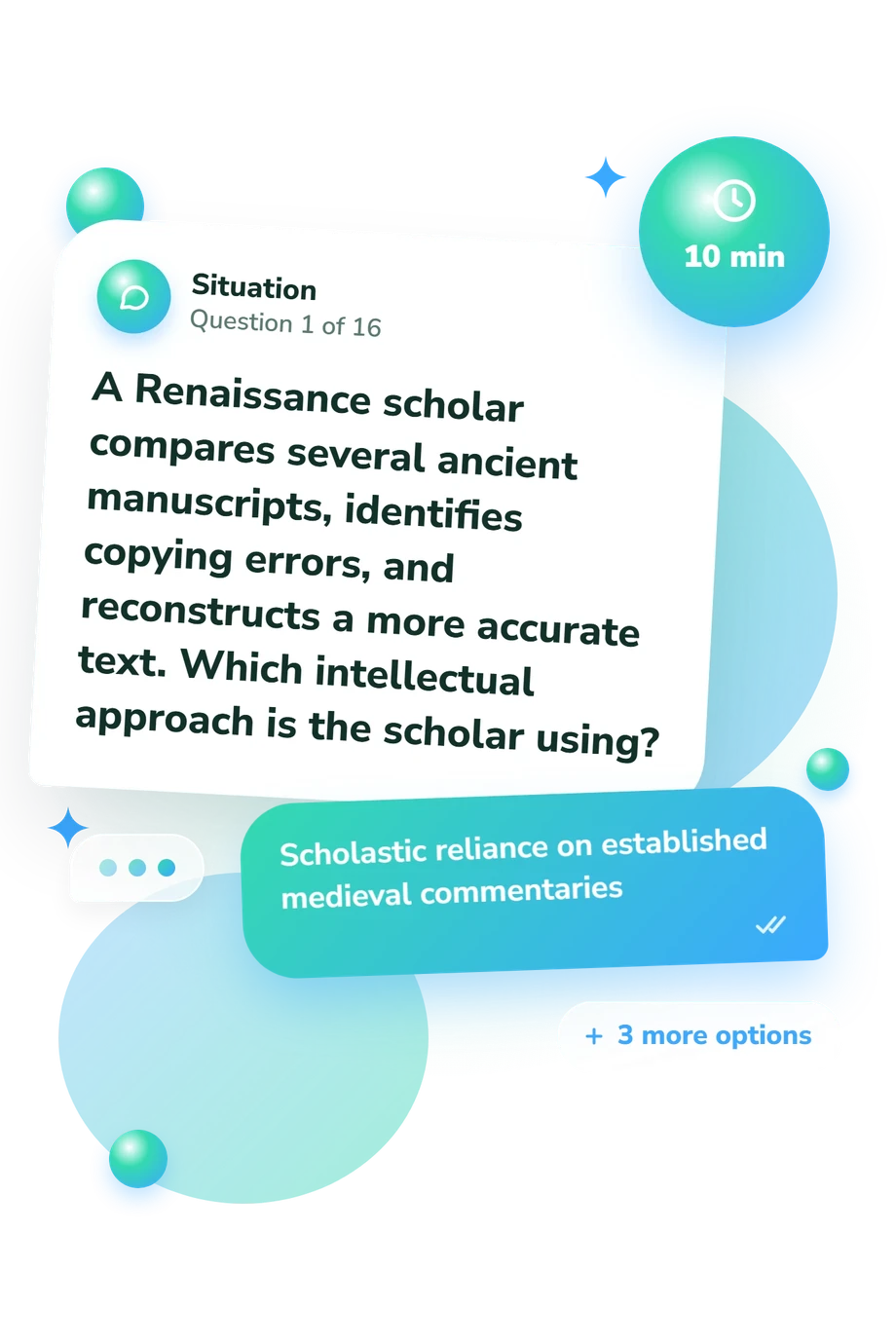
Each item presents a historical prompt with four answer choices and asks for the best response. It tests recognition, comparison, chronology, and causal reasoning, such as identifying an intellectual method or matching an agreement to its setting. The displayed summary organizes study guidance rather than reporting a documented psychometric score.
As an AP Euro history quiz, its content is conceptually aligned with the AP European History framework, which organizes study around periods, themes, historical reasoning, and evidence. It is a standalone questionnaire, not an adaptation of a published instrument; topic alignment alone does not establish score validity.
The AERA, APA, and NCME Standards distinguish evidence supporting score interpretations from reference distributions used as norms. Here, the displayed bands summarize performance on this item sample, not established population norms.
Within this item sample, the result can show which historical reasoning areas merit review. A short set cannot represent the full AP European History curriculum, and preparation, wording, or familiarity with multiple-choice reasoning may affect performance; review missed topics alongside the band.
- College Board. AP European History Course and Exam Description, Effective Fall 2026. New York, NY: College Board, 2026.
- Lynn Hunt, Thomas R. Martin, Barbara H. Rosenwein, and Bonnie G. Smith. The Making of the West: Peoples and Cultures. 7th ed. Boston: Bedford/St. Martin's, 2022.
- American Educational Research Association, American Psychological Association, and National Council on Measurement in Education. Standards for Educational and Psychological Testing. Washington, DC: American Educational Research Association, 2014.
- Barbara S. Plake and Lauress L. Wise. "What Is the Role and Importance of the Revised AERA, APA, NCME Standards for Educational and Psychological Testing?" Educational Measurement: Issues and Practice 33, no. 4 (2014): 4-12. 10.1111/emip.12045
Updated: