
HTML and CSS Quiz
How the Scales are Structured
Who Usually Takes This Test?
See How You Compare
Below is a preview of how scores are typically distributed across each scale.
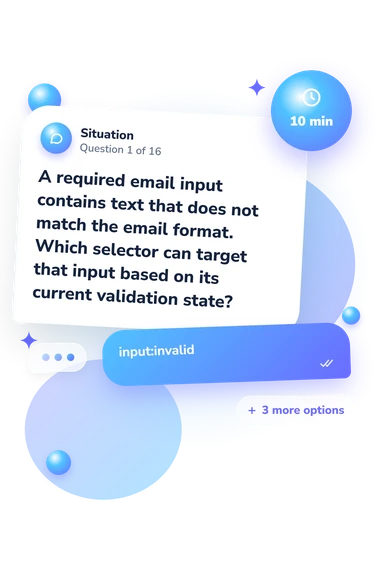
Example Questions From the Test
- text-align: center; vertical-align: middle;
- justify-content: space-between; align-content: center;
- align-self: center; margin-left: auto;
- justify-content: center; align-items: center;
- <label name=""email"">Email</label>
- <label id=""email"">Email</label>
- <label target=""email"">Email</label>
- <label for=""email"">Email</label>
- display: none;
- visibility: hidden;
- opacity: 0;
- position: relative;
HTML and CSS Quiz - Description and methodology of the test
People who want a practical snapshot of their front-end foundations can use the HTML and CSS Quiz to review common markup and styling decisions. It suits learners, self-taught developers, and practitioners revisiting core web skills. Covering both languages, this HTML/CSS quiz helps locate strengths and revision priorities before hands-on practice.
What This Assessment Explores
Questions focus on choices in page structure, styling, accessibility, and responsive behavior. As an HTML and CSS assessment, it examines whether you can recognize semantic elements, connect labels to controls, use selectors and custom properties, reason about the cascade, and choose layout and sizing rules.
Three groups describe the single score's content:
- Semantic HTML and forms show whether you can choose meaningful elements and associate labels with controls.
- CSS rules and layout indicate how you apply selectors, source order, flexbox, Grid, the box model, and sizing.
- Accessibility and responsive design reveal whether you account for meaningful alternatives and changing viewport widths.
Results are reported on HTML and CSS Knowledge (0-16): Building Foundations (0-6), Developing Knowledge (7-12), and Strong Knowledge (13-16). These bands summarize the fundamentals demonstrated here; Strong Knowledge is an educational summary, not professional certification.
Methodology and Evidence Base
The method is an online multiple-choice knowledge check: each item presents a short web-development situation with four answer choices. Choosing the best rule tests recognition and application of fundamentals rather than extended explanation. The displayed total summarizes performance across the questionnaire, while no separate item-weighting formula is stated.
As a front-end skills test, the quiz has a conceptual evidence base rather than documented formal psychometric standardization. Its content is conceptually consistent with the CSS Snapshot, the HTML Standard, WCAG 2.2, and Park’s syntax-error study; these sources provide content context rather than psychometric validation.
Interpret the band alongside the topics you missed. Since the questionnaire publishes no norms, reliability estimates, or validated cutoff study, the score may reflect guessing, recent study, concentration, familiarity with the wording, and uneven experience with particular HTML or CSS tasks. Use it to set practice priorities, then check transfer through hands-on coding.
- Tab Atkins Jr., Elika J. Etemad, Florian Rivoal, Chris Lilley, and Sebastian Zartner, editors. CSS Snapshot 2025. W3C Group Note, 18 September 2025.
- Anne van Kesteren, Domenic Denicola, Domenic Farolino, Philip Jägenstedt, and Simon Pieters, maintainers. HTML Standard. WHATWG Living Standard, last updated 21 September 2026.
- Alastair Campbell, Chuck Adams, Rachael Bradley Montgomery, Michael Cooper, and Andrew Kirkpatrick, editors. Web Content Accessibility Guidelines (WCAG) 2.2. W3C Recommendation, 12 December 2024.
- Thomas H. Park, Brian Dorn, and Andrea Forte. An Analysis of HTML and CSS Syntax Errors in a Web Development Course. ACM Transactions on Computing Education, 15(1), Article 4, 1-21, 2015. 10.1145/2700514