
Ser Quiz
How the Scales are Structured
Who Usually Takes This Test?
See How You Compare
Below is a preview of how scores are typically distributed across each scale.
Example Questions From the Test
- está
- es
- son
- tiene
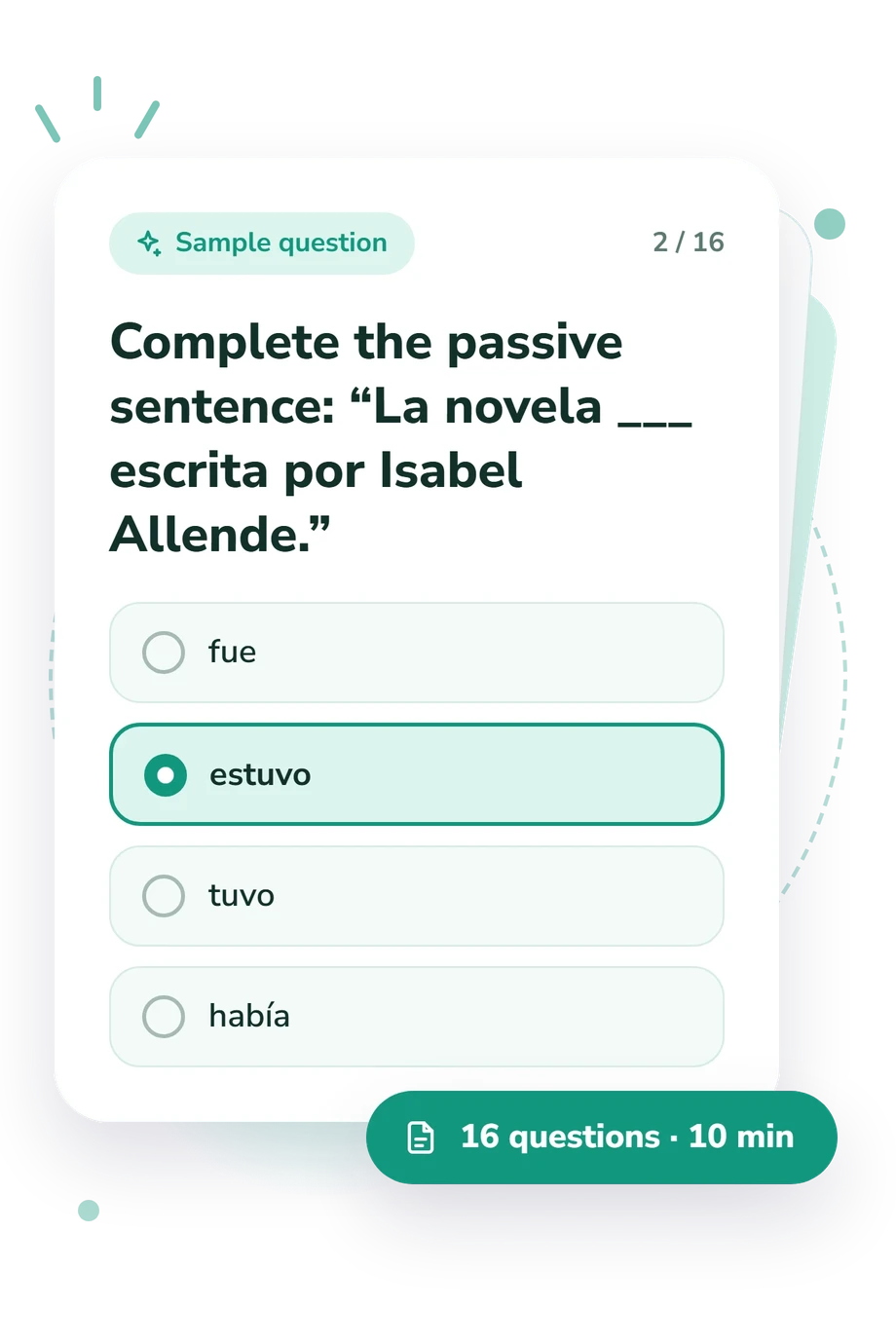
- fue
- estuvo
- tuvo
- había
- soy
- es
- estoy
- está
Ser Quiz - Description and methodology of the test
Spanish learners who want to clarify the contrast between ser and estar can use this ser quiz to examine how context guides verb choice. It suits anyone practising everyday sentences involving identity, origin, condition, location, and actions in progress. As a ser conjugation quiz, it turns common grammar decisions into a focused self-check. The result indicates overall performance across the tested contexts.
What This Assessment Explores
Ser and estar are selected by meaning and sentence structure, not by a single translation. This ser and estar test suits learners who hesitate when identity, condition, location, or event meaning changes. Items cover relationships, origin, possession, current states, passive forms, and ongoing actions.
The single scale is Ser and Estar Knowledge (0-16), with one point per correct answer. Foundations to build (0-6) calls for review of identity versus condition and event versus physical location; Developing command (7-12) shows many common uses with some contextual confusion; Strong command (13-16) shows accurate use across familiar and nuanced contexts.
These themes contribute to one overall score, not separate subscales:
- Identity and origin test whether ser identifies people, relationships, and source.
- Conditions and location test whether estar fits current states and position.
- Events and constructions test event location, passive forms, and ongoing actions.
Methodology and Scientific Basis
Methodologically, this is a context-based, self-administered multiple-choice assessment. Each prompt presents a Spanish sentence or situation and four answer choices, asking you to choose the verb form that fits, so the task examines contextual selection rather than isolated conjugation recall. The format creates useful Spanish verb practice through decisions about meaning, tense, and sentence pattern.
The questionnaire is conceptually consistent with Dussias et al. (2014), whose study examines how learners process ser and estar in relation to objects and events. Collentine and Asención-Delaney (2010) is relevant to discourse functions and adjective contexts in learner Spanish, while Butt, Benjamin, and Moreira Rodríguez provide a descriptive reference grammar for modern usage. These sources clarify the grammatical distinctions being tested; they do not establish this online questionnaire as a reproduction or validated adaptation of their work.
The raw score reflects choices in this format, so guessing, attention, prior instruction, and familiarity with particular examples can affect it; read it as a snapshot of performance on these contexts rather than a complete measure of Spanish proficiency.
- Paola E. Dussias, Carla Contemori, and Pedro Román. 2014. Processing ser and estar to locate objects and events: An ERP study with L2 speakers of Spanish. Spanish Journal of Applied Linguistics 27(1): 54-86. 10.1075/resla.27.1.03dus
- Joe Collentine and Yuly Asención-Delaney. 2010. A Corpus-Based Analysis of the Discourse Functions of Ser/Estar + Adjective in Three Levels of Spanish as FL Learners. Language Learning 60(2): 409-445. 10.1111/j.1467-9922.2010.00563.x
- John Butt, Carmen Benjamin, and Antonia Moreira Rodríguez. 2019. A New Reference Grammar of Modern Spanish. 6th ed. Routledge.
Updated: