
Stoner Quiz
How the Scales are Structured
Who Usually Takes This Test?
See How You Compare
Below is a preview of how scores are typically distributed across each scale.
Example Questions From the Test
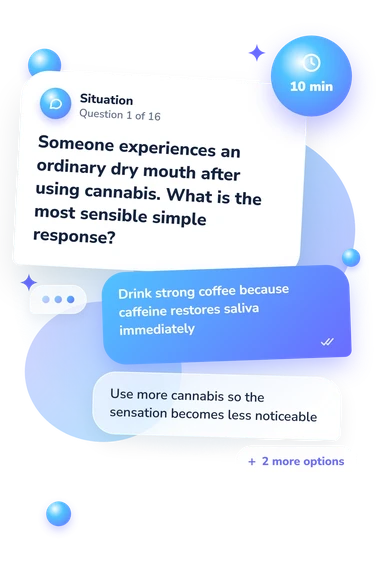
- Drink strong coffee because caffeine restores saliva immediately
- Use more cannabis so the sensation becomes less noticeable
- Sip water and allow time for the effect to pass
- Drink alcohol because it hydrates faster than water
- Much of its aroma and flavor
- The plant's legal classification
- The weight of its seeds
- Its ability to grow without light
- It keeps going out because the flower is too finely ground
- A ring of resin is forming near the lit end
- It is burning unevenly down one side
- The filter is sliding out of the paper
Stoner Quiz - Description and methodology of the test
People who want a clearer picture of their cannabis knowledge can use the Stoner Quiz to examine how confidently they recognize common terms, effects, preparation methods, and safer-use situations. It is intended for curious readers and anyone reviewing their understanding before making decisions around cannabis. The questionnaire helps answer the practical question behind an am-I-a-stoner-quiz label: whether basic knowledge is in place.
What This Assessment Measures
Questions focus on cannabis literacy rather than personality, use frequency, or intoxication. They test terms, plant features, effects, preparation, and safer responses. The result describes knowledge breadth, not whether someone should use cannabis or react to it.
For readers approaching it with an are-you-a-stoner-quiz question in mind, the profile covers:
- Terminology and culture measure terpenes, trichomes, decarboxylation, “420,” and slang.
- Effects and products measure THC, tolerance, edibles, vaporizing, and indica-sativa labels.
- Safer-use judgment measures storage, delayed effects, mixing, driving, emergencies, dry mouth, and uneven burning.
The displayed scale is Stoner Knowledge (0-16). Budding Knowledge (0-6) indicates recognition of some basics, with terminology, delayed effects, impairment, and safer storage to review; Developing Knowledge (7-12) indicates a useful foundation with cultural and harm-reduction details to sharpen; Strong Knowledge (13-16) indicates broad command of the concepts covered. It is educational, not a medical, legal, or intoxication measure.
Methodology and Evidence Base
Each item presents a short knowledge question or scenario with four response options. As an online self-report, the respondent chooses the answer that best fits the facts or safer action. Responses produce one total on the displayed scale, then the supplied result band provides the interpretation; the range does not establish a separate point formula.
Its closest published reference is the Cannabis Knowledge Assessment Tool (CKAT; Bayat et al., 2023). This questionnaire is conceptually consistent with that approach, but is not an administration or adaptation of CKAT. The study by Leos-Toro et al. (2020) adds context on cannabis-related health knowledge and risk perceptions; it does not establish authorship or validation of this online test.
For readers weighing a what-kind-of-stoner-are-you-quiz, the result is a topic profile rather than an identity label. The questionnaire has no stated normative standardization or diagnostic threshold, and its score is not evidence of impairment, future behavior, or a predictable personal reaction. Memory, guessing, current context, and willingness to choose the safest option can affect answers. Use the profile to identify topics worth reviewing, never to decide whether driving or operating machinery is safe.
- Bayat A, Mansell H, Taylor J, Szafron M, Mansell K. The development of a Cannabis Knowledge Assessment Tool (CKAT). PLoS One. 2023;18(9):e0291113. 10.1371/journal.pone.0291113
- Leos-Toro C, Fong GT, Meyer SB, Hammond D. Cannabis health knowledge and risk perceptions among Canadian youth and young adults. Harm Reduct J. 2020;17:54. 10.1186/s12954-020-00397-w