
Adding and Subtracting Fractions Quiz
How the Scales are Structured
Who Usually Takes This Test?
See How You Compare
Below is a preview of how scores are typically distributed across each scale.
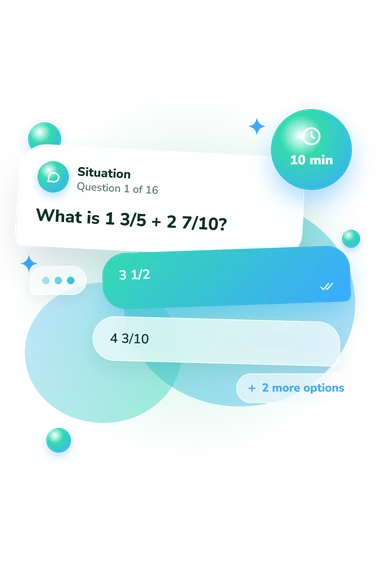
Example Questions From the Test
- 3 1/2
- 4 3/10
- 3 4/15
- 4 1/5
- 7/12
- 4/6
- 5/24
- 2/3
- 0
- 1/4
- 1/2
- 1
Adding and Subtracting Fractions Quiz - Description and methodology of the test
For learners who want a clearer picture of their fraction skills, the Adding and Subtracting Fractions Quiz focuses on how accurately they reason through calculations and practical situations. It is suited to people learning, teaching, or revisiting school mathematics. As an adding and subtracting fractions online quiz, it can highlight whether errors arise from computation, comparison, simplification, or benchmark choice.
What This Assessment Measures
Items cover like and unlike denominators, mixed numbers, simplification, missing values, comparison, estimation, and practical situations. They test calculation alongside error recognition, benchmark choice, and interpretation.
The result reflects selected answers and reports one displayed knowledge scale. The questions cover these aspects:
- Adding and Subtracting Fractions Knowledge (0-16) places the result in Foundations to build (0-6), Developing knowledge (7-12), or Strong knowledge (13-16).
- Procedural fluency shows how reliably the learner changes denominators, operates with mixed numbers, and simplifies.
- Applied reasoning shows how well the learner handles comparisons, estimates, errors, and everyday contexts.
Subtraction questions in the subtracting fractions quiz can guide review without explaining each mistake. The score gives a broad performance view; identifying a particular error requires reviewing the relevant calculation or response.
Methodology and Evidence Base
Each item offers four answer choices and asks the learner to calculate, select an equivalent result, identify an error, or judge a benchmark or comparison. The response format creates a performance check rather than a rating of confidence.
Scoring is represented by one overall result interpreted through the displayed performance bands. The stated format does not establish different weights for answers or a separate conversion formula, so interpretation should stay tied to item performance.
Conceptually, the closest comparison is the Test of Fraction Procedures discussed in Jayanthi and colleagues’ 2021 study; this questionnaire is not presented as an adaptation of that instrument. The 2017 study by Schumacher and Malone offers a relevant lens for recurring calculation errors, while Gabriel and colleagues’ 2013 work supports viewing fraction learning as interacting components.
As an add and subtract fractions quiz, it can guide targeted review, but its result remains a snapshot. It functions as an online educational questionnaire with no stated population norms, reliability estimates, or independently validated cutoffs, and performance may reflect current instruction, attention, or guessing as well as mastery.
- Jayanthi, Madhavi, Russell Gersten, Robin F. Schumacher, Joseph Dimino, Keith Smolkowski, and Samantha Spallone. "Improving Struggling Fifth-Grade Students' Understanding of Fractions: A Randomized Controlled Trial of an Intervention That Stresses Both Concepts and Procedures." Exceptional Children 88, no. 1 (2021): 81-100. 10.1177/00144029211008851
- Schumacher, Robin F., and Amelia S. Malone. "Error Patterns with Fraction Calculations at Fourth Grade as a Function of Students' Mathematics Achievement Status." Elementary School Journal 118, no. 1 (2017): 105-127. 10.1086/692914
- Gabriel, Florence, Frédéric Coché, Dénes Szűcs, Vincent Carette, Bernard Rey, and Alain Content. "A Componential View of Children's Difficulties in Learning Fractions." Frontiers in Psychology 4 (2013): 715. 10.3389/fpsyg.2013.00715