
Purse Quiz
How the Scales are Structured
Who Usually Takes This Test?
See How You Compare
Below is a preview of how scores are typically distributed across each scale.
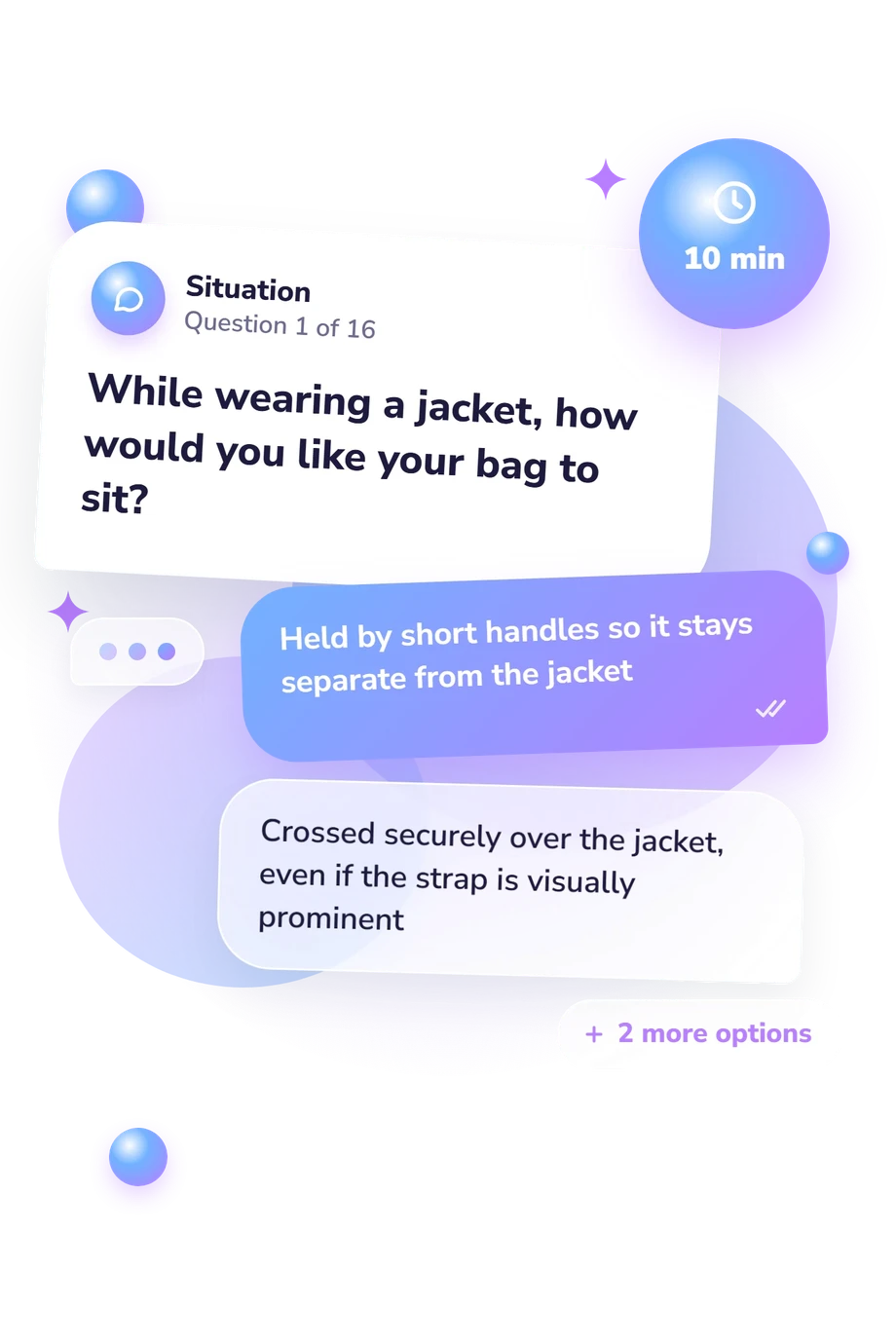
Example Questions From the Test
- A softly shaped bag tucked under my arm with a simple opening
- A shoulder bag with some structure and easy access
- A closed crossbody that I bring around to the front each time
- A handled bag that I set down before retrieving anything
- A soft, casual bag that changes shape with its contents
- A relaxed bag with a few polished details
- A semi-structured bag that balances refinement and ease
- A crisp satchel with defined handles and a composed shape
- Frustrating; I want to reach in with almost no interruption
- Acceptable occasionally, but not for my usual bag
- A reasonable exchange for a tidier appearance and interior
- Worthwhile because the composed design is exactly what I want
Purse Quiz - Description and methodology of the test
People choosing an everyday bag often balance mobility, capacity, access, and appearance rather than one isolated feature. The Purse Quiz is intended for anyone who wants to turn those preferences into a clear style profile before buying, editing a wardrobe, or planning for a different routine. This handbag quiz makes these trade-offs visible, showing which silhouette most closely fits your habits.
What This Assessment Explores
This assessment reads preferences about movement, access, capacity, structure, and changing plans. Scenarios involving commuting, social outings, organization, and unexpected purchases reveal which priorities matter most. The profile answers the central question in this What Kind of Purse Should I Get Quiz: which style best fits your routines.
These result dimensions are:
- Hands-Free Crossbody (0-12) measures affinity for secure, compact carrying: Strap Optional (0-4), Situational Crossbody (5-8), Crossbody Natural (9-12).
- Polished Satchel (0-12) measures affinity for composed structure: Soft-Style Leaning (0-4), Selectively Polished (5-8), Satchel Natural (9-12).
- Relaxed Shoulder Bag (0-12) measures affinity for easy under-arm access: Defined Alternative (0-4), Casual Shoulder Match (5-8), Shoulder-Bag Natural (9-12).
- Spacious Tote (0-12) measures affinity for flexible capacity: Compact Carrier (0-4), Occasional Tote User (5-8), Tote Natural (9-12).
The highest score is strongest; styles within one point blend.
Methodology and Evidence Base
As a purse style quiz, it uses four-option scenarios and preference-based self-report. Prompts contrast hands-free movement, access, closure, capacity, structure, and outfit coordination. The response choices ask you to select the situation or trade-off closest to your routine, while each option represents a different practical priority. This format lets the questionnaire compare preferences across several everyday situations.
The four displayed scores are compared together. The highest displayed score indicates the strongest affinity, while scores within one point form a blended result. The displayed bands are descriptive labels for this questionnaire, showing different levels of preference intensity.
A discrete-choice study of consumer bag attributes offers a conceptual comparison for how people weigh bag features. Separate research examines relationships among bag type, carrying method, posture, and gait. These studies keep the focus on carrying decisions; the questionnaire is conceptually consistent with that work but is not an adaptation of those instruments.
Because responses are self-reported, current clothing, workload, travel, and daily load can affect choices. Self-awareness also shapes how accurately preferences are described, so treat the result as a practical profile for reflection or shopping rather than a fixed identity.
- Chu Lo, Canie K. Y., Suzan Burton, Regan Lam, and Paul Nesbit. “Which Bag? Predicting Consumer Preferences for a Luxury Product With a Discrete Choice Experiment.” Australasian Marketing Journal, 29(4), 329-340, 2021. 10.1177/1839334921999506
- Kato, Chiho, Hisayo Ishihara, and Kyohei Joko. “The Influence of the Bag Type and Carrying Method on Young Women’s Postures.” Journal of the Japan Research Association for Textile End-Uses, 61(12), 837-848, 2020. 10.11419/senshoshi.61.12_837
- Son, Sungmin, and Hyolyun Noh. “Gait Changes Caused by the Habits and Methods of Carrying a Handbag.” Journal of Physical Therapy Science, 25(8), 969-971, 2013. 10.1589/jpts.25.969
Updated: