
NBA Finals MVP Quiz
How the Scales are Structured
Who Usually Takes This Test?
See How You Compare
Below is a preview of how scores are typically distributed across each scale.
Example Questions From the Test
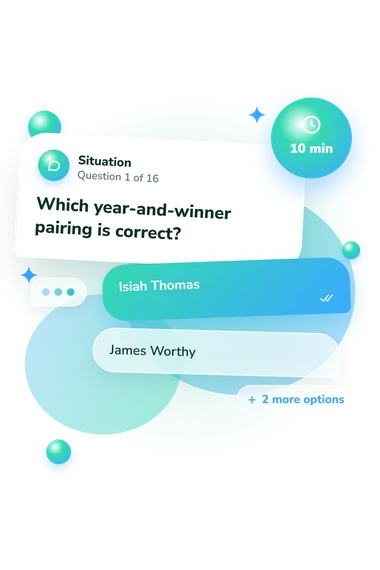
- Isiah Thomas
- James Worthy
- Joe Dumars
- Larry Bird
- Larry Bird and Kobe Bryant
- Magic Johnson and Shaquille O’Neal
- Michael Jordan and Shaquille O’Neal
- LeBron James and Tim Duncan
- Stephen Curry
- Klay Thompson
- Kevin Durant
- Draymond Green
NBA Finals MVP Quiz - Description and methodology of the test
Readers who enjoy NBA history, championship trivia, or player legacies can use the NBA Finals MVP Quiz to test how well they retain the award’s story and decide which parts of their knowledge deserve attention. It suits fans who want a contained way to revisit championship context without committing to a broad basketball history exam. This Finals MVP quiz challenges fans to match memory against the league’s championship history.
What This Assessment Explores
The questionnaire measures knowledge of NBA Finals MVP history rather than opinions about who deserved an award. Its items ask readers to connect players, franchises, seasons, records, and award milestones, including the inaugural presentation, repeat winners, renamed stars, team firsts, and signature title runs. For fans who want to check recall across multiple eras, this quiz covers NBA Finals MVPs without concentrating on one team or player.
The displayed scale is NBA Finals MVP Knowledge (0-16), interpreted through three result bands:
- Starting Lineup (0-6) indicates recognition of some Finals history while pointing to room for stronger foundations.
- Playoff Form (7-12) shows solid knowledge across several eras, with a few names, years, or career links to sharpen.
- Finals Historian (13-16) reflects excellent command of records, timelines, and less obvious winner clues through the 2024 Finals.
Methodology and Scientific Basis
Each of the 16 items presents a historical prompt with four answer choices and asks for the single best identification. The result is presented as a historical-recall score with descriptive bands, not as a profile of personal traits.
The research context is historical and conceptual. An official NBA historical record supplies reference points for winners, records, and milestones. Stewart and Kennedy’s account provides Finals chronology, while the NBA’s review of the 1968-69 season establishes the award’s inaugural context. Kershnar and Feit’s discussion clarifies how most-valuable judgments operate in sport, separating an award concept from a measurable personal trait. Taken together, the questions form a Finals MVP history quiz consistent with those sources, not an adaptation of any one of them.
The catalogue presents descriptive bands for historical recall; the cited sources support award-history content, not validation or population norms for this online quiz. Memory, NBA exposure, and era familiarity can affect results, and the 2024 endpoint excludes later Finals. Read the score as a snapshot of historical recall, not a diagnosis or substitute for assessment.
- Staff. "NBA Finals MVP Award Winners.", updated June 14, 2026.
- Stewart, Mark, and Mike William Kennedy. The NBA Finals. The Watts History of Sports. Scholastic Library Publishing, 2003. ISBN 9780531119556.
- Staff. "Season Review: 1968-69.", September 13, 2021.
- Kershnar, Stephen, and Neil Feit. "The Most Valuable Player." Journal of the Philosophy of Sport, vol. 28, no. 2, 2001, pp. 193-206. DOI 10.1080/00948705.2001.9714613