
Redneck Quiz
How the Scales are Structured
Who Usually Takes This Test?
See How You Compare
Below is a preview of how scores are typically distributed across each scale.
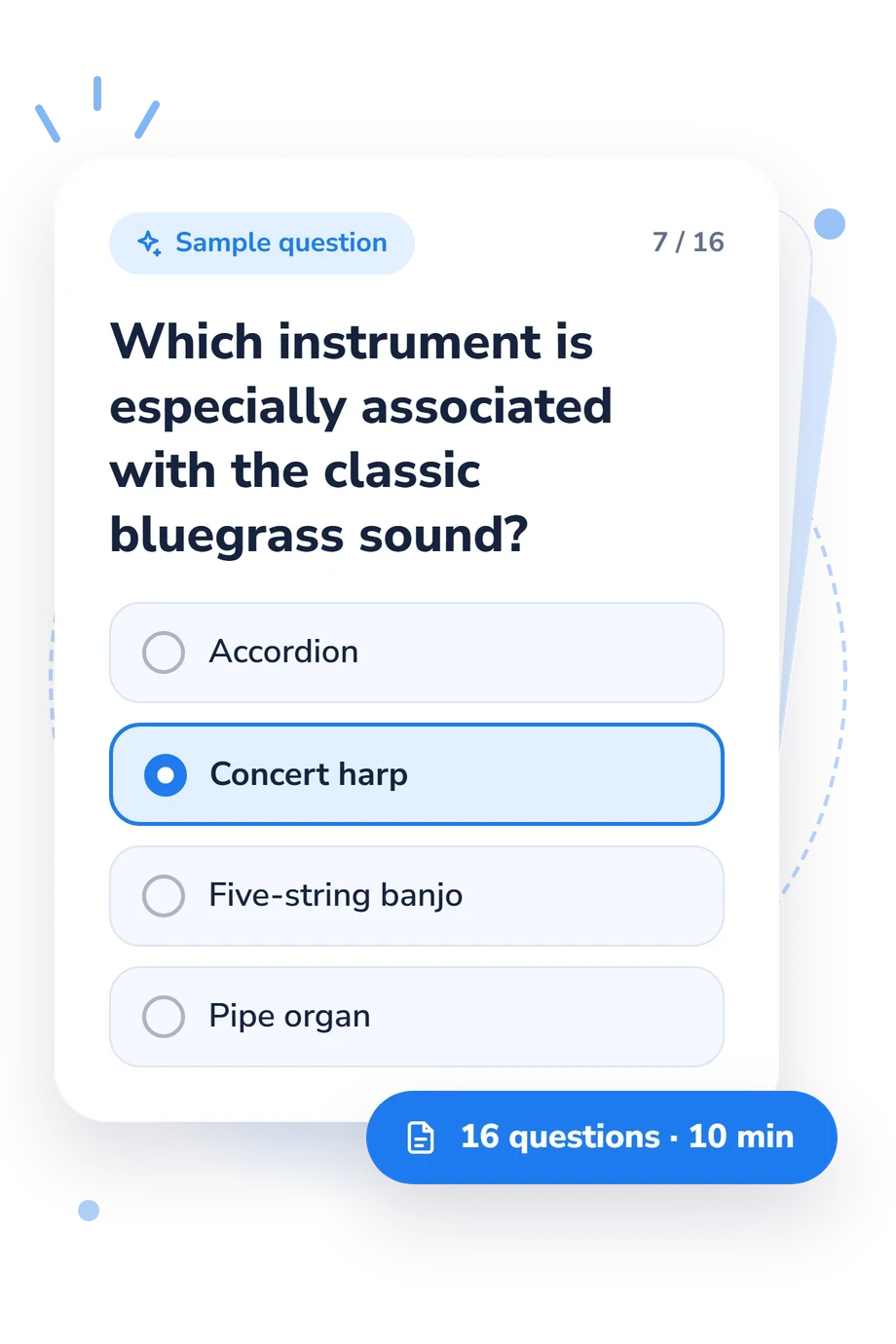
Example Questions From the Test
- Current local licensing, season, size, and catch-limit rules
- Whether the lake is large enough for motorboats
- Whether other anglers appear to be keeping the same fish
- Whether the fish species is commonly sold in restaurants
- Home, Heritage, Harvest, and Honor
- Head, Heart, Hands, and Health
- Horses, Horticulture, Hunting, and Husbandry
- Hope, Help, Hospitality, and Humility
- Boiling meat before briefly warming it over a flame
- Cooking small pieces rapidly on an uncovered grate
- Cooking meat slowly with indirect heat and often smoke
- Searing meat in a pan and serving it without further cooking
Redneck Quiz - Description and methodology of the test
For readers curious about regional culture, know-how, and a label that can feel affectionate or dismissive, this redneck quiz offers a way to examine familiarity without turning identity into a pass-or-fail category. The result gives a snapshot of cultural knowledge rather than an identity verdict. For someone exploring regional references, this redneck culture quiz offers a basis for reflection while recognizing that belonging varies by family, place, and experience.
What This Assessment Explores
The questionnaire examines knowledge rather than identity. Its scenarios cover safety, customs, geography, music, food, media, and the social meaning of redneck. Questions in this redneck trivia quiz measure cultural familiarity and practical judgment, not qualification for a label.
The thematic groups show what the result draws on:
- Outdoor skills show familiarity with camping, fishing, driving, towing, and cast-iron care.
- Regional culture measures recognition of Appalachia, 4-H, traditions, and everyday references.
- Music, food, and media capture bluegrass, country, Southern cooking, NASCAR, and CB language.
- Identity and context show that the label can be affectionate in one setting and insulting in another.
The displayed scale is Redneck Knowledge: 0-16. Curious Starter (0-6) reflects familiarity, Culture-Savvy (7-12) broad recognition, and Deep Knowledge (13-16) wide-ranging command of the topics. It reflects cultural references and practical knowledge, not identity; customs vary by family and region.
Methodology and Evidence Base
Structured as a redneck knowledge quiz, it uses short scenarios or factual prompts with four answer choices. Selecting the most accurate response combines cultural recognition with practical judgment, while one total score avoids presenting separate personality traits.
Results are interpreted descriptively rather than against population norms. Higher totals indicate broader command of the represented topics; lower totals suggest areas for further reading or experience. The bands are descriptive rather than norm-referenced, and no reliability or validation basis is established for this online version; the score organizes familiarity with camping, fishing, regional traditions, music, food, driving, and related references rather than estimating calibrated ability or cultural belonging.
Its evidence base is conceptual rather than a claim of adaptation. Besek and Cunningham (2020) link redneck identity with environmental setting and rural community life; Huber (2006) adds historical context for Appalachian and working-class identity; Rehder (2004) describes regional folkways. The questionnaire is conceptually consistent with these sources but it is not an adaptation or validation of them.
Scores can vary with current interests, regional exposure, terminology, and familiarity with the situations described.
- Besek, Jordan Fox, and Jeanine Cunningham. "On the Environmental Embeddedness of Redneck Identity and Politics: The Original Redneck Fishin’ Tournament and Invasive Species in a Rural Community." Sociologia Ruralis 60(2) (2020): 394-413. 10.1111/soru.12296
- Huber, Patrick. "Red Necks and Red Bandanas: Appalachian Coal Miners and the Coloring of Union Identity, 1912-1936." Western Folklore 65(1-2) (2006): 194-210.
- Rehder, John B. Appalachian Folkways. Johns Hopkins University Press, 2004. 10.56021/9780801878794
Updated: