
Sales Quiz
How the Scales are Structured
Who Usually Takes This Test?
See How You Compare
Below is a preview of how scores are typically distributed across each scale.
Example Questions From the Test
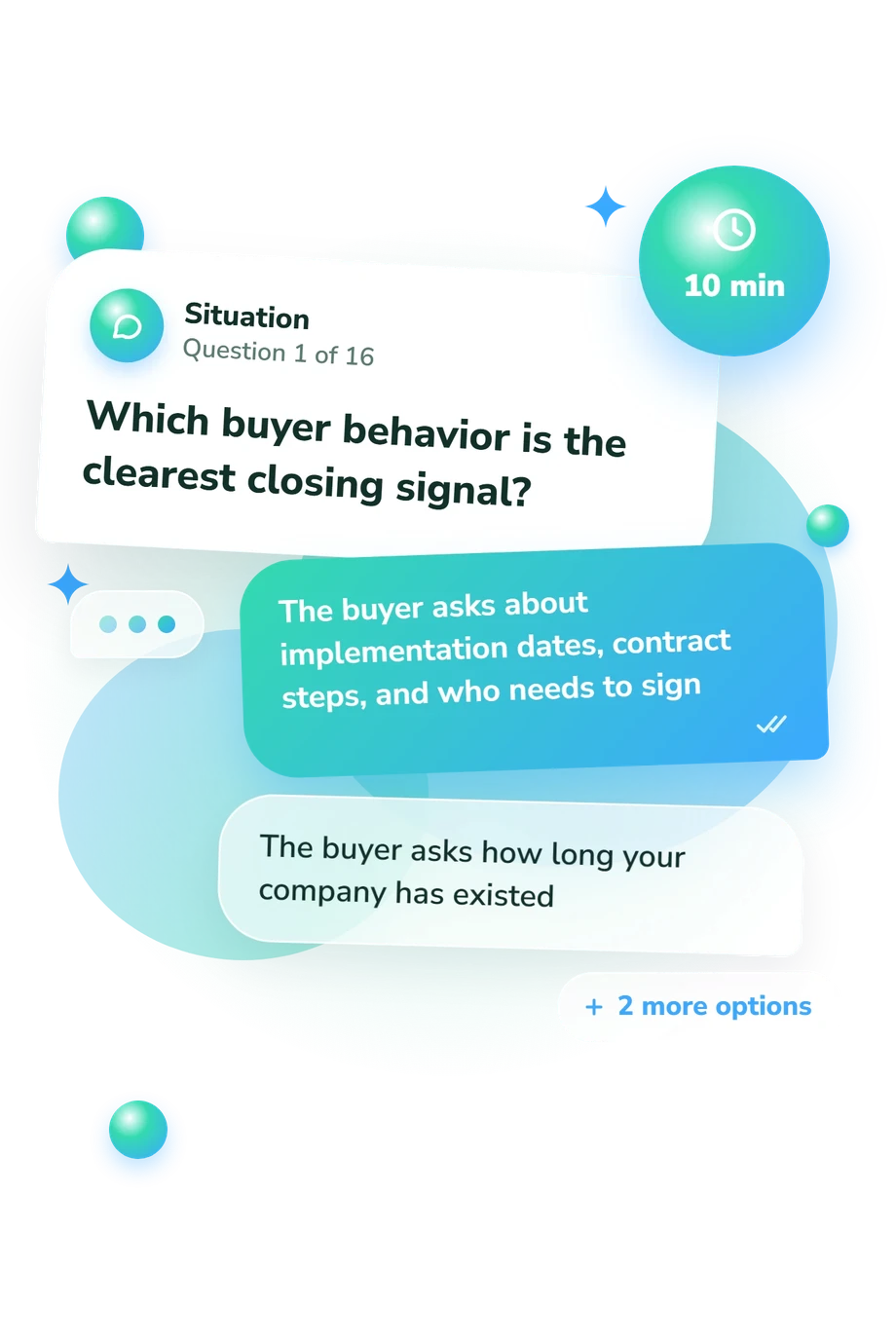
- The buyer asks about implementation dates, contract steps, and who needs to sign
- The buyer asks how long your company has existed
- The buyer says the project may be considered someday
- The buyer opens a general newsletter
- A long introduction describing the seller’s company history
- A generic claim that every organization needs the product
- A concise connection between a credible trigger or observed priority and a problem the offer may help address
- A request for a meeting without explaining why the conversation could matter
- Wait silently until the buyer chooses to respond
- Send daily reminders until a decision is made
- Assume acceptance unless the buyer objects by a certain date
- Confirm a specific review date, participants, and next conversation while clarifying any open questions
Sales Quiz - Description and methodology of the test
Designed for learners, new representatives, and experienced sellers, this sales quiz offers a practical check on customer-centered judgment. It helps a reader decide whether qualification, discovery, negotiation, or follow-up habits deserve closer practice. Its questions and answers about selling use realistic buyer situations, so the result supports focused reflection rather than terminology recall.
What This Assessment Explores
Good selling here is a chain of decisions moving from buyer context to responsible next steps. Questions about sales practice cover readiness, discovery, qualification, stakeholders, value, objections, negotiation, pipeline judgment, and CRM follow-through. They suit readers learning core principles or refining established habits.
The displayed scale is Sales Cycle Knowledge (0-16). Its bands are Foundation to build (0-6), Developing command (7-12), and Strong command (13-16). The result summarizes customer-focused choices across the cycle; it is a training summary, not a guarantee of sales performance.
The result brings together these themes:
- Buying signals, qualification, and stakeholder judgment show how readiness, fit, authority, timing, and buying capacity are weighed.
- Discovery and value communication show whether problems are linked to meaningful business outcomes.
- Negotiation, objections, and pipeline discipline show how concerns, commitments, follow-up, and CRM evidence are managed.
Methodology and Scientific Basis
Each item presents a short sales decision with four answer choices. The respondent selects the option that best matches sound, customer-focused practice, covering discovery, pricing, qualification, forecasting, and follow-up. The displayed score is reported on the single training scale described above; its range does not establish a diagnostic cutoff or a fixed claim about real-world results.
Conceptually, the questionnaire is consistent with Moncrief and Marshall (2005), who describe selling as an evolving cycle rather than a rigid seven-step script. It also corresponds with Rackham’s SPIN framework for Situation, Problem, Implication, and Need-payoff questions, and with Rentz et al. (2002), which treats selling skill as multidimensional. These are conceptual reference points, not evidence that this online questionnaire adapts, reproduces, or validates those published instruments.
No norm group or independent validation is stated for this version. As a sales skills test, it is best interpreted as a structured training snapshot: responses can reflect current experience, confidence, memory, and ideal-answer bias. Comparing results with observed sales conversations, CRM evidence, and coaching feedback gives a more grounded view of performance.
- William C. Moncrief and Greg W. Marshall (2005), "The Evolution of the Seven Steps of Selling," Industrial Marketing Management, 34(1), 13-22. 10.1016/j.indmarman.2004.06.001
- Joseph O. Rentz, C. David Shepherd, Armen Tashchian, Pratibha A. Dabholkar, and Robert T. Ladd (2002), "A Measure of Selling Skill: Scale Development and Validation," Journal of Personal Selling & Sales Management, 22(1), 13-21. 10.1080/08853134.2002.10754289
- Neil Rackham (1988), SPIN Selling, McGraw-Hill, New York.
Updated: