
Was I Roofied Quiz
How the Scales are Structured
Who Usually Takes This Test?
See How You Compare
Below is a preview of how scores are typically distributed across each scale.
Example Questions From the Test
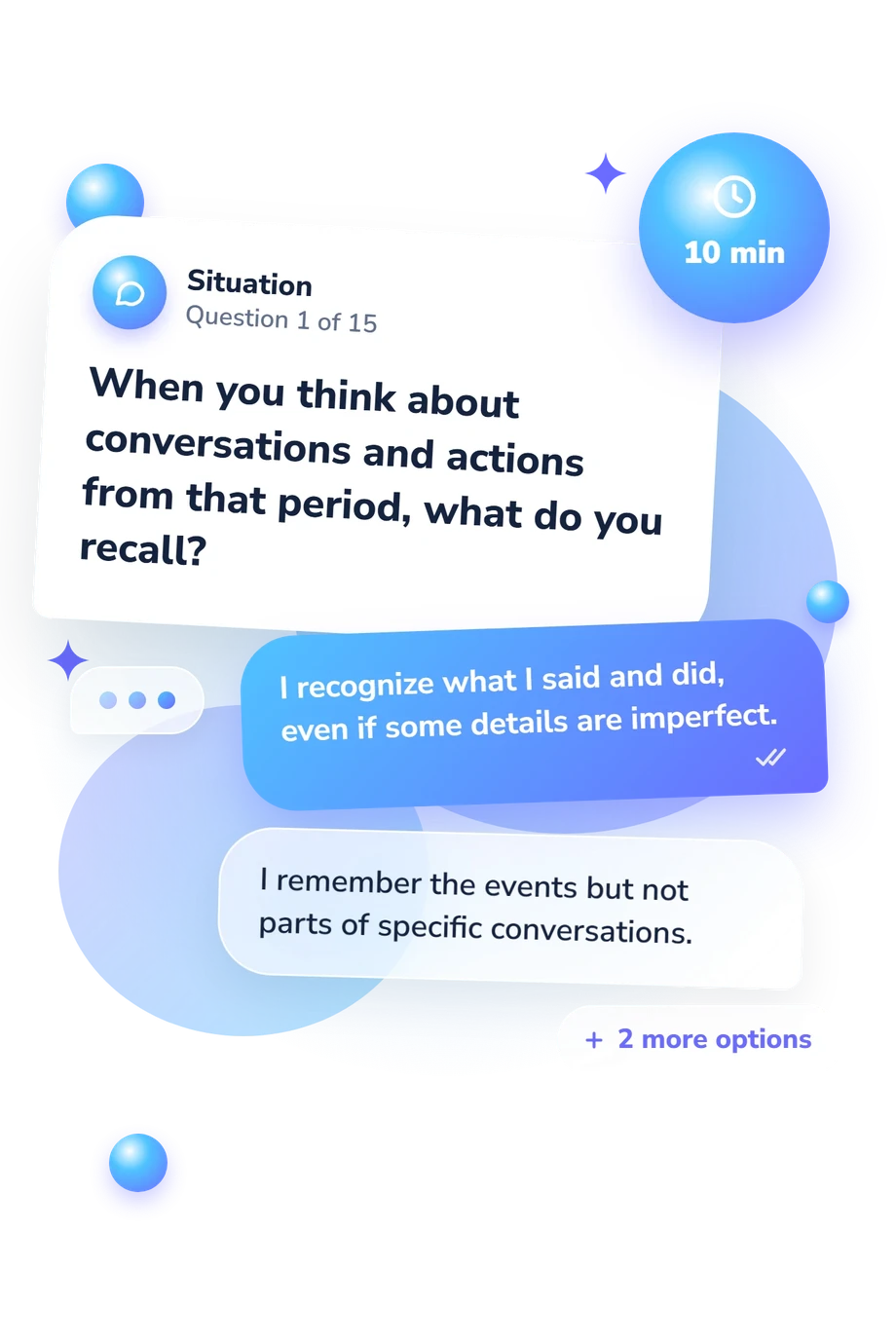
- I recognize what I said and did, even if some details are imperfect.
- I remember the events but not parts of specific conversations.
- Messages, photos, or other people describe several actions I do not remember.
- Others report that I was functioning or speaking while I now remember nothing at all.
- They described me as aware, and later events matched my memory.
- They noticed mild repetition or forgetfulness that I partly remember.
- They said I was markedly confused or performed actions I cannot recall.
- They said I was unresponsive, repeatedly lost awareness, or could not be awakened normally.
- I did not notice unusual physical symptoms.
- I had mild nausea, headache, dry mouth, or dizziness.
- I had pronounced spinning, blurred vision, shaking, sweating, or intense nausea.
- I had trouble breathing, a seizure, repeated vomiting, collapse, or an inability to stay awake.
Was I Roofied Quiz - Description and methodology of the test
For people reviewing an uncertain episode involving a drink or other substance, the was i roofied quiz offers a structured starting point. It frames the was i drugged quiz question without treating uncertainty as proof. The questionnaire is intended for reviewing one's own experience, with trusted support if appropriate. Results may guide documentation, safety decisions, and timely help.
What This Assessment Explores
Questions cover memory continuity, observed awareness, sudden impairment, physical symptoms, tampering, unexplained movements, and interference with choice or safety. No single clue is conclusive. Considering signs of being roofied alongside records and witness accounts adds context.
The displayed scales separate the main patterns:
- Memory and Time Continuity (0-15) covers missing periods, unclear transitions, and unremembered actions; Result limited: 0, Indicator present: 1-2, and Prompt action warranted: 3-15.
- Tampering Context and Immediate Safety (0-15) covers unexpected substance access and coercive or unsafe circumstances; Result limited: 0, Indicator present: 1-2, and Prompt action warranted: 3-15.
- Unexpected Impairment and Physical Signs (0-15) covers disproportionate effects, awareness or coordination changes, and physical symptoms; Result limited: 0, Indicator present: 1-2, and Prompt action warranted: 3-15.
Any concerning response should be considered independently of the total and can override it; it is a signal to examine, not proof of drugging.
Methodology and Evidence Base
Four ordered choices move from little concern to more marked memory, physical, contextual, or safety concern. Results display a total and band for each scale, but no weighting or point value is stated for individual responses.
The questionnaire is a drug exposure self-check. Its bands are unvalidated reflective summaries, not severity ratings, clinical or legal cutoffs, or a diagnostic measure, and cannot confirm or exclude drugging.
A low total should not override a red-flag response; documenting known facts and preserving safe evidence may help, while a higher result supports reaching a safe place and considering appropriate medical, emergency, or assault-service help.
Du Mont's research on drug-facilitated sexual assault and toxicological or DNA findings, plus Fields's work on impaired trauma memory and mental-health treatment, are conceptually relevant comparators, not validation of this questionnaire's scoring, bands, or norms.
Interpret results alongside timing, known substance use, witness accounts, records, and current safety. A drink spiking concern warrants documentation and supported help; avoid confronting a suspected person alone. Detection windows vary, substances may leave no visible trace, and self-report depends on memory and context.
- Du Mont J, Macdonald S, Rotbard N, Asllani E, Bainbridge D, Cohen MM. Factors associated with suspected drug-facilitated sexual assault. CMAJ. 2009;180(5):513-519. 10.1503/cmaj.080570
- Du Mont J, Macdonald S, Rotbard N, Bainbridge D, Asllani E, Smith N, Cohen MM. Drug-facilitated sexual assault in Ontario, Canada: toxicological and DNA findings. Journal of Forensic and Legal Medicine. 2010;17(6):333-338. 10.1016/j.jflm.2010.05.004
- Fields L, Young DA, Patel AR, Munroe C, Shumway M, Bell S, Richer LA. Drug-facilitated sexual assault, impaired trauma memory, and implications for mental health treatment. European Journal of Psychotraumatology. 2022;13(1):2057165. 10.1080/20008198.2022.2057165
Updated: