
Pharmacy Abbreviations Quiz
How the Scales are Structured
Who Usually Takes This Test?
See How You Compare
Below is a preview of how scores are typically distributed across each scale.
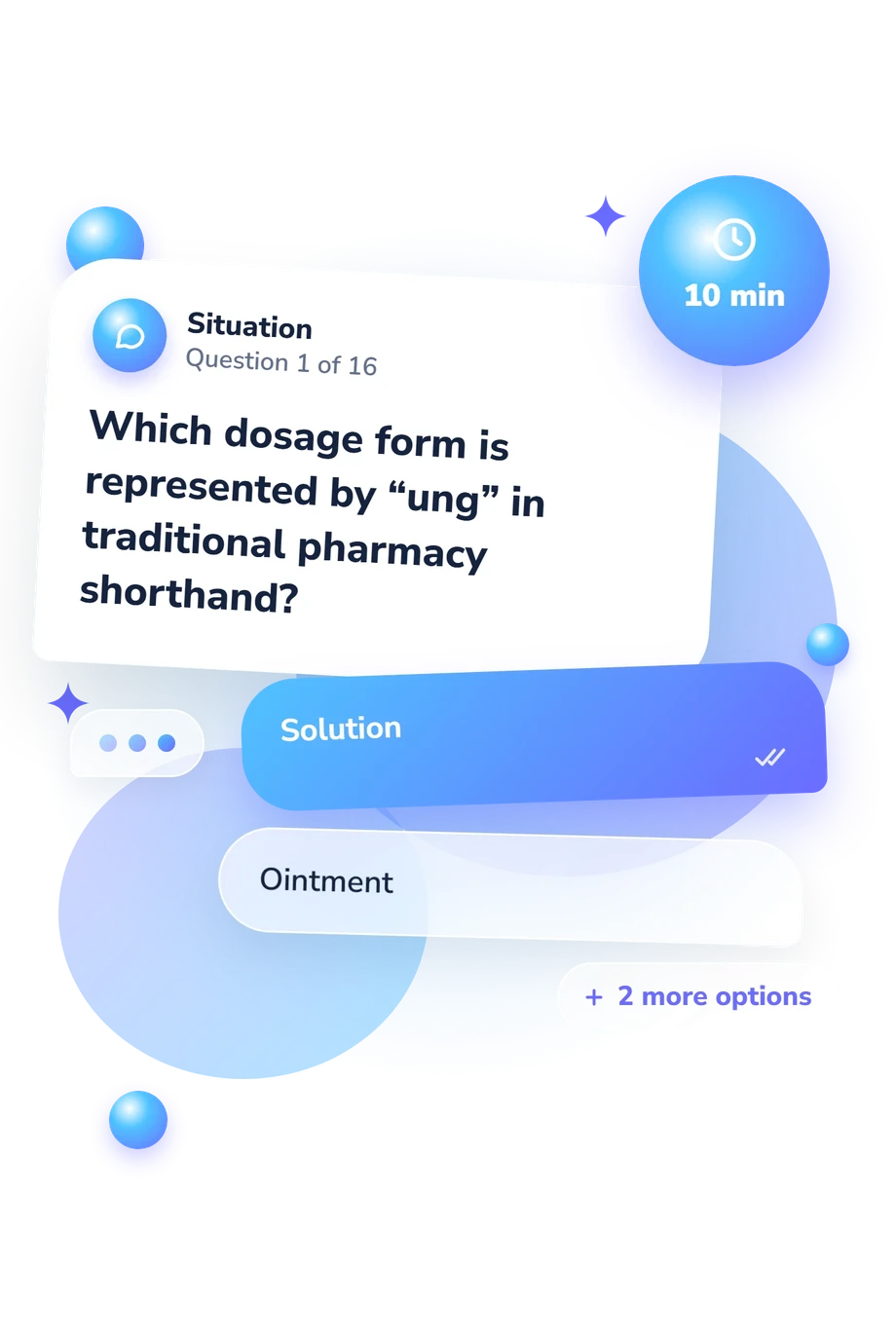
Example Questions From the Test
- Solution
- Ointment
- Suppository
- Capsule
- Every eight hours
- Once each morning for eight days
- At 8:00 each evening
- Eight times per day
- Before meals
- As needed
- At bedtime
- Immediately
Pharmacy Abbreviations Quiz - Description and methodology of the test
For learners who read prescription language, this assessment offers a focused opportunity to practice interpreting medication shorthand. The pharmacy abbreviations quiz is intended for students, trainee technicians, and anyone reviewing medication directions. Its result provides an indication of overall recognition of the covered abbreviations and a guide to further review. The questionnaire also serves as a sig codes pharmacy quiz while giving practice in related medication shorthand.
What This Assessment Measures
Questions sample shorthand used in orders and labels. They cover dosage forms, routes, meal timing, dosing intervals, as-needed use, urgency, quantity, and placement. The emphasis is on understanding what each short form directs the reader to do, which makes this pharmacy tech abbreviations quiz useful for learners building medication-language fluency before supervised practice.
Performance can be read through four practical content areas:
- Dosage forms and quantities show whether notation identifies an ointment, tablet count, or dispensed amount.
- Timing and frequency indicate whether intervals, daily schedules, meal-related instructions, and as-needed use are distinguished.
- Routes and administration show whether oral, intravenous, intramuscular, sublingual, or topical use is recognized.
- Instructional status and urgency reveal whether nothing-by-mouth directions, immediate administration, or surface application is understood.
The assessment reports Pharmacy Abbreviations Knowledge (0-16). Results are Foundation to build (0-6), Developing knowledge (7-12), or Strong knowledge (13-16).
Methodology and Evidence Base
This pharmacy technician abbreviations quiz uses a single-best-answer format, with distractors testing whether similar abbreviations are separated correctly. One point is awarded for each correct response, so the result describes performance on these terms rather than overall pharmacy competence. The questionnaire can support pharmacy-technician study by helping learners review included terms and distinguish closely related shorthand.
This questionnaire is consistent with Jayatilake and Oyibo (2023) on ambiguity and competing meanings in medical abbreviations and Shiffman et al. (2015) on differing interpretations among healthcare professionals. It is also consistent with Horon, Hayek, and Montgomery (2012) and the Institute for Safe Medication Practices (2024) on avoiding error-prone shorthand and using clearer medication communication, but it is not an adaptation of those works.
Use the result as an educational snapshot of recognition for covered terms. The bands are educational rather than validated clinical cutoffs, and local policies vary. Because current familiarity, attention, and context can affect performance, the result may not represent pharmacy competence; an unclear or potentially unsafe medication direction should be confirmed with a pharmacist or prescriber.
- Jayatilake DC, Oyibo SO. Interpretation and Misinterpretation of Medical Abbreviations Found in Patient Medical Records: A Cross-Sectional Survey. Cureus. 2023;15(9):e44735. 10.7759/cureus.44735
- Shiffman S, Cotton H, Jessurun C, Sembower MA, Pype S, Phillips J. Pharmacist and Physician Interpretation of Abbreviations for Acetaminophen Intended for Use in a Consumer Icon. Pharmacy. 2015;3(4):169-181. 10.3390/pharmacy3040169
- Horon K, Hayek K, Montgomery C. Prohibited Abbreviations: Seeking to Educate, Not Enforce. Canadian Journal of Hospital Pharmacy. 2012;65(4):294-299. 10.4212/cjhp.v65i4.1160
- Institute for Safe Medication Practices. ISMP List of Error-Prone Abbreviations, Symbols, and Dose Designations. 2024.
Updated: