
Am I Constipated Quiz
How the Scales are Structured
Who Usually Takes This Test?
See How You Compare
Below is a preview of how scores are typically distributed across each scale.
Example Questions From the Test
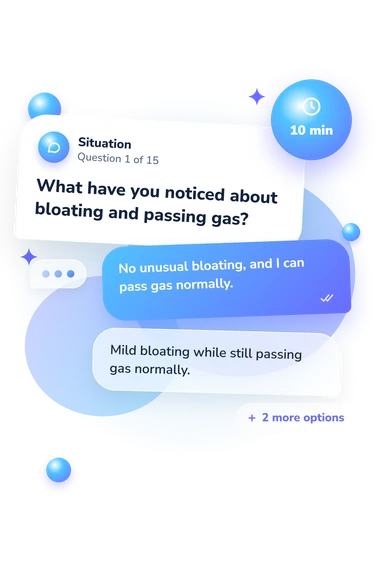
- No unusual bloating, and I can pass gas normally.
- Mild bloating while still passing gas normally.
- Marked or persistent bloating with more difficulty passing gas.
- A visibly swollen abdomen with inability to pass gas.
- Neither nausea nor vomiting has occurred.
- I have had brief, mild nausea without vomiting.
- I have had recurring nausea or a substantial loss of appetite.
- I have vomited repeatedly or cannot keep fluids down.
- This has not happened.
- It happened once.
- It has happened several times.
- It happens most days or repeatedly within the same day.
Am I Constipated Quiz - Description and methodology of the test
People noticing harder stools, straining, fewer bowel movements, or a changed urge can use the Am I Constipated Quiz to organize recent symptoms and decide what deserves attention. It is intended for anyone reviewing a bowel change who wants to distinguish a pattern worth monitoring from one that calls for routine advice or prompt action. By organizing several observations, this constipation symptom checker clarifies the bowel-change pattern that deserves attention.
What This Assessment Explores
Rather than assigning a yes-or-no label, the questionnaire examines stool hardness, straining, incomplete evacuation, blockage sensations, altered frequency, longer gaps, reduced output, and influences such as medicines, illness, diet, fluids, activity, or routine. Other items identify warning signs that can make a change more concerning.
The result shows three dimensions:
- Accompanying Warning Signs (0-15) shows whether listed signals were endorsed: Baseline pattern 0; Worth noting 1-2; Prompt attention 3-15.
- Bowel Rhythm Change (0-15) reflects reduced frequency or a changed pattern: Baseline pattern 0; Worth observing 1-2; Action warranted 3-15.
- Stool and Passage Difficulty (0-15) captures hardness, straining, incomplete emptying, blockage, or assistance needs: Baseline pattern 0; Worth observing 1-2; Action warranted 3-15.
Together, the dimensions show whether the main signal lies in rhythm, passage, or an accompanying concern. As a constipation quiz, it groups the result by the pattern that deserves attention.
Methodology and Evidence Base
Each item offers four ordered responses, from no change through mild or occasional change to marked or urgent presentation. Themes group the questions. The exact point contribution of each response is not stated, so the displayed ranges do not establish a point-per-answer rule.
The content is conceptually consistent with Koch et al. (1997) on constipation-related symptoms and with the Rome IV diagnostic questionnaire developed by Palsson et al. (2016). It is neither an adaptation nor a validated administration of either. Warning-sign emphasis is consistent with the American Gastroenterological Association position statement by Bharucha et al. (2013). The displayed bands are explicitly unvalidated, with no stated norms, and are not severity or diagnostic cutoffs.
For this constipation self-assessment, interpretation should follow the pattern shown, not the number alone. Zero does not rule out constipation; interpret the result alongside the symptoms themselves. Read the result with personal baseline, medicines, illness, hydration, routine, anxiety, and response bias in mind. Any concerning symptom matters independently; a red-flag response overrides the total. Severe pain, repeated vomiting, inability to pass gas with swelling, substantial bleeding, black stool, fainting, or rapid decline warrants urgent medical attention.
- Koch A, Voderholzer W. A., Klauser A. G., Müller-Lissner S. Symptoms in chronic constipation. Diseases of the Colon and Rectum. 1997;40(8):902-906. 10.1007/BF02051196
- Palsson O. S., Whitehead W. E., van Tilburg M. A. L., et al. Development and Validation of the Rome IV Diagnostic Questionnaire for Adults. Gastroenterology. 2016;150(6):1481-1491. 10.1053/j.gastro.2016.02.014
- American Gastroenterological Association; Bharucha A. E., Dorn S. D., Lembo A., Pressman A. American Gastroenterological Association medical position statement on constipation. Gastroenterology. 2013;144(1):211-217. 10.1053/j.gastro.2012.10.029