
Subject and Predicate Quiz
How the Scales are Structured
Who Usually Takes This Test?
See How You Compare
Below is a preview of how scores are typically distributed across each scale.
Example Questions From the Test
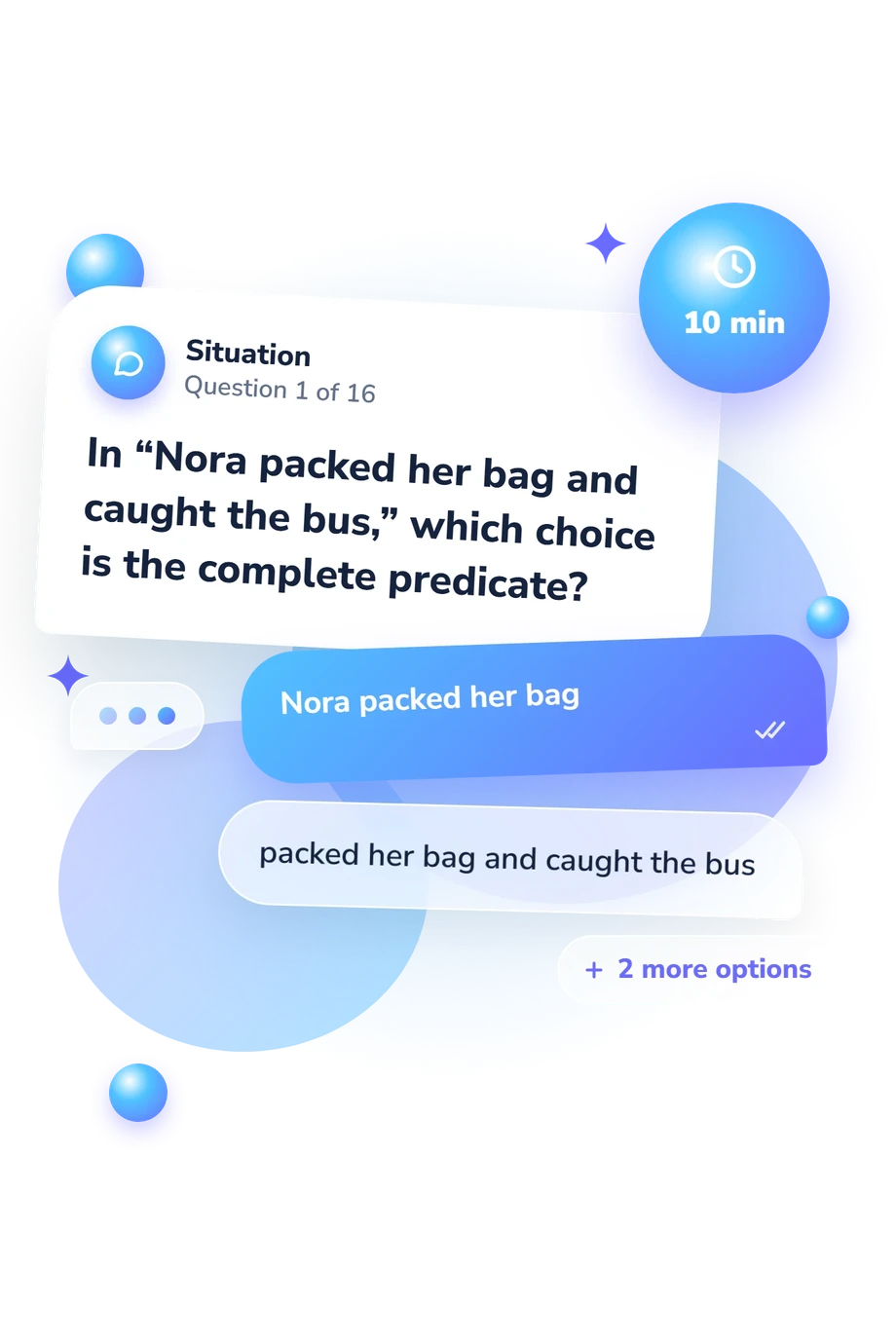
- Nora packed her bag
- packed her bag and caught the bus
- her bag and the bus
- caught the bus
- arrived
- have arrived
- by noon
- might have arrived
- rain
- playground
- the rain had stopped
- children
Subject and Predicate Quiz - Description and methodology of the test
Students, teachers, and independent learners who want a grammar check can use this subject and predicate quiz to examine how sentence parts are identified. It functions as a subject and predicate test for readers working on English sentence analysis, especially when modifiers, helping verbs, commands, or inverted word order make grammatical structure less obvious. The result points to areas that deserve review rather than assigning a measure of language ability.
What This Assessment Explores
The questionnaire examines how a sentence divides into what is discussed and what is stated about it. Items ask you to separate simple from complete subjects and predicates, including modifiers, helping verbs, compound elements, introductory phrases, dependent clauses, and the understood subject of a command. As a subject predicate quiz, it measures grammatical structure rather than vocabulary or reading skill.
The result uses one scale, Subject and Predicate Knowledge (0-16). Its bands are Foundation to Build (0-6), Developing Control (7-12), and Strong Control (13-16). They show whether core definitions need review, common patterns are developing, or the tested structures are identified consistently.
The main areas are:
- Simple subjects show whether you can locate the noun or pronoun at the center of the grammatical role.
- Complete subjects show whether you include the words that belong with it.
- Predicates show whether you identify the verb core and its expression.
Methodology and Evidence Base
Each item presents a sentence or short grammatical prompt with several answer choices. The respondent selects the option that identifies the requested part, such as a simple predicate with helping verbs or a complete subject with its modifiers. This recognition format does not require sentence writing or revision.
Across the subject predicate questions, the score summarizes performance on the displayed scale; no separate weighting rule for individual options is stated. Huddleston and Pullum (2002) provide a grammatical framework for clause functions and constituent boundaries. Celce-Murcia, Larsen-Freeman, and Williams (1999) support its instructional approach, while Hornby (1972) is relevant to the psychological distinction between subject and predicate. The questionnaire is conceptually consistent with these works, not an adaptation of any one of them.
Interpret the result as a snapshot of the structures tested. A stronger score suggests more consistent identification in these patterns; a lower score highlights targets for review. No norm sample, reliability estimate, or diagnostic standard is stated, and performance may shift with attention, prior instruction, and momentary uncertainty. Broader assessment is needed before drawing conclusions about language proficiency.
- Huddleston, Rodney D., and Geoffrey K. Pullum. The Cambridge Grammar of the English Language. Cambridge University Press, 2002. 10.1017/9781316423530
- Celce-Murcia, Marianne, Diane Larsen-Freeman, and Howard Alan Williams. The Grammar Book: An ESL/EFL Teacher's Course. 2nd ed., Heinle & Heinle, 1999.
- Hornby, Peter A. The psychological subject and predicate. Cognitive Psychology, 3(4), 1972, 632-642. 10.1016/0010-0285(72)90023-0
Updated: