
Sacrum Labeling Quiz
How the Scales are Structured
Who Usually Takes This Test?
See How You Compare
Below is a preview of how scores are typically distributed across each scale.
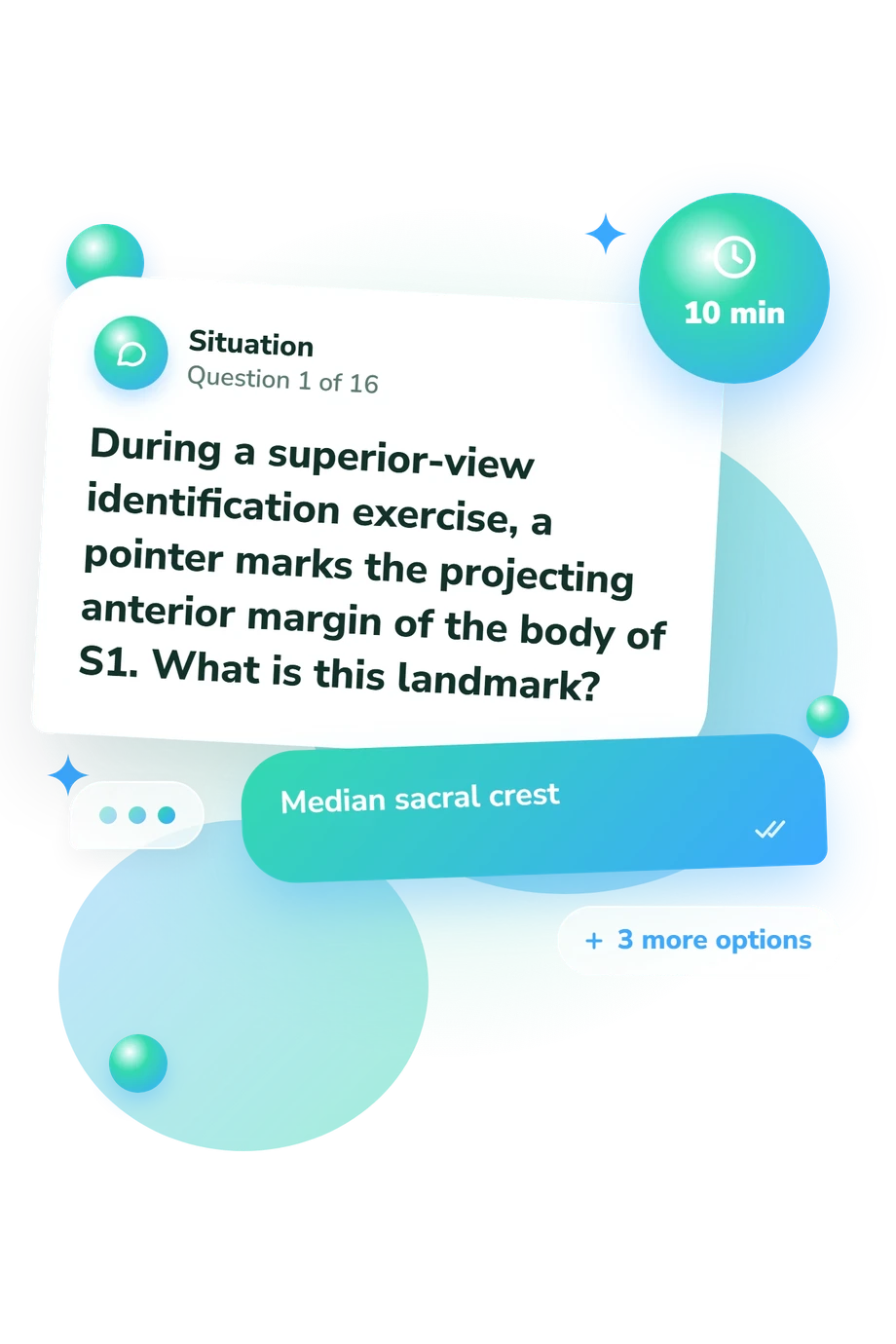
Example Questions From the Test
- Median sacral crest
- Lateral sacral crest
- Intermediate sacral crest
- Sacral promontory
- Pelvic surface
- Dorsal surface
- Superior surface
- Auricular surface
- Lumbar spinal nerve roots only
- Dorsal rami of the sacral spinal nerves
- Ventral rami of the sacral spinal nerves
- The spinal cord itself
Sacrum Labeling Quiz - Description and methodology of the test
Students reviewing the bony pelvis and anatomy learners preparing for laboratory or practical study can use this sacrum labeling quiz to check whether they connect names with landmarks, surfaces, openings, and articulations. The result highlights areas that deserve another look in an atlas or course notes. This sacrum quiz checks connections among sacral landmarks and supports focused osteology review.
What This Assessment Explores
Items move from orientation to neighboring landmarks, asking learners to connect names with location, structure, and anatomical relationships. The sacral anatomy test helps learners connect each name with the landmark’s position and structure.
Themes cover three areas:
- Orientation identifies the base, apex, alae, and pelvic or dorsal surfaces, so the result reflects recognition of the sacrum’s overall form.
- Crests, foramina, canal features, hiatus, and cornua test whether neighboring posterior and anterior landmarks can be distinguished.
- Articular landmarks identify the auricular surface and its connection with the ilium, linking surface anatomy to skeletal relationships.
The displayed Sacrum Anatomy Knowledge scale spans 0-16: Foundation to build (0-6) indicates review of orientation and major surfaces; Developing knowledge (7-12) reflects recognition of many structures while some neighboring crests, openings, and articular features remain difficult; Strong knowledge (13-16) indicates command of most landmarks and spatial relationships.
Methodology and Scientific Basis
Each item presents a short identification prompt with four answer choices. Together, these prompts make the sacrum anatomy quiz a recognition exercise: learners infer landmarks from position, surface, vertebral relations, or connections with other bones. The format tests recognition and basic anatomical reasoning rather than hands-on technique.
The result is a bounded knowledge summary across the response set. No item-weighting rule or conversion formula is stated, so it reflects performance on this questionnaire and indicates topics for review.
Cheng and Song (2003) describe the sacral surfaces, foramina, crests, canal, and articulations that the items ask learners to distinguish. Grant’s and Moore’s anatomy texts support the regional relationships, while FIPAT terminology supports consistent anatomical naming. The questionnaire is conceptually consistent with these references but is not presented as a standardized adaptation of any one source.
Because the questionnaire is text-based, has no reported norms or practical component, and can be influenced by prior instruction, memory, wording, and current study context, its score cannot establish general anatomy proficiency or specimen-identification skill; interpret it as a focused guide for further study.
- Cheng, Joseph S., and John K. Song. Anatomy of the sacrum. Neurosurgical Focus 15, no. 2 (2003): E3. 10.3171/foc.2003.15.2.3
- Agur, Anne M. R., and Arthur F. Dalley II. Grant's Atlas of Anatomy. 16th ed. Philadelphia: Wolters Kluwer, 2024.
- Dalley, Arthur F. II, and Anne M. R. Agur. Moore's Clinically Oriented Anatomy. 9th ed. Philadelphia: Wolters Kluwer, 2023.
- FIPAT. Terminologia Anatomica. 2nd ed. Federative International Programme for Anatomical Terminology, 2019.
Updated: