
Por and Para Quiz
How the Scales are Structured
Who Usually Takes This Test?
See How You Compare
Below is a preview of how scores are typically distributed across each scale.
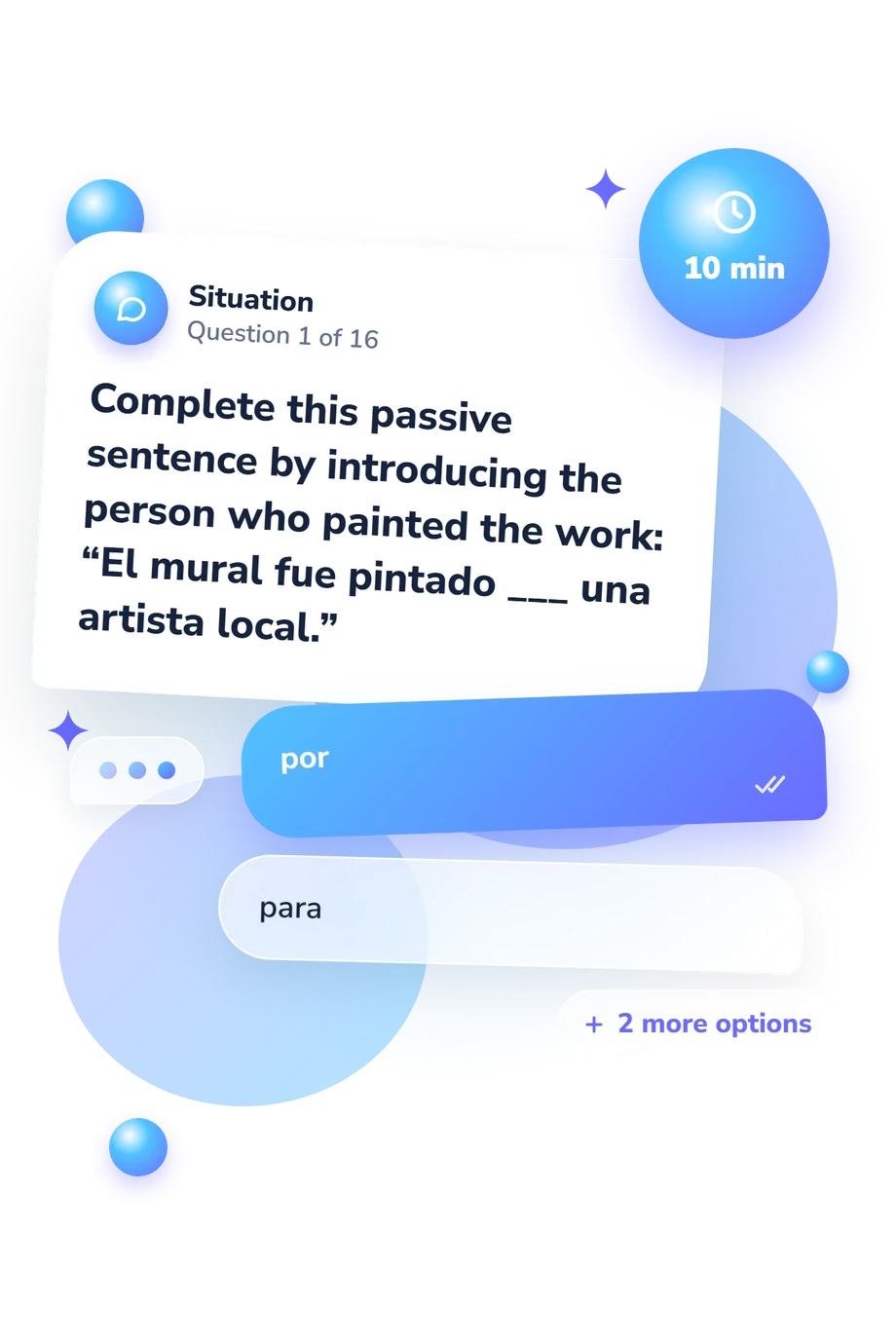
Example Questions From the Test
- por
- para
- hacia
- entre
- por
- para
- a
- desde
- para de
- a
- desde
- por
Por and Para Quiz - Description and methodology of the test
Designed for learners who want to check their control of two easily confused Spanish prepositions, this por and para quiz focuses on meaning in context rather than isolated translation. It suits students, independent learners, and anyone reviewing practical sentence use. It also serves as a por vs para practice quiz, with the overall result indicating command across the tested contexts.
What This Assessment Explores
It examines whether a learner can choose por or para when a sentence expresses a particular relation: agency, comparison, substitution, purpose, movement, cause, price, duration, destination, frequency, employment, deadlines, means, viewpoint, or intended recipient. These contexts show why literal translation alone is often insufficient.
With this practice quiz on por and para, the result summarizes how well learners connect each preposition with its function. It suits Spanish learners studying formally or independently. One displayed scale, Por and Para Knowledge (0-16), organizes the result into three bands:
- Foundations to Review (0-6) indicates that core patterns need renewed attention.
- Developing Command (7-12) shows understanding of common distinctions, with less familiar contexts still unstable.
- Strong Command (13-16) reflects consistent choices across common rules and practical situations.
Methodology and Evidence Base
The format presents a sentence-completion multiple-choice task: the respondent reads a Spanish context and selects the preposition that best expresses the intended relation. The items cover semantic groups including agency and cause, purpose and destination, duration and deadlines, movement through or toward a place, price, frequency, employment, communication channel, viewpoint, and recipient. This makes it a practical quiz about the difference between por and para rather than a vocabulary-free rule drill.
Scoring is direct: each correct answer contributes one point to the total, and the result band follows the displayed score range. Pinto and Rex (2006) provide the closest classroom-learning comparison, while Lafford and Ryan (1995) examine how learners acquire these preposition meanings in another learning context. Lam (2009) applies a cognitive-linguistic perspective to teaching the distinction, and Batchelor (2006) supplies grammatical treatment of the two forms.
The questionnaire is conceptually consistent with these works, but it is not presented as a standardized adaptation of any of them. Its bands function as descriptive learning levels rather than external norms. Performance can also reflect vocabulary familiarity, guessing, and prior instruction, so the result is best read as a focused learning snapshot rather than a complete measure of Spanish proficiency.
- Pinto, Derrin, and Scott M. Rex. "The Acquisition of the Spanish Prepositions Por and Para in a Classroom Setting." Hispania 89, no. 3 (2006): 611-622. 10.2307/20063366
- Lafford, Barbara A., and John M. Ryan. "The Acquisition of Lexical Meaning in a Study Abroad Context: The Spanish Prepositions Por and Para." Hispania 78, no. 3 (1995): 528-547. 10.2307/345295
- Lam, Yvonne. "Applying Cognitive Linguistics to Teaching the Spanish Prepositions Por and Para." Language Awareness 18, no. 1 (2009): 2-18. 10.1080/09658410802147345
- Batchelor, Ronald E. "Prepositions Por and Para (Las Preposiciones Por y Para)." In A Student Grammar of Spanish, 220-226. Cambridge University Press, 2006. 10.1017/CBO9781139168502.028
Updated: