
Am I Useless Quiz
How the Scales are Structured
Who Usually Takes This Test?
See How You Compare
Below is a preview of how scores are typically distributed across each scale.
Example Questions From the Test
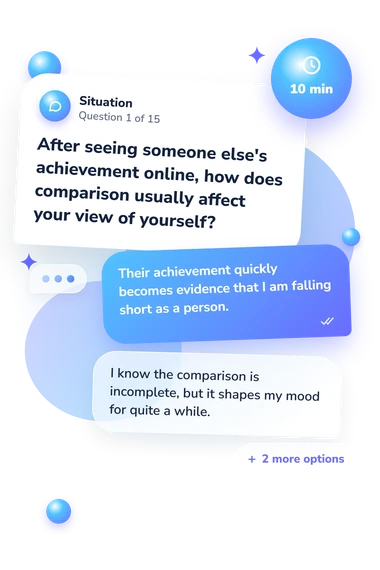
- Their achievement quickly becomes evidence that I am falling short as a person.
- I know the comparison is incomplete, but it shapes my mood for quite a while.
- I can usually remember that their visible result and my circumstances are different.
- I notice the comparison, identify what it brings up, and return to my own priorities.
- I take being stuck as a sign that I should not have attempted it.
- I switch to other things and leave the goal open-ended.
- I adjust one part of the goal or ask one targeted question.
- I identify the barrier, then choose between help, a break, a smaller step, or a revised scope.
- Without my normal output, I am not useful.
- My contribution has paused, so I become uncertain about my value.
- My capacity has changed, but smaller or less visible contributions can still count.
- “Useless” is too global; I would assess my capacity, needs, and possible actions separately.
Am I Useless Quiz - Description and methodology of the test
People who turn a setback, low-energy period, or comparison into a judgment about their whole identity may use the Am I Useless Quiz to examine that pattern more carefully. It is intended for self-reflection around blocked action, overlooked contribution, and harsh self-talk. It can serve as a self-doubt questionnaire, helping you notice whether your current interpretation leaves room for context, support, and specific evidence.
What This Assessment Explores
The items explore how comparison, mistakes, low energy, and disrupted plans affect action, contribution, and self-judgment. They are useful for readers reflecting on thoughts or feelings of worthlessness, while the result examines responses to those experiences rather than personal worth.
The displayed dimensions are:
- Agency and Connection (0-15) measures access to manageable action and support, not independence or value: Action feels blocked (0-5), Selective momentum (6-10), Connected agency (11-15).
- Everyday Contribution (0-15) measures recognition of practical, relational, and less visible impact, not worth: Narrow recognition (0-5), Mixed recognition (6-10), Broad recognition (11-15).
- Self-Talk Flexibility (0-15) measures responses to harsh global judgments, not whether thoughts are justified: Critic dominates (0-5), Emerging distance (6-10), Flexible response (11-15).
Methodology and Scientific Basis
Each item presents a situation with four ordered response choices, moving from global self-condemnation or withdrawal toward specific interpretations, manageable action, contextual evidence, and support. The format examines how a person responds to setbacks, help, comparison, and contribution in everyday life.
Results use named score bands, but the questionnaire does not specify how many points each option contributes. Interpret the named band as a snapshot of current patterns, not an inferred clinical cutoff. This online self-reflection questionnaire captures patterns that may shift with stress, energy, relationships, and recent events.
The questionnaire is conceptually consistent with Turnell and colleagues’ 2019 Self-Hate Scale, which addresses global self-rejection and self-hating thoughts; it is not that instrument or a direct adaptation. It is also conceptually consistent with the Interpersonal Needs Questionnaire, Van Orden and colleagues’ 2012 work, Snyder and colleagues’ 1991 agency-and-pathways model, and Neff’s 2003 self-compassion work. These sources provide construct-level context, not standardized norms for this online questionnaire. Persistent or function-impairing worthlessness merits professional support; immediate danger or thoughts of self-harm require urgent local help.
- Turnell, Adrienne I., Daniel B. Fassnacht, Philip J. Batterham, Alison L. Calear, and Michael Kyrios. (2019). The Self-Hate Scale: Development and validation of a brief measure and its relationship to suicidal ideation. Journal of Affective Disorders, 245, 779-787. 10.1016/j.jad.2018.11.047
- Van Orden, Kimberly A., Kelly C. Cukrowicz, Tracy K. Witte, and Thomas E. Joiner. (2012). Thwarted belongingness and perceived burdensomeness: Construct validity and psychometric properties of the Interpersonal Needs Questionnaire. Psychological Assessment, 24(1), 197-215. 10.1037/a0025358
- Snyder, Charles R., Cheri Harris, John R. Anderson, Sharon A. Holleran, Lori M. Irving, Sandra T. Sigmon, Lauren Yoshinobu, June Gibb, Charyle Langelle, and Pat Harney. (1991). The will and the ways: Development and validation of an individual-differences measure of hope. Journal of Personality and Social Psychology, 60(4), 570-585. 10.1037/0022-3514.60.4.570
- Neff, Kristin D. (2003). The development and validation of a scale to measure self-compassion. Self and Identity, 2(3), 223-250. 10.1080/15298860309027