
Literary Terms Quiz
How the Scales are Structured
Who Usually Takes This Test?
See How You Compare
Below is a preview of how scores are typically distributed across each scale.
Example Questions From the Test
- Second-person point of view
- First-person point of view
- Third-person limited point of view
- Third-person omniscient point of view
- Caesura
- Refrain
- End rhyme
- Enjambment
- Blank verse
- Heroic couplets
- Prose poetry
- Free verse
Literary Terms Quiz - Description and methodology of the test
Readers who want a concise check of their familiarity with literary language can use this literary terms quiz. It is intended for learners, teachers, and curious readers who want a focused way to revisit terminology rather than a broad judgment of writing ability. The lit terms quiz gives a broad indication of performance across the quiz’s terminology items.
What This Assessment Explores
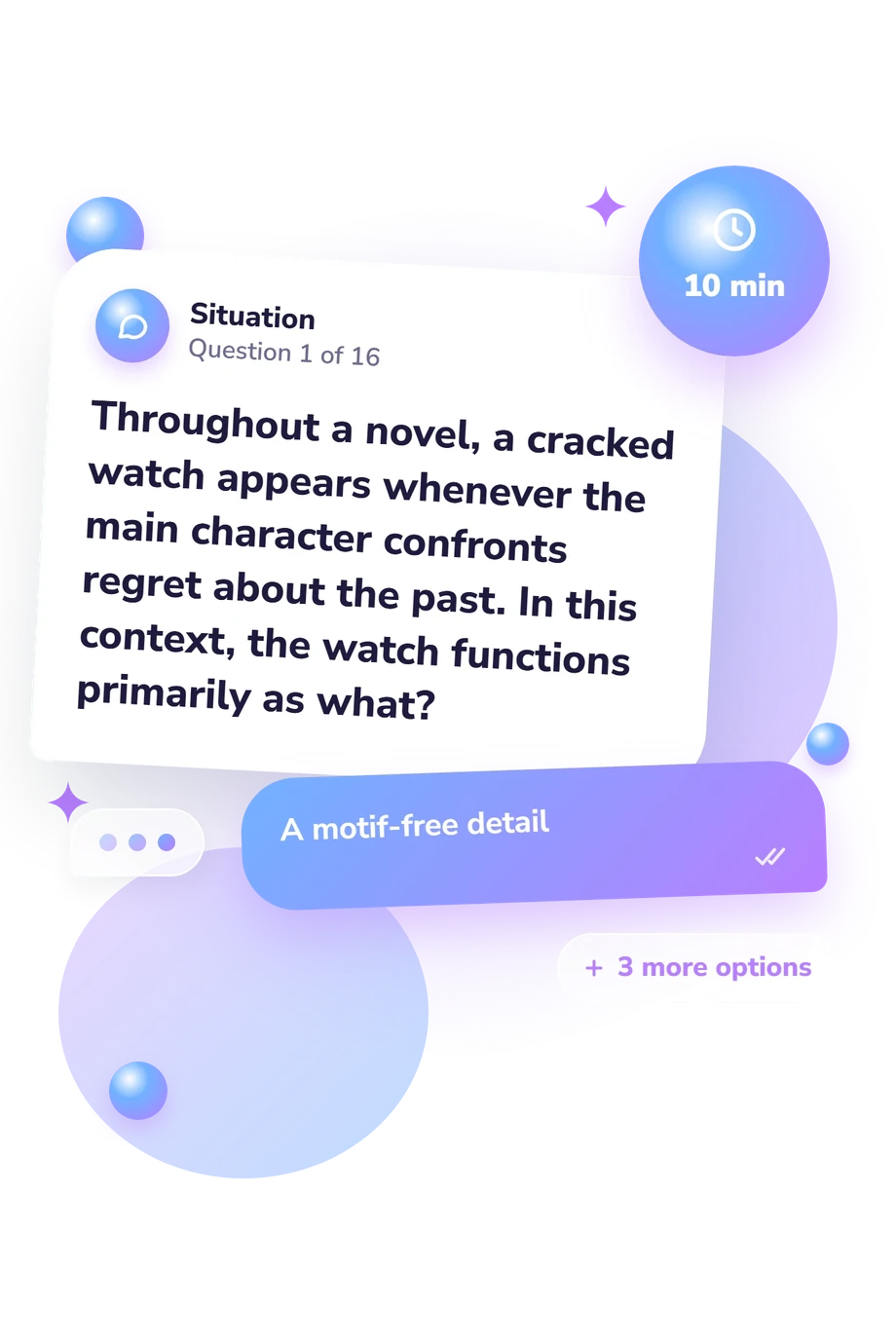
The questionnaire checks whether a reader can connect a literary term with a concrete textual situation. Its examples span meaning-making devices, narration and character roles, and poetic form, sound, and metre. The result indicates overall performance on the quiz’s terminology items.
The principal thematic groups are:
- Literary devices show whether you identify symbolism, personification, irony, foreshadowing, and metaphor from their function.
- Narrative perspective and character roles indicate recognition of viewpoints, narrators, protagonists, foils, and complex characters.
- Poetic form, sound, and structure reflect recognition of enjambment, alliteration, blank verse, metre, and anticipatory details.
Taken together, the result supports a focused literary terminology test for study or review. It reflects performance on the sampled concepts, not a complete measure of interpretation, originality, or overall literary ability.
Methodology and Evidence Base
Each item uses a short quotation, scenario, or definition and offers four answer choices, so the task focuses on selecting the best-fitting term rather than composing a response. The questionnaire reports performance on the displayed Literary Terms Knowledge scale, ranging from 0-16. Building Foundations covers 0-6, Developing Command covers 7-12, and Strong Command covers 13-16. These bands describe performance on this quiz, not overall literary ability.
Conceptually, the content is consistent with terminology defined in Abrams and Harpham (2015), while Brody et al. (1989) place literary assessment in a broader educational context. This online questionnaire is a literary-terminology quiz with no documented standardization. Its multiple-choice format can also be considered alongside the item-writing principles reviewed by Haladyna et al. (2002), including clear prompts and plausible alternatives.
Because no published norms are stated for this online questionnaire, this literary terms assessment is best used to understand overall quiz performance and guide revision. Prior exposure, wording, concentration, and familiarity with conventional examples can all affect performance.
- Brody, Pamela, Carol De Milo, and Alan C. Purves. The Current State of Assessment in Literature. Report Series 3.1. Center for the Learning and Teaching of Literature, 1989. ERIC ED315763.
- Abrams, M. H., and Geoffrey Galt Harpham. A Glossary of Literary Terms. 11th ed. Cengage Learning, 2015. ISBN 9781285465067.
- Haladyna, Thomas M., Steven M. Downing, and Michael C. Rodriguez. A Review of Multiple-Choice Item-Writing Guidelines for Classroom Assessment. Applied Measurement in Education, 15(3), 309-333, 2002. 10.1207/S15324818AME1503_5.
Updated: