
Fitness Quiz
How the Scales are Structured
Who Usually Takes This Test?
See How You Compare
Below is a preview of how scores are typically distributed across each scale.
Example Questions From the Test
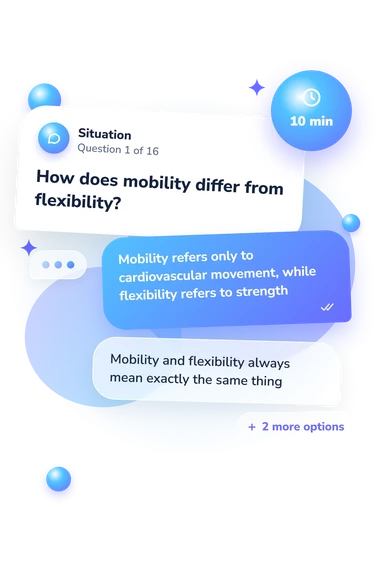
- Mobility refers only to cardiovascular movement, while flexibility refers to strength
- Mobility and flexibility always mean exactly the same thing
- Flexibility is active joint control, while mobility is the ability to hold a passive stretch
- Mobility includes actively controlling movement through a range, while flexibility concerns tissue extensibility and available range
- Changing exercises every session to prevent adaptation
- Gradually increasing an appropriate training demand as your capacity improves
- Training to complete exhaustion whenever possible
- Adding weight on a fixed schedule regardless of technique
- Sharp pain that begins during one specific repetition
- Numbness that travels down an arm or leg during exercise
- Muscle tenderness and stiffness that become noticeable later, often the next day
- A sudden joint injury that disappears when the workout ends
Fitness Quiz - Description and methodology of the test
Readers who want to check or refresh their understanding of general exercise principles can use this fitness quiz to review the ideas behind training, recovery, and safety. It covers physical fitness in a quiz format, but it tests knowledge rather than physical capacity. The result gives them a clearer basis for evaluating routines, effort, and warning signs.
What This Assessment Explores
Across the assessment, the items use short scenarios about mobility, flexibility, progressive overload, specificity, effort, recovery, warm-ups, endurance, body-weight change, and warning symptoms, so this quiz about exercise and fitness turns knowledge into practical decisions. The focus is practical: recognizing sound choices and knowing when exercise should stop.
Four areas shape the result:
- Movement control shows understanding of active range, flexibility, and preparation.
- Training design shows whether progression and specificity match the goal.
- Effort and recovery show understanding of exertion, rest, sleep, soreness, and adaptation.
- Safety and planning show whether warning symptoms and balanced weekly choices are recognized.
Fitness Knowledge is scored from 0-16. Foundations to build covers 0-6, Developing knowledge covers 7-12, and Strong knowledge covers 13-16. These bands describe educational understanding of core principles, not physical fitness or medical clearance.
Methodology and Evidence Base
The questionnaire uses multiple-choice items: its fitness-quiz questions have one best answer and test exercise knowledge. Each correct response adds one point to the score, so the format tests recognition of principles rather than strength, endurance, mobility, or body composition.
The questionnaire’s topics are conceptually consistent with the exercise principles discussed by Garber et al. (2011) and Kraemer and Ratamess (2004), including fitness components, progression, exercise selection, rest, and adaptation. It is not an adaptation of either source, and those publications do not validate its score.
Viewed together, questions and answers from this fitness-focused quiz offer an educational check of reasoning across common exercise situations. Riebe et al. (2015) offers related background on preparticipation health screening; the emergency-response item asks respondents to recognize when exercise should stop.
Higher scores indicate recognition of more core principles, while lower scores point to subjects worth revisiting. As an online multiple-choice knowledge test, results can be affected by guessing, attention, prior experience, and current context, so the score remains an educational snapshot rather than a measure of physical capacity.
- Garber, Carol Ewing, Bryan Blissmer, Michael R. Deschenes, Barry A. Franklin, Michael J. LaMonte, I-Min Lee, David C. Nieman, and David P. Swain. Quantity and Quality of Exercise for Developing and Maintaining Cardiorespiratory, Musculoskeletal, and Neuromotor Fitness in Apparently Healthy Adults: Guidance for Prescribing Exercise. Medicine & Science in Sports & Exercise, 43(7), 1334-1359, 2011. 10.1249/MSS.0b013e318213fefb
- Kraemer, William J., and Nicholas A. Ratamess. Fundamentals of Resistance Training: Progression and Exercise Prescription. Medicine & Science in Sports & Exercise, 36(4), 674-688, 2004. 10.1249/01.mss.0000121945.36635.61
- Riebe, Deborah, Barry A. Franklin, Paul D. Thompson, Carol Ewing Garber, Geoffrey P. Whitfield, Meir Magal, and Linda S. Pescatello. Updating ACSM's Recommendations for Exercise Preparticipation Health Screening. Medicine & Science in Sports & Exercise, 47(11), 2473-2479, 2015. 10.1249/MSS.0000000000000664