
Red Q Logo Quiz
How the Scales are Structured
Who Usually Takes This Test?
See How You Compare
Below is a preview of how scores are typically distributed across each scale.
Example Questions From the Test
- Choose the shape with the largest mathematical area
- Test both at actual icon sizes in their common interface contexts
- Judge both shapes only on a large design monitor
- Select whichever shape was drawn first
- Separate the elements with two similar tints
- Use a clear silhouette and negative-space separation
- Create separation with a thin gradient
- Use a soft shadow around the Q
- Sharpen the enlarged PNG repeatedly
- Place the PNG on a circular background
- Return to the vector source and export at the required size
- Lower the banner’s contrast to hide the blur
Red Q Logo Quiz - Description and methodology of the test
People who want a practical check of their logo judgment can use the Red Q Logo Quiz to examine how they handle a red letterform across common design situations. It suits learners, marketers, and designers reviewing foundational decisions rather than artistic style. As a logo quiz about red logos, it turns choices about color, contrast, spacing, and file preparation into a focused review of design knowledge.
What This Assessment Explores
Applied logo judgment, rather than artistic style or personal taste, is the focus of this brand logo quiz about red logos. The situations ask how a red Q remains recognizable when color, background, size, format, or nearby elements change. Learners and designers can use the result to identify principles needing practice.
It groups one displayed measure with supporting themes:
- Red Q Logo Knowledge (0-16) reports sound-choice recognition: Foundation to build (0-6) means principles need review; Developing knowledge (7-12) means application is incomplete; Strong knowledge (13-16) means choices are consistently identified.
- Color and contrast decisions show whether you protect legibility across light, dark, saturated, and monochrome settings.
- Shape, spacing, scalability, and reproduction decisions show how you judge silhouettes, clear space, optical centering, safe areas, vector files, and simplified variants.
The result points to review priorities rather than overall creative talent.
Methodology and Scientific Basis
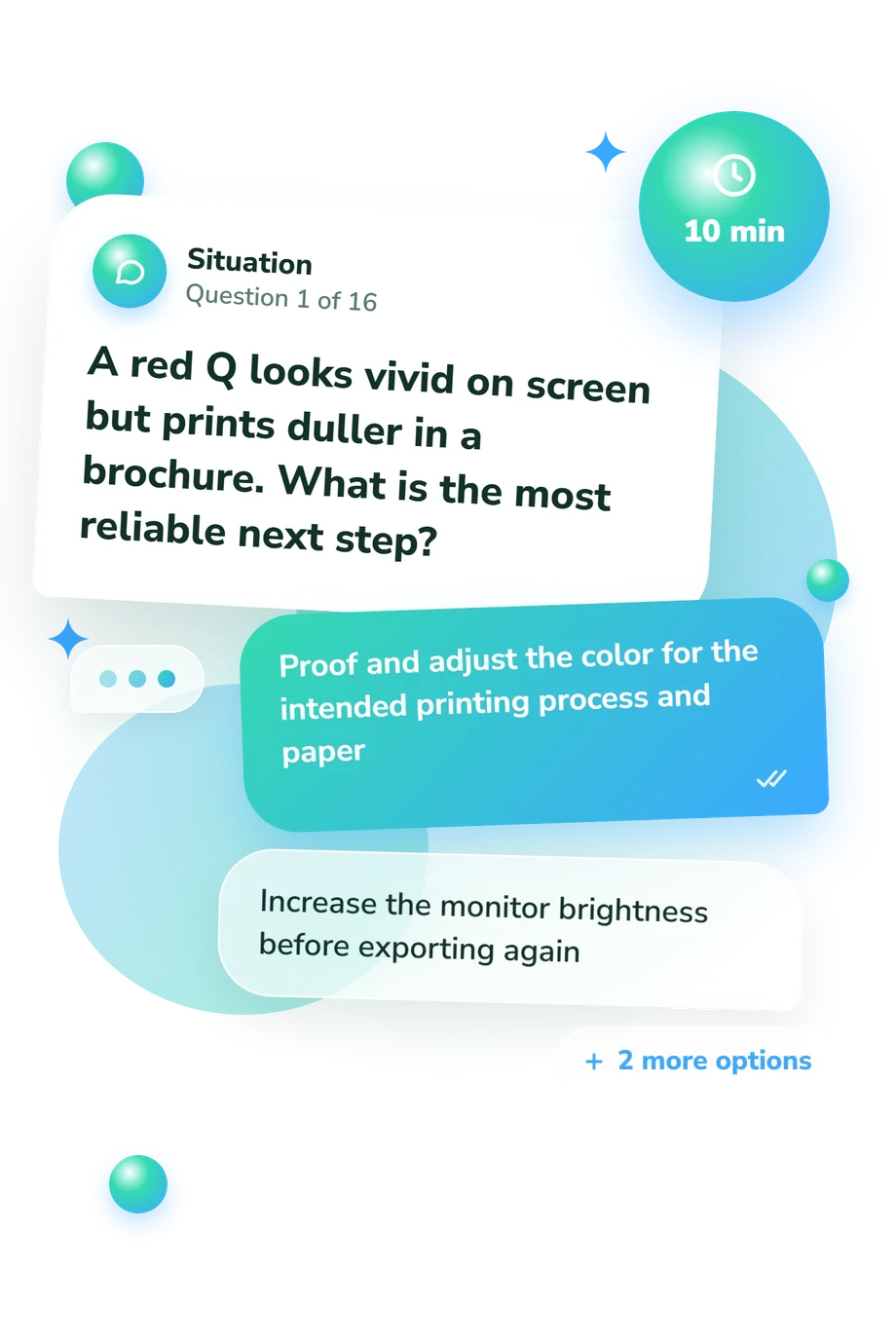
Each item presents a design situation with four answer choices. The respondent selects the most reliable action, so this red Q logo design quiz tests applied recognition rather than autobiographical ratings. The situations cover color, contrast, shape, spacing, responsive simplification, formats, accessibility, and clearance. Each correct response contributes one point, and the total is interpreted through the catalogue’s bands.
The content is conceptually consistent with Henderson and Cote (1998), whose work addresses logo selection and modification. Jiang, Gorn, Galli, and Chattopadhyay (2016) offer a perspective on circular and angular forms in brand judgments. WCAG 2.2 supports contrast and distinguishability, while SVG 1.1 explains vector scaling for geometric marks. The questionnaire is conceptually consistent with these works but is a separate online assessment, not an adaptation of the named studies or standards.
Interpret the result as performance on these scenarios: a higher total means more correct choices, not a professional credential. The bands describe performance on these scenarios rather than a population percentile. Guessing, attention, prior training, and familiarity with production work can affect performance.
- Pamela W. Henderson and Joseph A. Cote, “Guidelines for Selecting or Modifying Logos,” Journal of Marketing, vol. 62, no. 2, 1998, pp. 14-30. 10.1177/002224299806200202
- Yuwei Jiang, Gerald J. Gorn, Maria Galli, and Amitava Chattopadhyay, “Does Your Company Have the Right Logo? How and Why Circular- and Angular-Logo Shapes Influence Brand Attribute Judgments,” Journal of Consumer Research, vol. 42, no. 5, 2016, pp. 709-726. 10.1093/jcr/ucv049
- World Wide Web Consortium, Web Content Accessibility Guidelines (WCAG) 2.2, W3C Recommendation, 5 October 2023.
- World Wide Web Consortium, Scalable Vector Graphics (SVG) 1.1 (Second Edition), W3C Recommendation, 16 August 2011.
Updated: