
Is He Using Me Quiz
How the Scales are Structured
Who Usually Takes This Test?
See How You Compare
Below is a preview of how scores are typically distributed across each scale.
Example Questions From the Test
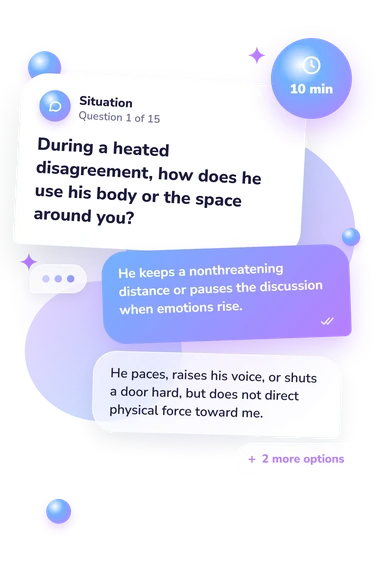
- He keeps a nonthreatening distance or pauses the discussion when emotions rise.
- He paces, raises his voice, or shuts a door hard, but does not direct physical force toward me.
- He crowds me, corners me, or uses his size and proximity to make me back down.
- He has pushed, hit, kicked, choked, burned, or otherwise physically injured me.
- He waits until I am awake, clear-headed, and actively able to agree.
- He has initiated while I was very tired but stopped immediately when I seemed uncertain.
- He minimizes signs of impairment or encourages more drinking when sexual activity is being discussed.
- He has attempted or engaged in sexual activity while I was asleep, unconscious, or unable to consent.
- He does not use objects or property to express intimidation.
- He has slammed down an object or struck furniture in frustration without directing it toward me.
- He has repeatedly punched walls, broken his own objects, or damaged the surroundings in a way that frightened me.
- He has thrown an object at me, destroyed my belongings to frighten me, displayed a weapon, or caused an injury.
Is He Using Me Quiz - Description and methodology of the test
For someone questioning whether a partner’s requests, pressure, or reactions are crossing a line, the Is He Using Me Quiz offers a structured way to examine relationship experiences. Its behavior-focused questions make this a how to know if a guy is using you quiz grounded in conduct rather than guessed motives. They bring requests, refusal, isolation, money, sex, threats, or blocked exits into one review.
What This Assessment Explores
These items examine emotional control, coercion, intimidation, deception, withdrawal, and repeated one-sided use across situations. They cover conduct that can make someone less free to leave, seek support, protect privacy, or decide about contraception, as well as patterns involving sex, money, help, or access. The focus is observable conduct and impact, not whether one disagreement proves motive.
Questions about money, help, transport, housing, favors, and fabricated emergencies make this an is he using me for money quiz. Repeated benefit-taking, emotional leverage, or deception can signal one-sided use even when caring behavior is present.
Sexual access, intimate images, reproductive choices, and consent make this an is he using me for my body quiz about pressure. A result in this area highlights pressure or boundary violations to examine; it does not assign a label or prove why a partner acted.
Methodology and Scientific Basis
Four ordered descriptions run from respectful to concerning conduct; choose the closest fit. Bands are unvalidated reflective summaries, not clinical, legal, or severity cutoffs. Results group concerns into three scales:
- Emotional Control and One-Sided Use (0-15) measures emotional control, coercion, deliberate exploitation, withdrawal, and repeated one-sided patterns in context; bands: No indicators endorsed (0), Something to examine (1-2), Act on the concern (3-15).
- Physical Safety and Threats (0-15) measures threats, blocked exits, violence, or injury; bands: No indicator endorsed (0-0), Something to examine (1-2), Act on the concern (3-15).
- Sexual Boundaries and Pressure (0-15) measures sexual pressure, refusal violations, image threats, or reproductive interference; bands: No indicators endorsed (0), Something to examine (1-2), Act on the concern (3-15).
The questionnaire is conceptually consistent with C-CAS, CASR-SF, Reproductive Coercion Scale, and Revised Conflict Tactics Scales, but is not a validated adaptation of them. It focuses on observable acts and patterns, not on an is he just using me quiz about motives or whether his motives are genuine. Self-report varies with context; any concerning experience matters independently, and a score-3 red flag should be acted on.
- Hegarty, Kelsey, Cynthia Brown, Elizabeth McLindon, Kelly M. FitzPatrick, and Laura Tarzia. "Validation of the Coercive-Composite Abuse Scale (C-CAS) in an Australian sample of women experiencing intimate partner abuse." BMJ Open 16(6) (2026): e115748. 10.1136/bmjopen-2025-115748
- Ford-Gilboe, Marilyn, C. Nadine Wathen, Colleen Varcoe, Harriet L. MacMillan, Kelly Scott-Storey, Tara Mantler, Kelsey Hegarty, and Nancy Perrin. "Development of a brief measure of intimate partner violence experiences: the Composite Abuse Scale (Revised)-Short Form (CASR-SF)." BMJ Open 6(12) (2016): e012824. 10.1136/bmjopen-2016-012824
- McCauley, Heather L., Jay G. Silverman, Kelley A. Jones, Daniel J. Tancredi, Michele R. Decker, Marie C. McCormick, S. Bryn Austin, Heather A. Anderson, and Elizabeth Miller. "Psychometric properties and refinement of the Reproductive Coercion Scale." Contraception 95(3) (2017): 292-298. 10.1016/j.contraception.2016.09.010
- Straus, Murray A., Sherry L. Hamby, Sue Boney-McCoy, and David B. Sugarman. "The Revised Conflict Tactics Scales (CTS2): Development and Preliminary Psychometric Data." Journal of Family Issues 17(3) (1996): 283-316. 10.1177/019251396017003001