
Am I British Quiz
How the Scales are Structured
Who Usually Takes This Test?
See How You Compare
Below is a preview of how scores are typically distributed across each scale.
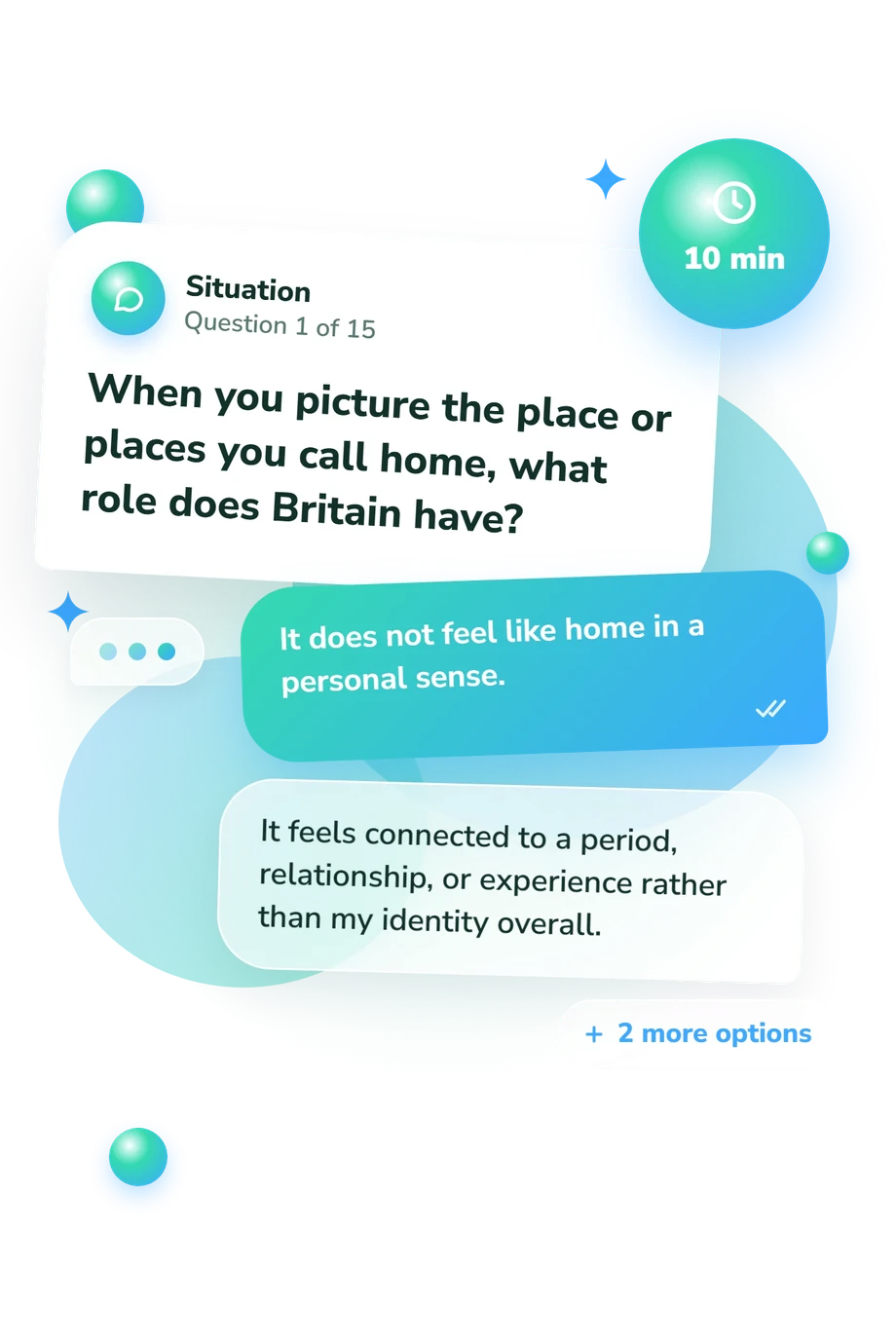
Example Questions From the Test
- It does not feel like home in a personal sense.
- It feels connected to a period, relationship, or experience rather than my identity overall.
- It is one meaningful home among other places or identities.
- It is deeply woven into my sense of home, even if I also belong elsewhere.
- Mostly as an argument about systems that feel separate from me.
- As news from a country or society I know something about.
- As an issue affecting people and places I care about.
- As a debate about institutions I experience as partly mine.
- It would not describe how I see myself.
- I would hesitate because it fits only in limited contexts.
- It would fit one meaningful strand of my identity.
- It would feel like a direct and natural description of me.
Am I British Quiz - Description and methodology of the test
Anyone reflecting on home, cultural familiarity, or their relationship with Britain can use this assessment to organise questions that are often difficult to answer in everyday conversation. The Am I British Quiz examines lived experience, including recognition of social cues, without requiring a liking for stereotypical foods, entertainment, or humour or using legal status as its measure. It offers a structured profile rather than an are you british quiz verdict, helping people consider how Britishness fits their lives.
What This Assessment Explores
Britishness is layered, covering UK terms, routines, institutions, regional and social cues, home, identity, and the country's future.
Together, they give this how British are you quiz three dimensions:
- Everyday Cultural Familiarity (0-15) shows natural recognition of UK references, language, routines, and cues: Exploring familiarity (0-5), Working familiarity (6-10), or Lived familiarity (11-15).
- National and Civic Connection (0-15) measures your stake in UK public life, institutions, and its future-not political views: Observing connection (0-5), Participating connection (6-10), or Deep civic stake (11-15).
- Personal British Belonging (0-15) explores whether Britishness shapes your identity and sense of home: Distant belonging (0-5), Contextual belonging (6-10), or Central belonging (11-15).
The strands can diverge; read the result as a profile.
Methodology and Scientific Basis
Each item presents a situation or self-description with four ordered choices. Prompts cover UK language, routines, humour, institutions, elections, ceremonies, regional terms, and identity, so respondents indicate degrees of familiarity or connection rather than choosing yes or no.
Responses combine into three displayed scores. Read them as a profile: a higher result on one dimension does not imply a higher result on another, and each band describes the measured tendency, not nationality, virtue, or political allegiance.
Conceptually, this questionnaire is consistent with research on British and European identity. Cinnirella and Hamilton's 2007 study is especially relevant to layered national identity and differing social positions. Georgiadis and Manning (2013) and Kiss and Park (2014) support treating Britishness as multidimensional rather than one attitude or label. These studies provide conceptual context; this questionnaire is not presented as one of those published measures.
For a reader using this questionnaire, the result turns the are you a true Brit quiz into a reflection on how Britishness relates to identity and experience, not a verdict; self-report remains sensitive to current context and self-awareness. Use the result to notice patterns, then interpret it alongside personal history and experience.
- Cinnirella, Marco, and Saira Hamilton. (2007). Are all Britons reluctant Europeans? Exploring European identity and attitudes to Europe amongst British citizens of South Asian ethnicity. Ethnic and Racial Studies, 30(3), 481-501. 10.1080/01419870701217530
- Georgiadis, Andreas, and Alan Manning. (2013). One nation under a groove? Understanding national identity. Journal of Economic Behavior & Organization, 93, 166-185. 10.1016/j.jebo.2012.10.013
- Kiss, Zsolt, and Alison Park. (2014). National Identity: Exploring Britishness. In Alison Park, Caroline Bryson, and John Curtice (eds.), British Social Attitudes: The 31st Report, pp. 61-77. London: NatCen Social Research.
Updated: