
Context Clues Quiz
How the Scales are Structured
Who Usually Takes This Test?
See How You Compare
Below is a preview of how scores are typically distributed across each scale.
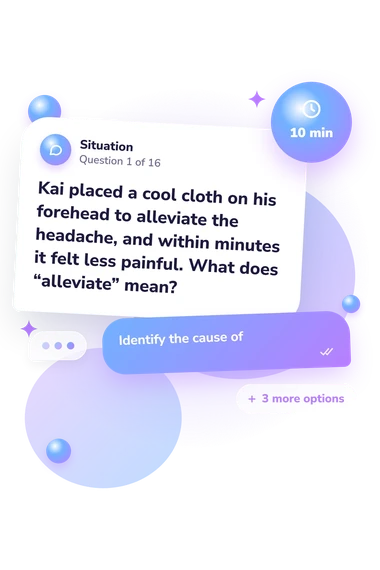
Example Questions From the Test
- Protected from cold weather
- Unable to grow again
- Temporarily inactive
- Hidden deep underground
- Available only in a limited amount
- Difficult to carry
- Unsafe without treatment
- Unevenly shared among people
- Arranged in a pattern
- Strikingly bright
- Unusually large
- Naturally varied
Context Clues Quiz - Description and methodology of the test
Readers who want to strengthen vocabulary inference can use the context clues quiz to examine how they draw meaning from nearby information. Words such as “alleviate,” “ambiguous,” and “resilient” appear in sentences where local evidence matters more than memorized recall. As a quiz with answer choices for interpreting context clues, it lets you review each choice against the sentence evidence.
What This Assessment Measures
Questions ask you to infer unfamiliar meanings from definitions, examples, contrasts, and nearby descriptions. The test is useful as context clues practice for readers examining how they connect details with meaning.
Clue relationships include:
- Definitions show whether a nearby explanation guides your choice.
- Contrasts show whether differences between situations change the meaning.
- Examples show whether concrete actions or properties clarify the word.
- Cause and effect show whether surrounding events support your inference.
Context Clues Knowledge (0-16) summarizes these decisions. Emerging (0-6) means direct clues are identified but some relationships need checking; Developing (7-12) means interpretation is often accurate with occasional rereading; Strong (13-16) means nearby details are combined consistently. These bands describe quiz performance, not overall reading ability.
Methodology and Evidence Base
Each item presents a sentence with an unfamiliar word and four answer choices. The respondent selects the meaning best supported by surrounding details, so the total summarizes performance across keyed responses rather than broad vocabulary knowledge. As a vocabulary context clues test, it emphasizes meaning selection from evidence, not definitions recalled in isolation.
The design is conceptually consistent with the Guessing from Context Test (Sasao & Webb, 2018), which examines inference from contextual information, but this quiz is not presented as an adaptation or standardized administration of that instrument. Clarke and Nation (1980) support strategies involving sentence-level, grammatical, and semantic clues, while Schatz and Baldwin (1986) show why context alone can be an unreliable predictor of meaning.
This is an online, non-normed questionnaire with performance bands, not a standardized measure of overall reading ability. Scores can vary with word familiarity, attention, guessing, and current context, so read the result as focused feedback about these inference decisions rather than a complete evaluation of language skill.
- Sasao, Yosuke, and Stuart Webb. 2018. "The guessing from context test." ITL - International Journal of Applied Linguistics 169(1): 115-141. 10.1075/itl.00009.sas
- D. F. Clarke and I. S. P. Nation. 1980. "Guessing the meanings of words from context: Strategy and techniques." System 8(3): 211-220. 10.1016/0346-251X(80)90003-2
- E. K. Schatz and R. S. Baldwin. 1986. "Context Clues Are Unreliable Predictors of Word Meanings." Reading Research Quarterly 21(4): 439-453. 10.2307/747615