
League Ability Quiz
How the Scales are Structured
Who Usually Takes This Test?
See How You Compare
Below is a preview of how scores are typically distributed across each scale.
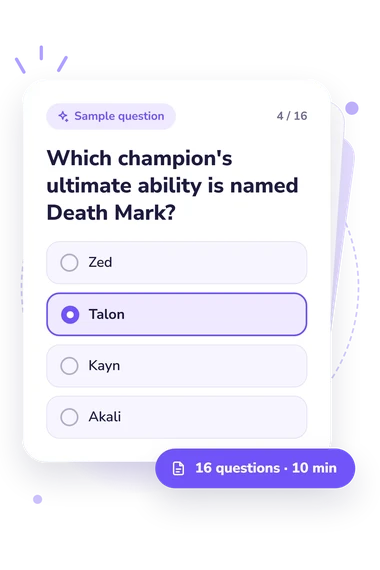
Example Questions From the Test
- Zac
- Karthus
- Anivia
- Sion
- Samira
- Lucian
- Miss Fortune
- Katarina
- Zed
- Talon
- Kayn
- Akali
League Ability Quiz - Description and methodology of the test
Players deciding what to revisit in their League of Legends knowledge can use this League of Legends ability test to identify gaps in champion-kit recall. The league ability quiz connects familiar names with the effects, conditions, and tactical situations that make abilities recognizable. Its result can point to strengths in roster knowledge and mechanics worth reviewing.
What This Assessment Measures
In this champion ability quiz, questions test recognition and functional understanding rather than rank, reflexes, or mechanical execution. They ask you to match champions with named abilities, infer effects from combat situations, and separate correct interactions from plausible alternatives. The result suits fans who want a snapshot of their familiarity with the playable roster.
It describes fan knowledge of iconic kits and defining mechanics in common situations, not ladder position, complete gameplay skill, or performance under pressure.
One scale reports that profile:
- League Ability Knowledge (0-16) reflects recognition of the featured abilities: Foundation to Build (0-6) means you recognize some prominent abilities but may confuse their owners or effects; Developing Knowledge (7-12) means you know many familiar kits and can interpret several practical interactions, with room to sharpen less familiar details; Strong Command (13-16) means you accurately recognize most featured abilities and understand how their defining mechanics work in common situations.
Methodology and Evidence Base
Each item presents a prompt with four answer choices. Some match an ability name to its champion; others describe a shield, ultimate, crowd-control interaction, or movement effect and ask you to identify the mechanic. Responses produce the displayed scale and bands, which organize the result descriptively rather than as clinical cutoffs.
The content is conceptually consistent with a study by Ding and colleagues on game expertise and behavioral and neural differences in multiplayer online battle arena play. That study gives context for testing game knowledge, but it does not validate this questionnaire.
Ability names and mechanics are aligned with Riot Games' Data Dragon documentation. Focused on recall, this questionnaire is an lol ability quiz, not a standardized psychometric instrument, and its descriptive bands should not be treated as population norms. Familiarity with featured champions, memory, and attention can affect performance, so use the result to guide review rather than infer rank or complete gameplay ability.
- Yue Ding, Xin Hu, Jiawei Li, Jingbo Ye, Fei Wang, and Dan Zhang. (2018). What Makes a Champion: The Behavioral and Neural Correlates of Expertise in Multiplayer Online Battle Arena Games. International Journal of Human-Computer Interaction, 34(8), 682-694. 10.1080/10447318.2018.1461761
- Erica Kleinman, Christian Gayle, and Magy Seif El-Nasr. (2021). "Because I'm Bad at the Game!" A Microanalytic Study of Self Regulated Learning in League of Legends. Frontiers in Psychology, 12, Article 780234. 10.3389/fpsyg.2021.780234
- Riot Games. Data Dragon Documentation. Riot Developer Portal.