
Am I Pagan Quiz
How the Scales are Structured
Who Usually Takes This Test?
See How You Compare
Below is a preview of how scores are typically distributed across each scale.
Example Questions From the Test
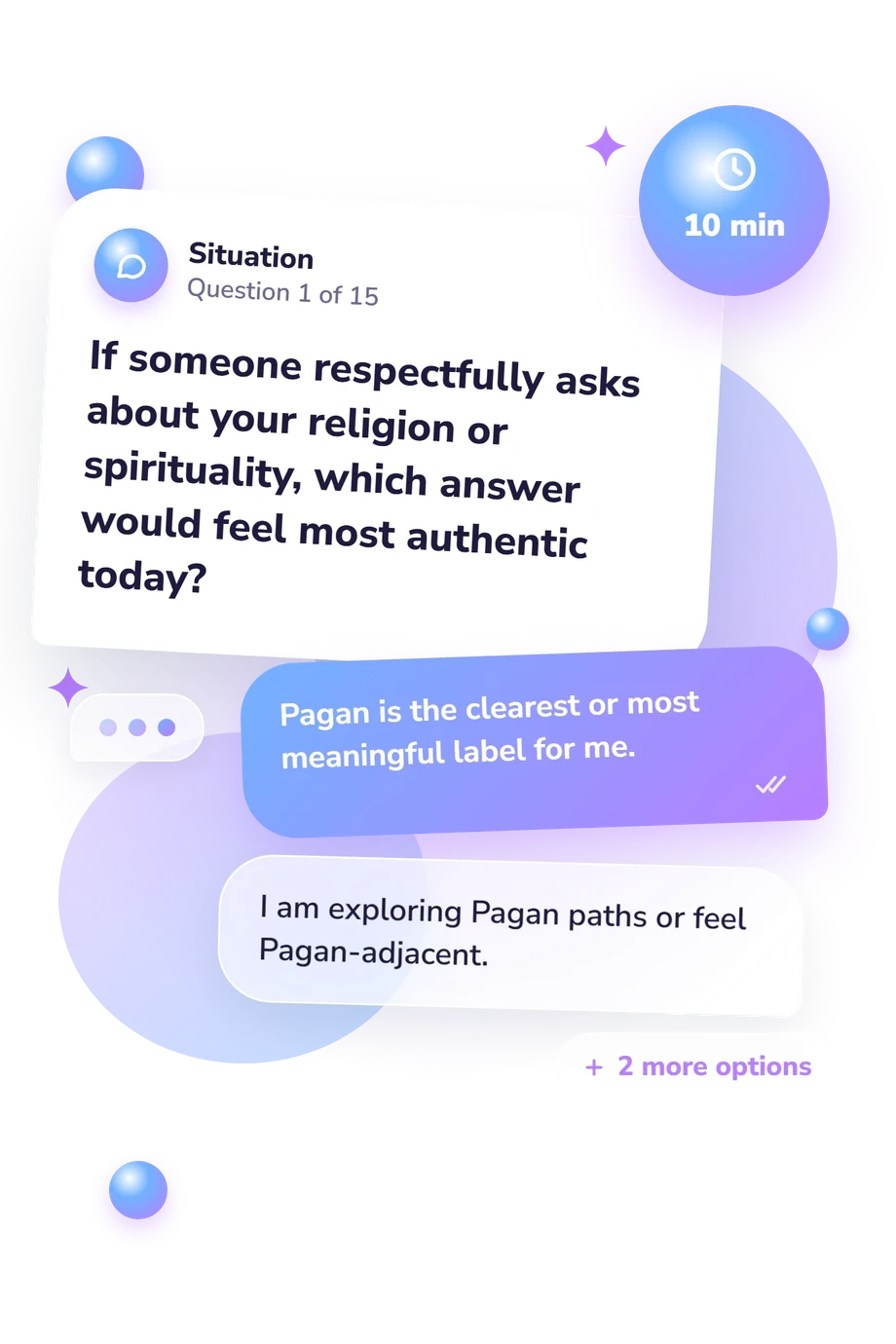
- Pagan is the clearest or most meaningful label for me.
- I am exploring Pagan paths or feel Pagan-adjacent.
- I prefer a broad phrase such as spiritual, nature-connected, or questioning.
- I use a secular, another religious, or no religious label.
- As a surviving expression of a possible deity or sacred presence.
- As a spiritual story that may contain more than one kind of truth.
- As a symbolic account of human motives or natural forces.
- Primarily as literature, folklore, or historical evidence.
- A Pagan seasonal celebration or open ritual.
- An introductory session comparing Pagan traditions and paths.
- A public lecture on mythology, folklore, or ancient religions.
- A non-spiritual social, educational, or outdoor event instead.
Am I Pagan Quiz - Description and methodology of the test
People questioning how Pagan ideas fit their lives may find the Am I Pagan Quiz useful for reflection without forcing a single identity. Readers using the what type of pagan am i quiz can use the profile to notice which worldview, identity and community, and ritual or seasonal-practice dimensions resonate, rather than treating the result as a Pagan typology. It suits curious, exploring, and self-identifying respondents seeking a nuanced result.
What This Assessment Explores
Rather than deciding whether someone is Pagan, it maps worldview, identity, and practice. Items cover deities, nature, ancestors, myths, seasons, community, ritual, offerings, and divination. Someone using the what kind of pagan am i quiz can use these themes for reflection, but the profile does not assign a Pagan type; ritual interest need not imply identity.
Three dimensions appear:
- Nature-Centered and Plural Spiritual Worldview (0-15) shows affinity with nature-centered, animist, polytheist, ancestral, or immanent views: Other Frameworks (0-5), Open & Exploring (6-10), or Strong Worldview Affinity (11-15).
- Pagan Identity and Community Affinity (0-15) reflects comfort with Pagan language, traditions, learning, and community: Different or Unlabeled (0-5), Pagan-Adjacent (6-10), or Strong Affinity (11-15).
- Ritual and Seasonal Practice (0-15) reflects appeal of ritual, seasonal observance, divination, offerings, and sacred spaces: Limited Practice Affinity (0-5), Selective Experimentation (6-10), or Strong Practice Affinity (11-15).
Solitary, blended, and changing paths remain possible.
Methodology and Scientific Basis
Each question offers four response choices, ranging from secular or non-spiritual interpretations through symbolic and exploratory positions to more direct sacred or Pagan engagement. This self-report format captures degree and style of affinity instead of forcing a yes-or-no identity.
Responses produce three separate results in the stated bands. As a pagan quiz, this questionnaire presents each scale independently, and its method does not specify how many points each answer contributes; no extra scoring rule should be inferred.
The evidence base is conceptually consistent with the published attitudes-toward-Paganism framework. Qualitative research on Pagan prayer, worship, and devotional practice adds context, while community research examines belonging among contemporary Pagans. These works provide relevant conceptual context but do not validate this questionnaire, determine its scoring, or establish identical psychometric properties. The online questionnaire is not a direct reproduction or validated adaptation of those sources.
Self-reported answers can be shaped by current context, self-awareness, and impression management. The questionnaire is an online self-reflection tool rather than a standardized instrument with established norms, reliability estimates, or clinical cutoffs, so the result is a reflective snapshot rather than a diagnosis.
- Williams, Emyr, Leslie J. Francis, and Ursula Billington. "The Williams Scale of Attitude toward Paganism: Development and Application among British Pagans." Archive for the Psychology of Religion, 32(2), 179-194, 2010. 10.1163/157361210X500900
- Goodall, Janet, Catherine Goodall, and Emyr Williams. "Pagan Prayer and Worship: A Qualitative Study of Perceptions." Pomegranate: The International Journal of Pagan Studies, 15(1-2), 178-210, 2014. 10.1558/pome.v15i1-2.178
- Pike, Sarah M. Earthly Bodies, Magical Selves: Contemporary Pagans and the Search for Community. University of California Press, 2001.
Updated: