
Breast Shape Quiz
How the Scales are Structured
Who Usually Takes This Test?
See How You Compare
Below is a preview of how scores are typically distributed across each scale.
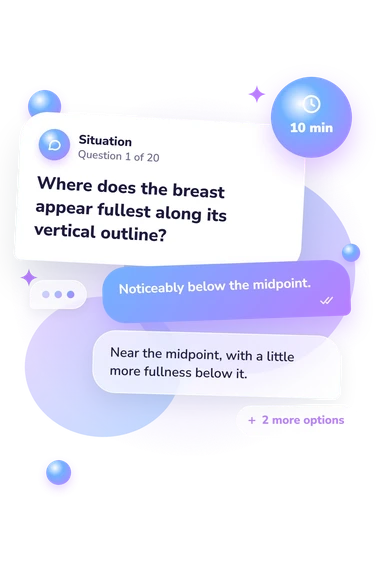
Example Questions From the Test
- The lower contour is a little broader.
- They are approximately the same width.
- The lower contour is substantially broader.
- The difference is modest and varies across the outline.
- It remains narrow for a substantial distance.
- It widens almost immediately into a broad outline.
- It stays narrow briefly and then widens moderately.
- It widens fairly early but retains a little vertical emphasis.
- Their placement or direction differs substantially.
- Their placement and direction are closely matched.
- There is a moderate, consistent difference.
- There is a subtle difference visible on close comparison.
Breast Shape Quiz - Description and methodology of the test
People seeking a clearer vocabulary for their natural proportions may find the breast shape quiz useful, especially when they want to compare several visible features rather than choose one fixed label. It addresses the question behind a what kind of breasts do I have quiz by organizing observations into a visual profile. The result is most useful for self-reflection, clothing discussions, or describing blended patterns.
What This Assessment Explores
Instead of forcing the body into one label, the questionnaire compares features that can coexist. It looks at upper-to-lower fullness, vertical proportion, central spacing, outward orientation, and differences between sides. This makes a boob shape quiz useful for describing a blended outline without implying that any appearance is more normal or desirable.
The five result dimensions are listed below; every scale uses the same displayed affinity bands: Limited affinity (0-4), Moderate affinity (5-8), and Strong affinity (9-12).
- Asymmetrical (0-12) reflects persistent differences in volume, position, contour, or nipple placement.
- Round/Even Fullness (0-12) reflects rounded contours with comparable fullness above and below the midpoint.
- Slender/Elongated (0-12) reflects a vertically longer, relatively narrow outline.
- Teardrop/Lower Fullness (0-12) reflects a gradual upper slope and fuller lower portion.
- Wide-Set/Outward-Facing (0-12) reflects center spacing and outward orientation of the breasts or nipples.
Methodology and Evidence Base
Each question offers four visual descriptions covering fullness, outline length, center spacing, outward direction, or side-to-side similarity. As a breast type quiz, it groups related answers into overlapping dimensions rather than one exclusive category. The result is an affinity summary for each dimension; no per-answer point value is stated, so scores should not be reverse-engineered from the ranges.
Pei et al. (2019) provides the closest conceptual parallel through 3D breast-shape categorization. Zhang et al. (2022) examined local features in classification, Losken et al. (2005) treated symmetry as measurable three-dimensional variation, and Mallucci and Branford (2012) discussed aesthetic breast dimensions. These works offer context; this questionnaire is not an adaptation or validation of any one of them.
It addresses the everyday question behind a what breast shape do I have quiz: which features stand out in your outline. Self-report, posture, lighting, and current body changes may affect responses. The unvalidated bands describe appearance rather than health, bra size, or diagnosis. A new or rapidly changing difference, lump, discharge, persistent pain, or skin or nipple change warrants professional medical advice.
- Pei, Jie, Huiju Park, and Susan P. Ashdown. Female breast shape categorization based on analysis of CAESAR 3D body scan data. Textile Research Journal 89(4) (2019): 590-611. 10.1177/0040517517753633
- Zhang, Beibei, Yue Sun, Zejun Zhong, Yuanping Xia, Shouning Jin, YuQing Li, and Bingfei Gu. Breast shape classification and discrimination driven by local features-focusing on Chinese women in their 20s. International Journal of Industrial Ergonomics 90 (2022): 103304. 10.1016/j.ergon.2022.103304
- Losken, Albert, Inessa Fishman, Donald D. Denson, Hunter R. Moyer, and Grant W. Carlson. An objective evaluation of breast symmetry and shape differences using 3-dimensional images. Annals of Plastic Surgery 55(6) (2005): 571-575. 10.1097/01.sap.0000185459.49434.5f
- Mallucci, Patrick, and Olivier Alexandre Branford. Concepts in aesthetic breast dimensions: analysis of the ideal breast. Journal of Plastic, Reconstructive & Aesthetic Surgery 65(1) (2012): 8-16. 10.1016/j.bjps.2011.08.006