
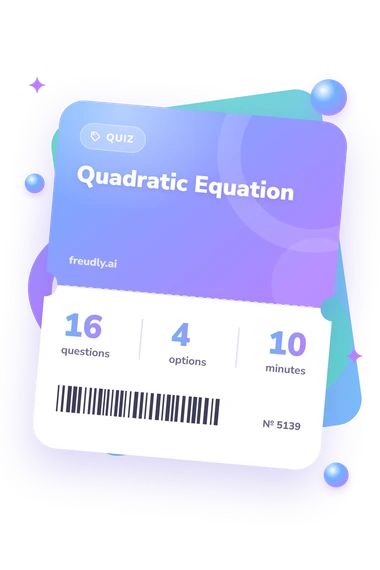
Quadratic Equation Quiz
How the Scales are Structured
Who Usually Takes This Test?
See How You Compare
Below is a preview of how scores are typically distributed across each scale.
Example Questions From the Test
- 3x^2 - 2x + 7 = 0, with the constant sign changed
- 3x^2 + 2x - 7 = 0, with 2x moved using the wrong sign
- 3x^2 - 2x - 7 = 0, after subtracting 2x from both sides
- 3x^2 - 9x = 0, after incorrectly combining unlike terms
- 10 metres, found by treating the area as a perimeter
- 8 metres, which would make the area 88 square metres
- 4 metres, which would make the area 28 square metres
- 5 metres, since 5(5 + 3) = 40
- x^2 + 3x - 10 = 0, which has the wrong sum of roots
- x^2 - 3x - 10 = 0, obtained from (x + 2)(x - 5) = 0
- x^2 - 7x + 10 = 0, which represents roots 2 and 5
- x^2 + 3x + 10 = 0, which uses the wrong constant sign
Quadratic Equation Quiz - Description and methodology of the test
Students revising algebra and teachers checking classroom understanding can use this assessment to connect procedures with meaning. The quadratic equation quiz shows whether a learner can move between equations, factors, graphs, and applications rather than recall an isolated rule. Its result offers a focused picture of current reasoning. As a quadratics quiz, this assessment provides a starting point for classroom discussion or method review.
What This Assessment Measures
Questions cover standard form, roots, factoring, the discriminant, symmetry, completing the square, exact solutions, and a rectangle application. They test method choice, algebraic accuracy, and links between symbolic, graphical, and applied forms.
Anyone reviewing school-level quadratic equations can use the result as a compact snapshot. The assessment’s quadratic formula quiz items form one component alongside factoring, graphs, completing the square, and other topics, while the result supplies a broad knowledge band rather than identifying the source of an error.
The single scale is Quadratic Equation Knowledge (0-16), with these result bands:
- Foundations to revisit (0-6) means standard form, roots, signs, or main methods need review.
- Developing knowledge (7-12) means core ideas are present but method comparison and algebra checks may help.
- Strong knowledge (13-16) means the learner shows secure command across calculations, graphs, and applications.
Methodology and Evidence Base
Each item uses four answer choices, testing recognition and reasoning within a problem rather than written derivations. Distractors target mistakes in signs, factorisation, formula substitution, completing the square, and interpretation. The multiple-choice format presents a quadratic-equation quiz with answers to choose from, not an open-response exercise.
The questionnaire reports one total score on the displayed scale, but its response-to-point rule is undocumented. No separate weighting rule should be assumed; read the band as a summary of performance across the sampled skills.
As a quiz for solving quadratic equations, this assessment is conceptually closest to the 2015 study by Didis and Erbas, which examines difficulties in representing and solving equations. The 2024 study by O’Connor and Norton discusses learning challenges, while the 2006 study by Vaiyavutjamai and Clements supports attention to conceptual understanding alongside procedures. These sources contextualise the content; they do not validate or standardise this online questionnaire.
The online questionnaire has no documented norms, reliability estimates, or standardisation sample, and its response-to-point rule is undocumented. Current instruction, notation familiarity, careless slips, and multiple-choice limits can affect results. Use the outcome to target review rather than as a standalone measure of mathematical ability.
- Didis, Makbule Gozde, and Ayhan Kursat Erbas. "Performance and Difficulties of Students in Formulating and Solving Quadratic Equations with One Unknown." Educational Sciences: Theory & Practice 15, no. 4 (2015): 1137-1150. 10.12738/estp.2015.4.2743
- O'Connor, Bronwyn Reid, and Stephen Norton. "Exploring the Challenges of Learning Quadratic Equations and Reflecting upon Curriculum Structure and Implementation." Mathematics Education Research Journal 36, no. 1 (2024): 151-176. 10.1007/s13394-022-00434-w
- Vaiyavutjamai, Pongchawee, and M. A. Ken Clements. "Effects of Classroom Instruction on Students’ Understanding of Quadratic Equations." Mathematics Education Research Journal 18, no. 1 (2006): 47-77. 10.1007/BF03217429