
Am I Italian Quiz
How the Scales are Structured
Who Usually Takes This Test?
See How You Compare
Below is a preview of how scores are typically distributed across each scale.
Example Questions From the Test
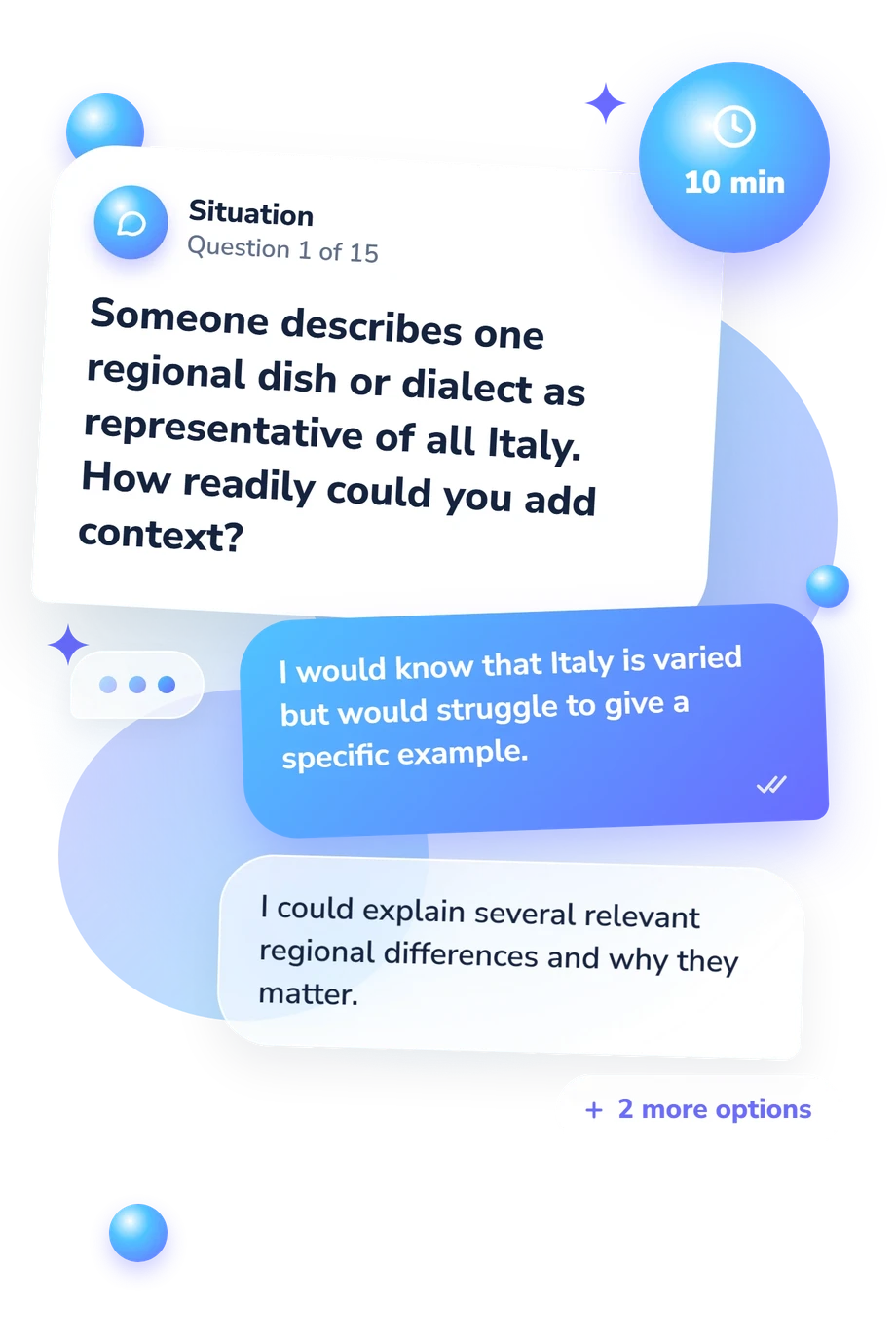
- I would know that Italy is varied but would struggle to give a specific example.
- I could explain several relevant regional differences and why they matter.
- I would probably accept the description because I do not yet know much about regional variation.
- I could offer at least one concrete example showing that traditions differ by region or locality.
- I could identify familiar words but would verify the practical meaning elsewhere.
- I could understand the key instruction and most supporting details.
- I would generally need a full translation.
- I could find the main point but might miss timing or condition details.
- A specific answer based on ongoing family, community, citizenship, upbringing, or lived experience.
- An answer based mainly on interests such as travel, food, language, art, or future plans.
- A tentative answer because I am only beginning to explore the connection.
- A meaningful answer tied to ancestry, relationships, residence, or formative experiences, though the connection is not active in every part of my life.
Am I Italian Quiz - Description and methodology of the test
For readers trying to understand whether an Italian connection comes from cultural participation, language use, family history, or community life, this assessment offers a nuanced profile rather than a single identity label. The Am I Italian Quiz is suited to learners, people exploring ancestry, and those with lived ties to Italy. Presented in an are you italian quiz format, it shows which parts of that relationship feel exploratory, developing, or established.
What This Assessment Explores
Questions place culture, language, and belonging in concrete situations: regional variation, media and history, practical communication, family stories, community participation, self-description, and future involvement. Its how Italian are you quiz format separates experiences that may develop at different speeds.
The displayed profile contains three dimensions:
- Italian Cultural Familiarity (0-15) shows cultural participation, from Exploring (0-5) through Building context (6-10) to Context-rich (11-15), without judging whether tastes are sufficiently Italian.
- Italian Language Engagement (0-15) shows current contact and use, from Exploratory (0-5) through Developing (6-10) to Established (11-15), not nationality or personal worth.
- Personal and Community Connection (0-15) shows how defined, active, and meaningful ties feel, from Curious connection (0-5) through Meaningful connection (6-10) to Rooted connection (11-15); it is not legal proof.
Methodology and Evidence Base
Each item presents a cultural, language, or relationship situation with four self-report options. Choices differ in knowledge, comprehension, confidence, frequency, involvement, or personal meaning, so the respondent selects the statement closest to current experience. This makes the Italian identity quiz a pattern profile, not a pass-or-fail judgment.
Responses feed dimensions separately rather than producing one identity total. The ranges organize the profile, but each option's point contribution is not specified. Interpretation is strongest when you consider patterns across dimensions and the situations that feel most representative.
Sgroi et al. (2020) is the closest comparison for how cultural participation and community ties relate in Italy. De Fina (2014) connects Italian-language use with identity work in communities of Italian origin, while Fortier (2006) examines belonging and intimate ethnicity as lived experience. Phinney (1992) offers a comparison through the Multigroup Ethnic Identity Measure for exploration and commitment. The questionnaire is conceptually consistent with these works, not an adaptation.
This online questionnaire has no established standardized norms, reliability estimates, or clinical validation, and self-report answers can shift with current context, memory, and self-awareness.
- Sgroi, Daniel, Michela Redoano, Federica Liberini, Ben Lockwood, Emanuele Bracco, and Francesco Porcelli. "Cultural Identity and Social Capital in Italy." IZA Discussion Paper No. 13783, Institute of Labor Economics, 2020.
- De Fina, Anna. "Language and identities in US communities of Italian origin." Forum Italicum 48, no. 2 (2014): 253-267. 10.1177/0014585814529227
- Fortier, Anne-Marie. "Community, belonging and intimate ethnicity." Modern Italy 11, no. 1 (2006): 63-77. 10.1080/13532940500492308
- Phinney, Jean S. "The Multigroup Ethnic Identity Measure." Journal of Adolescent Research 7, no. 2 (1992): 156-176. 10.1177/074355489272003
Updated: