
Zoo Quiz
How the Scales are Structured
Who Usually Takes This Test?
See How You Compare
Below is a preview of how scores are typically distributed across each scale.
Example Questions From the Test
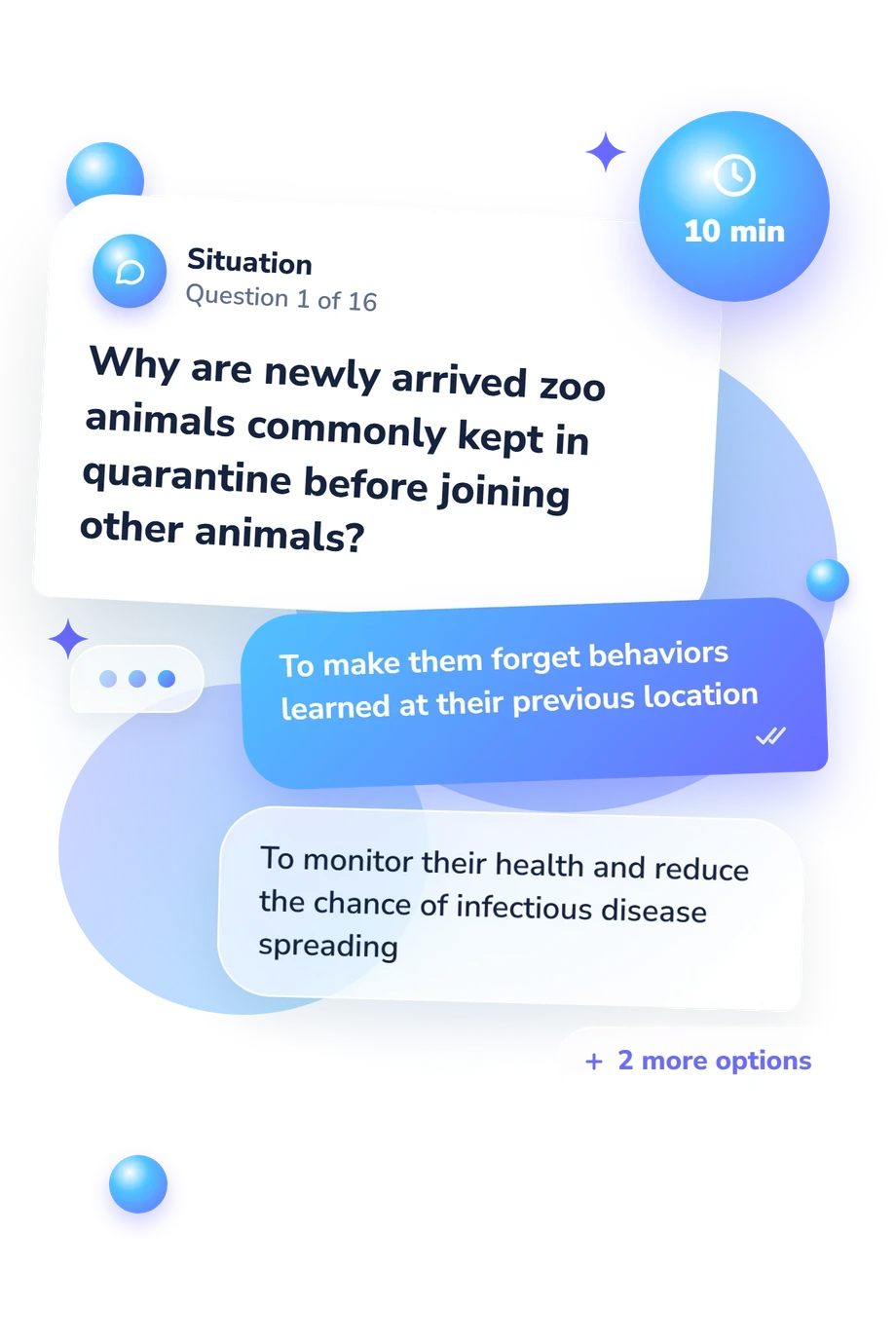
- To make them forget behaviors learned at their previous location
- To monitor their health and reduce the chance of infectious disease spreading
- To determine whether they can live without environmental enrichment
- To ensure they become familiar with visitors before meeting other animals
- Around midday
- Throughout the entire night only
- Around dawn and dusk
- At irregular times with no daily pattern
- They are two color forms of the same species
- They belong to the same genus but live in different habitats
- They are both members of the raccoon family
- They belong to different mammal families
Zoo Quiz - Description and methodology of the test
People seeking a structured way to connect animal facts with zoo practice can take this zoo quiz to examine how they apply knowledge to the management and conservation scenarios presented in its questions. It suits curious visitors, students, and learners who want more than isolated species trivia. Visitors can use this zoo animal quiz to focus their study on the subject areas covered by the assessment.
What This Assessment Explores
Questions connect biology with zoo decisions, covering quarantine, digestion, taxonomy, activity patterns, enrichment, cooperative care, enclosure design, visitor conduct, genetics, transfers, breeding, and reintroduction. Together, these zoo-focused quiz questions test applied understanding rather than isolated species trivia.
Themes include these areas. They contribute to one displayed scale, Zoo Knowledge (0-16), rather than separate dimensions:
- Biology and behavior show how you link anatomy, activity rhythms, diet, and natural behavior with care.
- Welfare and enrichment indicate choices that support agency, stimulation, comfort, and lower-stress husbandry.
- Habitat and collection management cover enclosure design, transfers, genetic planning, and population needs.
- Conservation practice captures connections between breeding, threats, monitoring, reintroduction, and responsible outcomes.
The bands are Foundation Building (0-6), Developing Knowledge (7-12), and Strong Knowledge (13-16). Foundation Building signals concepts needing development; Developing Knowledge indicates broader understanding; Strong Knowledge reflects well-rounded understanding.
Methodology and Evidence Base
Each item presents a factual prompt or short scenario with four answer choices. The respondent selects the best answer, and each correct response contributes one point, so the total reflects performance across the tested content. The items combine recall with application, such as interpreting nocturnal behavior, selecting a genetically appropriate pairing, or recognizing why enrichment and cooperative care matter.
The content is conceptually consistent with Hosey, Melfi, and Pankhurst (2013), whose work supports the biology, behavior, management, and welfare themes. Welfare principles also correspond with Mellor, Hunt, and Gusset (2015). Population-management items use the collection-planning perspective of Hutchins, Willis, and Wiese (1995), while reintroduction questions reflect IUCN/SSC (2013) guidance on risk assessment and monitoring. These sources support the subject areas, but this online questionnaire is not an adaptation or administration of any published instrument.
Viewed as a zoo knowledge test, it reports raw performance through the displayed bands. Higher results suggest command of tested concepts; lower results identify subjects for review. Prior study, attention, and wording familiarity may affect performance, so this score cannot show keeper competence or predict zoo behavior.
- Geoffrey R. Hosey, Vicky Melfi, and Sheila Pankhurst. Zoo Animals: Behaviour, Management, and Welfare. 2nd ed. Oxford: Oxford University Press, 2013. 10.1093/hesc/9780199693528.001.0001
- David J. Mellor, Susan Hunt, and Markus Gusset, eds. Caring for Wildlife: The World Zoo and Aquarium Animal Welfare Strategy. Gland, Switzerland: WAZA Executive Office, 2015.
- Michael Hutchins, Kevin Willis, and Robert J. Wiese. Strategic Collection Planning: Theory and Practice. Zoo Biology, 14(1), 5-25, 1995. 10.1002/zoo.1430140103
- IUCN/SSC. Guidelines for Reintroductions and Other Conservation Translocations. Version 1.0. Gland, Switzerland: IUCN Species Survival Commission, 2013.
Updated: