
Group Quiz Game
How the Scales are Structured
Who Usually Takes This Test?
See How You Compare
Below is a preview of how scores are typically distributed across each scale.
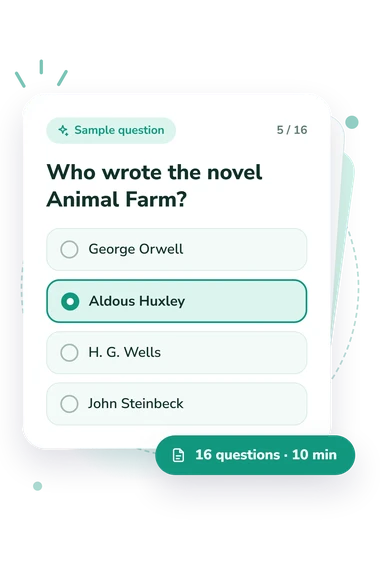
Example Questions From the Test
- One quarter
- Three quarters
- One half
- One third
- All mammals are ravens
- Some birds are mammals
- No mammals exist
- No ravens are mammals
- Oxygen
- Carbon dioxide
- Nitrogen
- Hydrogen
Group Quiz Game - Description and methodology of the test
People seeking a broad, low-pressure self-check can use the group quiz game to explore recall across several familiar subjects without preparing for a specialist exam. A general knowledge quiz result provides an overall snapshot of mixed-topic knowledge rather than separate subject scores. It suits friends, families, classrooms, or solo players who want a clear basis for discussion, shared play, or deciding what to review next.
What This Assessment Explores
This assessment samples broad knowledge rather than personality or intelligence as a whole. Its questions move across probability, science, vocabulary, logic, geography, history, music, art, civic knowledge, and cultural facts. Some test direct recall; others require applying a rule, interpreting a clue, or identifying a necessary conclusion. The result is a snapshot of accessible knowledge across mixed domains.
The format suits people who enjoy team quiz games, informal learning, or comparing answers, and it also works for solo respondents choosing subjects for further study. The displayed knowledge scale runs from 0-16 and uses these result bands:
- Warm-Up Round (0-6) indicates that broad trivia knowledge is still taking shape.
- Strong Contender (7-12) indicates a useful base across subjects, with room to broaden it.
- Trivia Standout (13-16) indicates consistently strong recall and reasoning across the mixed-topic quiz.
Methodology and Scientific Basis
Each item presents a short prompt with four answer choices. Some questions ask for direct factual recall, while others require a brief inference or application, such as calculating a probability, following a logical relation, or interpreting a definition. The result is reported on the displayed scale; no separate weighting, percentile conversion, or difficulty correction is stated for this questionnaire.
Conceptually, the format aligns with the 2020 Russian General-Knowledge Norms study, a published question bank for examining recall across subject areas. Nelson and Narens' 1980 norms represent an earlier norming tradition that also considered recall accuracy, response latency, and feeling-of-knowing judgments. Tauber and colleagues' later work updated and expanded that general-knowledge norming research. This questionnaire is conceptually consistent with those studies, not an adaptation of their item banks or standardization procedures.
The online format supports trivia practice, but scores can vary with language, education, cultural exposure, recent learning, topic familiarity, fatigue, and guessing. The cited studies are conceptual comparators; unless the questionnaire's norming is established, read the bands as a practical snapshot rather than population norms, a diagnosis, or an ability classification.
- Martin-Luengo, B., Zinchenko, O., Alekseeva, M., & Shtyrov, Y. (2020). Russian Norms for 500 General-Knowledge Questions. Frontiers in Psychology, 11, 545304. 10.3389/fpsyg.2020.545304
- Nelson, T. O., & Narens, L. (1980). Norms of 300 general-information questions: Accuracy of recall, latency of recall, and feeling-of-knowing ratings. Journal of Verbal Learning and Verbal Behavior, 19(3), 338-368. 10.1016/S0022-5371(80)90266-2
- Tauber, S. K., Dunlosky, J., Rawson, K. A., Rhodes, M. G., & Sitzman, D. M. (2013). General knowledge norms: Updated and expanded from the Nelson and Narens (1980) norms. Behavior Research Methods, 45(4), 1115-1143. 10.3758/s13428-012-0307-9