
Oedipus Rex Quiz
How the Scales are Structured
Who Usually Takes This Test?
See How You Compare
Below is a preview of how scores are typically distributed across each scale.
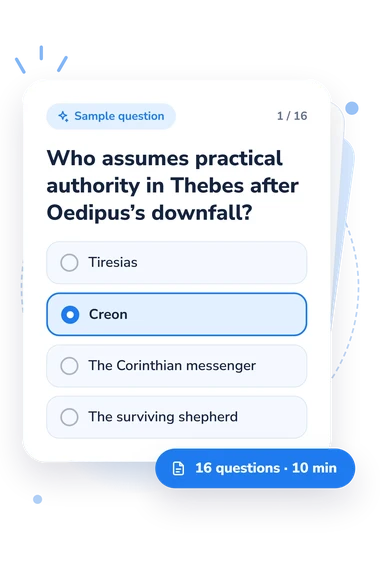
Example Questions From the Test
- Tiresias
- Creon
- The Corinthian messenger
- The surviving shepherd
- He defeated Laius’s enemies in battle.
- He solved the Sphinx’s riddle and freed the city.
- He negotiated an alliance with Corinth.
- He interpreted an oracle that saved the harvest.
- Merope has confessed that Oedipus was adopted.
- Corinth has been struck by the same plague as Thebes.
- A witness has accused Creon of killing Laius.
- Polybus has died, and Corinth wants Oedipus as its ruler.
Oedipus Rex Quiz - Description and methodology of the test
Readers who want to check how securely they remember Sophocles’ tragedy can use this Oedipus Rex Quiz as a focused review of plot, revelation, and dramatic meaning. The questions suit students, theatre readers, and anyone returning to the play after a first reading. This Oedipus quiz’s result places overall grasp of the play in a general band and indicates whether broad review may be useful.
What This Assessment Explores
The questionnaire covers the tragedy’s causal sequence and major interpretive turns. Items address authority after Oedipus falls, the plague, prophecy, Laius’s death, Jocasta’s recognition, and the ending. This Oedipus the King quiz in this format tests whether the reader can connect revelations with dramatic irony, sight imagery, and the chorus’s warning.
The result uses one displayed dimension:
- Oedipus Rex Knowledge (0-16) shows how securely you identify events, evidence, structure, and motifs; Foundation to build (0-6) signals a need to review, Developing command (7-12) reflects solid grasp with details to sharpen, and Strong command (13-16) indicates a well-developed understanding.
Because the items assume familiarity with the play, the quiz suits students, theatre readers, and independent learners. Taken together, these questions check recall of the plot alongside interpretation of its revelations, motifs, and dramatic structure.
Methodology and Evidence Base
Each item presents a question with four answer choices. Individual point contributions are not specified; the questionnaire reports performance on the displayed scale. The set moves from factual checks-such as the plague, Polybus’s death, and the shepherd’s testimony-to interpretive links involving dramatic irony, sight and blindness, and self-punishment. The displayed result reports performance on the knowledge scale and uses its bands to indicate how much of the play’s evidence and structure the respondent recognized.
Content selection is anchored in Oedipus Rex (Sophocles), the primary textual reference. Finglass offers scholarly context for the tragedy’s structure and interpretation, while Calame supports attention to vision, blindness, emotional intensity, and theatrical meaning. Together, these sources provide literary context for the questions.
This Oedipus knowledge quiz reports overall performance on the displayed knowledge scale rather than separate scores for individual themes. Performance may shift with memory, translation, classroom discussion, or attention on the day. The aggregate result is a focused reading snapshot, while the displayed bands describe levels of command rather than population norms.
- Sophocles. The Three Theban Plays: Antigone, Oedipus the King, Oedipus at Colonus. Translated by Robert Fagles; introduction and notes by Bernard Knox. Penguin Books, 1984.
- Finglass, P. J. “Sophocles’ Oedipus the King.” Oxford Bibliographies in Classics. Oxford University Press, 2017. 10.1093/obo/9780195389661-0266.
- Calame, Claude. “Vision, Blindness, and Mask: The Radicalization of the Emotions in Sophocles’ Oedipus Rex.” In Tragedy and the Tragic: Greek Theatre and Beyond, edited by M. S. Silk, 17-37. Oxford University Press, 1996. 10.1093/oso/9780198149514.001.0001.