
Quadrilateral Quiz
How the Scales are Structured
Who Usually Takes This Test?
See How You Compare
Below is a preview of how scores are typically distributed across each scale.
Example Questions From the Test
- It has four congruent sides
- It has four right angles
- It has congruent diagonals
- It has two pairs of parallel sides
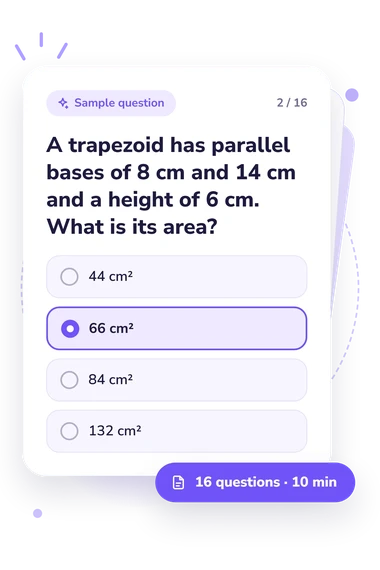
- 44 cm²
- 66 cm²
- 84 cm²
- 132 cm²
- It has exactly one pair of congruent sides
- It has no parallel sides
- It has two pairs of perpendicular sides
- It has at least one pair of parallel sides
Quadrilateral Quiz - Description and methodology of the test
Students reviewing plane geometry or checking their grasp of shape classification can use this quadrilateral quiz to connect definitions with calculations and structural relationships. The assessment suits learners who want an overall snapshot of demonstrated accuracy on tested quadrilateral content. It also works as a quadrilateral practice test, offering a starting point for reviewing missed ideas and choosing topics for practice in geometric reasoning.
What This Assessment Explores
Items test whether a learner defines a quadrilateral, distinguishes related classes, and applies properties. As a quiz about properties of quadrilaterals, it treats classification as a network: under the inclusive definition, a square is also a rectangle, rhombus, parallelogram, and trapezoid. Questions address angle sums, adjacent angles, area, diagonals, side relationships, and coordinates.
The single result gives an overall indication of how accurately the learner connects definitions with consequences and uses structural or numerical clues. The question themes are:
- Classification questions test whether inclusive category relationships are applied accurately.
- Property questions test whether side, angle, parallelism, and diagonal conditions are recognized.
- Measurement questions test whether areas, angles, coordinates, and diagonals support a conclusion.
Quadrilateral Knowledge (0-16) is labelled Foundation Building (0-6), Developing Knowledge (7-12), or Strong Knowledge (13-16), marking the level of command shown in these tasks.
Methodology and Scientific Basis
Each item presents four answer choices and asks for a definition, classification, calculation, or property-based inference. The questionnaire mixes definition and property recall with numerical calculation and structural application. As a special quadrilaterals quiz, the set examines relationships among rectangles, rhombi, trapezoids, kites, parallelograms, and squares. The content ranges from direct terminology and standard property recognition to calculations involving area, angles, coordinates, and diagonals, followed by classification or inference.
The displayed total is the number of correct answers: a raw performance measure on these items, without a norm-referenced comparison. It therefore describes performance on the tested content, not every aspect of geometric reasoning.
The framework is conceptually consistent with Fujita (2012), which examined inclusion relations and prototype effects in learners’ understanding of quadrilaterals. Classification principles also align with Usiskin, Griffin, Witonsky, and Willmore (2008) and Craine and Rubenstein (1993). These works support the mathematical and educational rationale; the online questionnaire is not their direct adaptation, standardized administration, or normed replication.
Interpretation can be affected by classroom conventions, especially the inclusive definition of trapezoid, and by guessing, careless reading, or recent practice. Use the result to target review of missed questions and the definitions, relationships, and calculations they cover.
- Fujita, Taro. "Learners' Level of Understanding of the Inclusion Relations of Quadrilaterals and Prototype Phenomenon." The Journal of Mathematical Behavior 31(1) (2012): 60-72. 10.1016/j.jmathb.2011.08.003
- Usiskin, Zalman, Jennifer Griffin, David Witonsky, and Edwin Willmore. The Classification of Quadrilaterals: A Study in Definition. Charlotte, NC: Information Age Publishing, 2008. 10.1108/978-1-60752-600-1
- Craine, Timothy V., and Rheta N. Rubenstein. "A Quadrilateral Hierarchy to Facilitate Learning in Geometry." The Mathematics Teacher 86(1) (1993): 30-36. 10.5951/MT.86.1.0030