
What Kind of Lover Am I Quiz
How the Scales are Structured
Who Usually Takes This Test?
See How You Compare
Below is a preview of how scores are typically distributed across each scale.
Example Questions From the Test
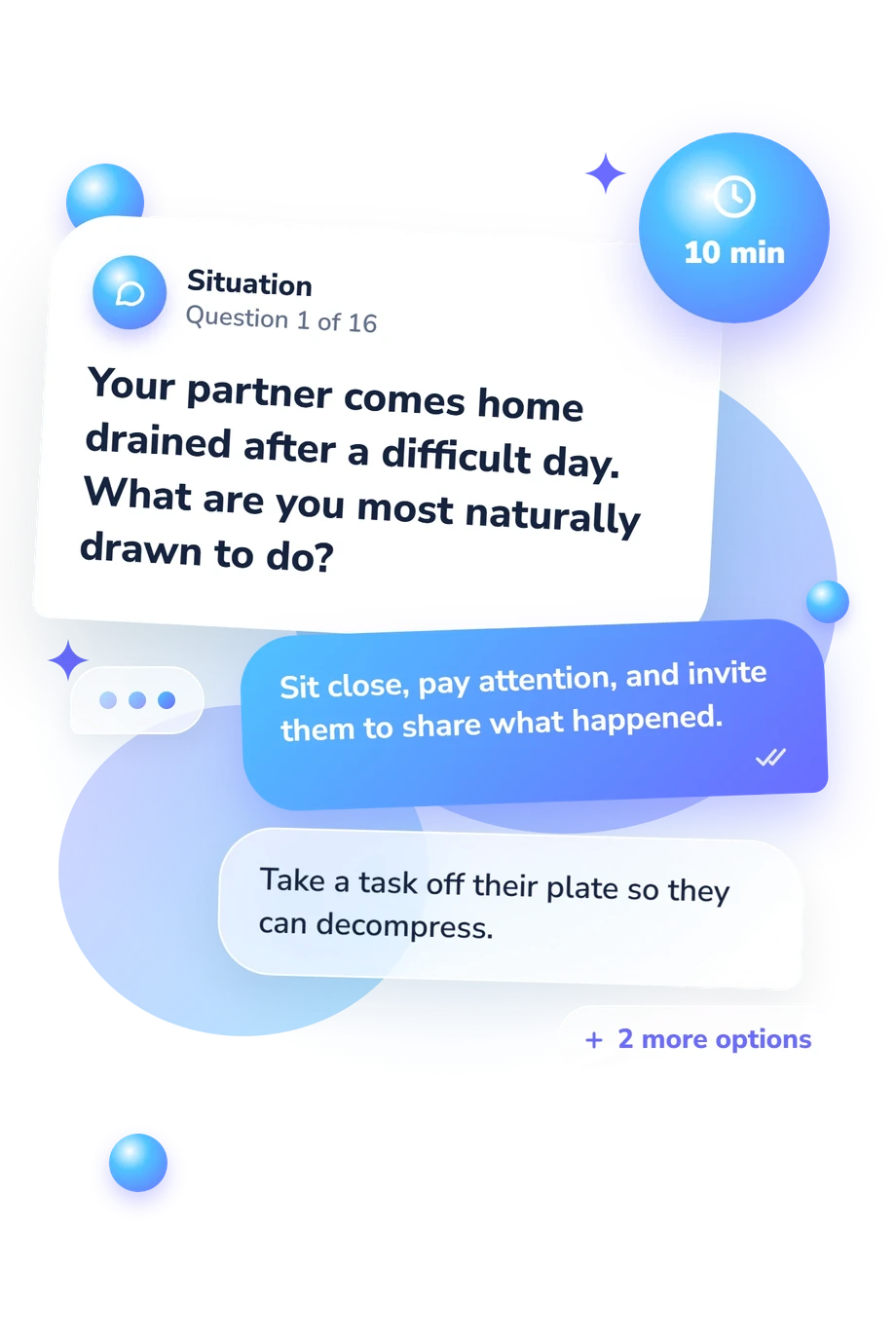
- Sit close, pay attention, and invite them to share what happened.
- Take a task off their plate so they can decompress.
- Offer a light distraction and let them decide whether to talk.
- Give them uninterrupted space until they rejoin the evening.
- Say clearly and often what the person means to me.
- Use warm messages, touch, or small expressive gestures.
- Share a private joke or understated signal they will understand.
- Let my reliability and practical actions communicate it.
- I actively seek it because discovery helps me feel connected.
- I enjoy it regularly, especially when we choose together.
- I like occasional changes within an otherwise familiar pattern.
- I connect more through revisiting experiences we already value.
What Kind of Lover Am I Quiz - Description and methodology of the test
Readers who want to understand how they tend to express romantic care and create closeness can use this assessment to reflect on relationship habits. It suits people curious about preferences rather than fixed labels, and the What Kind of Lover Am I Quiz presents a pattern of tendencies. Readers curious about their romantic style can use the What Type of Lover Am I Quiz to connect everyday choices with closeness.
What This Assessment Explores
These questions explore intimacy through scenarios involving support, affection, novelty, planning, rituals, and disruption. For readers wondering what kind of lover you are, each situation in this quiz makes a tendency concrete.
The result groups them into four scales:
- Attuned Supporter (0-12) measures noticing emotional or practical needs and responding with care: Independent Care (0-4), Responsive Presence (5-8), Attuned Supporter (9-12).
- Expressive Romantic (0-12) measures openly declaring affection, creating symbolic moments, and giving feelings vivid form: Quiet Expression (0-4), Meaningful Flourishes (5-8), Expressive Romantic (9-12).
- Playful Explorer (0-12) measures spontaneity, experimentation, novelty, and shared discovery: Familiar Enjoyment (0-4), Open Adventurer (5-8), Playful Explorer (9-12).
- Steady Builder (0-12) measures consistency, dependable rituals, advance planning, and continuity: Flexible Foundation (0-4), Selective Stability (5-8), Steady Builder (9-12).
The highest scale is your strongest affinity; scores within one point form a blended result.
Methodology and Scientific Basis
Each prompt in this type of lover quiz presents a situation with four response options. You choose the reaction that feels most natural, rather than the one that seems ideal. The result presents scores across the four dimensions and identifies your strongest affinity; scores within one point are treated as a blended result. The profile can prompt reflection on which romantic style feels most natural when you wonder which type of lover you are.
The Love Attitudes Scale, Lee’s model of loving styles, and relationship-maintenance research by Stafford and Canary provide broad conceptual parallels for these themes. They do not validate the questionnaire’s four online categories or establish its provenance; the questionnaire is not an adaptation of those instruments.
As you ask what type of lover you are, this quiz offers a comparative profile, not a fixed identity. Self-reported answers can vary with self-awareness, honesty, and current circumstances, while the displayed bands are descriptive categories rather than established population norms.
- Hendrick, Clyde, and Susan Hendrick. "A theory and method of love." Journal of Personality and Social Psychology, vol. 50, no. 2, 1986, pp. 392-402. 10.1037/0022-3514.50.2.392
- Davis, Keith E., and Holly Latty-Mann. "Love Styles and Relationship Quality: A Contribution to Validation." Journal of Social and Personal Relationships, vol. 4, no. 4, 1987, pp. 409-428. 10.1177/0265407587044002
- Lee, John Alan. Colours of Love: An Exploration of the Ways of Loving. New Press, Toronto, 1973.
- Stafford, Laura, and Daniel J. Canary. "Maintenance Strategies and Romantic Relationship Type, Gender and Relational Characteristics." Journal of Social and Personal Relationships, vol. 8, no. 2, 1991, pp. 217-242. 10.1177/0265407591082004
Updated: