
Inferior Skull Quiz
How the Scales are Structured
Who Usually Takes This Test?
See How You Compare
Below is a preview of how scores are typically distributed across each scale.
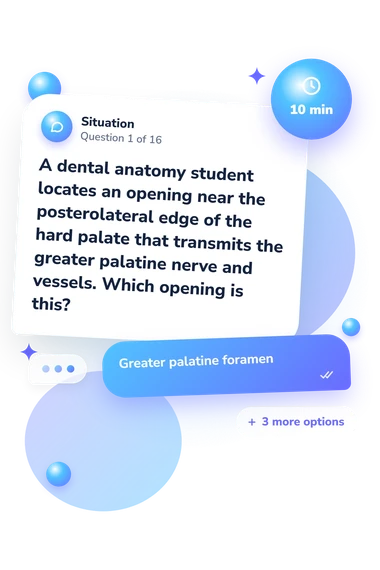
Example Questions From the Test
- Pterygoid hamulus
- Mastoid process
- Styloid process
- Occipital condyle
- Jugular foramen
- Foramen ovale
- Carotid canal
- Stylomastoid foramen
- External acoustic meatus
- Carotid canal
- Stylomastoid foramen
- Jugular foramen
Inferior Skull Quiz - Description and methodology of the test
Students and clinicians revisiting cranial anatomy can use the inferior skull quiz to check how confidently they identify structures on the skull’s inferior surface. The assessment suits focused revision, teaching preparation, and learners who want to connect visible landmarks with the nerves, vessels, canals, bones, and joints associated with them. It shows the most secure level by testing landmark recognition in an inferior view of skull quiz.
What This Assessment Measures
The questions treat the inferior skull as an integrated region. Respondents identify foramina, canals, fossae, processes, plates, and articular surfaces, then link each with a nerve, vessel, bone, attachment, or neighboring landmark. This suits learners strengthening spatial recall and anatomical naming.
Results appear on Inferior Skull Knowledge (0-16): Foundation to build (0-6), Developing knowledge (7-12), or Strong knowledge (13-16). The bands show whether review should start with major landmarks or progress to finer relationships.
The tested knowledge falls into three connected areas:
- Landmarks are identified by shape, position, and orientation.
- Openings and canals are matched with transmitted nerves, arteries, or passages.
- Bones and articulations are understood through borders, attachments, and neighboring surfaces.
Students can use this result to plan an inferior skull anatomy review, focusing first on the structures and relationships that need reinforcement.
Methodology and Evidence Base
Each item presents an anatomical prompt with four answer choices. Some use student, clinical, or research scenarios; others ask about a landmark. The respondent selects the best match among foramina, canals, bones, and articular surfaces. The four-choice format tests recognition and association of inferior-skull structures rather than open-ended labeling.
The displayed result is interpreted through the three catalogue bands. The questionnaire reports an educational total with no stated weighting model, norm group, or population ranking, so it describes performance within this questionnaire.
The content is conceptually consistent with Drake et al. (2020), whose atlas provides a regional reference for inferior skull anatomy questions and associated landmarks. Gray’s student anatomy text by Drake, Vogl, and Mitchell complements this framework, while Tayebi Meybodi et al. (2023) addresses related osseous and meningeal relationships. These works provide anatomical reference points rather than a validation study for this online questionnaire.
Because the quiz relies on selected answers and has no stated norm group or clinical cutoff, the result is an educational snapshot that can vary with memory, wording, and current study context.
- Richard L. Drake, A. Wayne Vogl, Adam W. M. Mitchell, Richard Tibbitts, and Paul Richardson. Gray's Atlas of Anatomy. 3rd ed. Elsevier; 2020. ISBN 978-0-323-63639-1.
- Richard L. Drake, A. Wayne Vogl, and Adam W. M. Mitchell. Gray's Anatomy for Students. 5th ed. Elsevier; 2023. ISBN 978-0-323-93423-7.
- Ali Tayebi Meybodi, Giancarlo Mignucci-Jiménez, Michael T. Lawton, James K. Liu, Mark C. Preul, and Hai Sun. Comprehensive microsurgical anatomy of the middle cranial fossa: Part I-Osseous and meningeal anatomy. Frontiers in Surgery. 2023;10:1132774. DOI 10.3389/fsurg.2023.1132774.