
Lightsaber Form Quiz
How the Scales are Structured
Who Usually Takes This Test?
See How You Compare
Below is a preview of how scores are typically distributed across each scale.
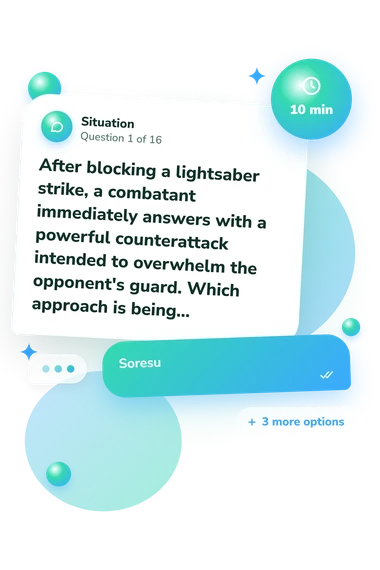
Example Questions From the Test
- Soresu and Ataru
- Shien and Djem So
- Juyo and Vaapad
- Shii-Cho and Niman
- Form III: Soresu
- Form II: Makashi
- Form IV: Ataru
- Form VI: Niman
- Form IV: Ataru
- Form V: Djem So
- Form I: Shii-Cho
- Form VII: Juyo
Lightsaber Form Quiz - Description and methodology of the test
Fans, students of Star Wars lore, and players who want to test their grasp of canonical combat traditions can use this lightsaber form quiz to examine how well they distinguish the seven forms and their variants. Questions combine lore-based recall with scenario reasoning, while the lightsaber style quiz asks readers to connect form names with combat situations. The result indicates overall performance across these tested knowledge areas.
What This Assessment Explores
The assessment examines canonical lightsaber forms rather than general Star Wars trivia. Items connect form names, variants, signature tactics, environments, and notable users, often through short combat situations instead of simple recall. The task is to apply lore to an encounter, distinguishing defensive control, precise dueling, broad fundamentals, and aggressive offense.
Scenario-based choices keep the lightsaber combat forms quiz focused on distinctions among the covered styles. The displayed Lightsaber Form Knowledge scale (0-16) summarizes the result in three bands:
- Foundations to Build (0-6) indicates recognition of some core ideas, with possible confusion between forms or specialties.
- Developing Command (7-12) shows understanding of major distinctions while leaving tactical or historical details to refine.
- Strong Command (13-16) indicates consistent identification of forms and accurate application of their principles.
Methodology and Evidence Base
Each item uses a direct lore prompt or a brief scenario followed by four answer choices. The alternatives distinguish related concepts, such as Shien and Djem So, defensive principles and aggressive tactics. The displayed result is a single knowledge score, so interpretation should begin with its named band rather than an assumed weighting of topics.
Conceptually, the content aligns with Judkins (2016), which examines the seven-form lightsaber framework as a fictional martial-arts system. Wallace (2011), Windham (2007), and Reynolds, Luceno, and Windham (2006) provide published Star Wars lore references for names, variants, associations, and lore details. This questionnaire is not an adaptation of Judkins’ study or a standardized psychological instrument; it is a themed knowledge assessment.
Answers can vary with prior exposure, memory, and attention to scenario wording. The score describes performance on this item set, not overall expertise or physical combat ability. As a lightsaber form assessment, it indicates overall command of the covered lore and may motivate broader review of the forms discussed.
- Judkins, Benjamin N. "The seven forms of lightsaber combat: hyper-reality and the invention of the martial arts." Martial Arts Studies, no. 2, 2016, pp. 6-22. 10.18573/j.2016.10067.
- Wallace, Daniel. Star Wars: The Jedi Path: A Manual for Students of the Force. Chronicle Books, 2011.
- Windham, Ryder. Jedi vs. Sith: Star Wars: The Essential Guide to the Force. Random House, 2007.
- Reynolds, David West, James Luceno, and Ryder Windham. Star Wars: The Complete Visual Dictionary. DK Publishing, 2006.