
Liver Quiz
How the Scales are Structured
Who Usually Takes This Test?
See How You Compare
Below is a preview of how scores are typically distributed across each scale.
Example Questions From the Test
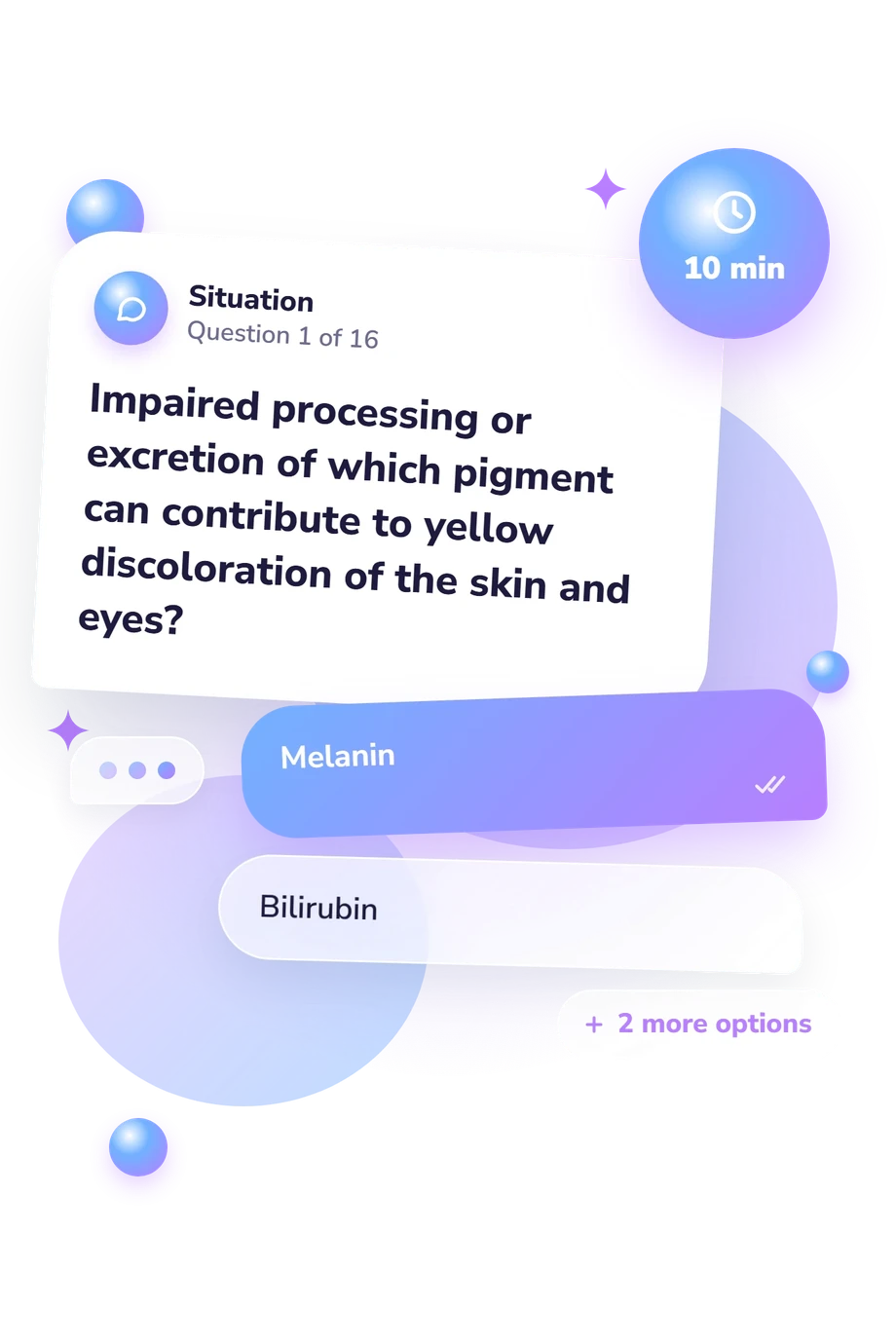
- Melanin
- Bilirubin
- Myoglobin
- Hemoglobin
- Bile canaliculi
- Lymphatic ducts
- Hepatic sinusoids
- Central veins
- The common hepatic duct
- The hepatic portal vein
- The hepatic artery proper
- The hepatic vein
Liver Quiz - Description and methodology of the test
For students, curious readers, and anyone preparing to discuss liver health, this liver quiz offers a focused way to check foundational knowledge rather than symptoms or laboratory results. It is useful when you want to review liver anatomy, connect structures with functions, and see which concepts deserve more study. The result describes your educational profile and points to topics for further learning.
What This Assessment Explores
The questions connect the liver’s location and landmarks with its vessels, ducts, lobules, sinusoidal spaces, resident cells, and major functions. Rather than asking about symptoms, they test whether you can recognize structures and explain the basic process each supports.
This focus suits learners reviewing liver physiology or building a foundation for anatomy and histology. The result shows how securely you understand relationships among blood supply, bile flow, glucose handling, digestion, and microscopic organization.
The result is reported on one educational scale, with these levels:
- Liver Knowledge (0-16): Foundations to build (0-6) signals partial recognition and a need to review core structures.
- Developing knowledge (7-12) shows that many structures and functions are understood, with some applied distinctions to strengthen.
- Strong knowledge (13-16) reflects an integrated grasp of its anatomy and function.
Methodology and Scientific Basis
Each item presents a short anatomy or physiology scenario and four answer choices, with one best response expected. The format uses recognition and applied recall: you identify a vessel, cell, duct, region, or process and select the option that completes the relationship. The questionnaire reports a knowledge level without a published item-weighting scheme, diagnostic cutoff, or population norm.
Its content is conceptually consistent with Kanel (2016), whose work describes gross anatomy, microscopic organization, blood channels, and principal liver cell types. Moore, Mescher, and Hall add complementary anatomical, histological, and physiological grounding for the portal triad, hepatic sinusoids, lobules, bile pathways, and metabolic regulation. This connection explains the educational framework; it does not make the online questionnaire a reproduction or validated adaptation of those books.
The coverage makes it useful as a liver function test quiz for reviewing glucose regulation, bile production, circulation, and related physiology. As with other online self-assessments, performance can be affected by guessing, attention, prior study, and current concentration. The score cannot diagnose liver disease; symptoms or health concerns require separate clinical evaluation.
- Kanel GC. Liver: Anatomy, Microscopic Structure, and Cell Types. In: Podolsky DK, Camilleri M, Fitz JG, Kalloo AN, Shanahan F, Wang TC, editors. Yamada's Atlas of Gastroenterology. 5th ed. Wiley-Blackwell; 2016:50-57. 10.1002/9781118512104.ch8
- Dalley AF II, Moore KL, Agur AMR. Moore's Clinically Oriented Anatomy. 9th ed. Wolters Kluwer; 2023.
- Mescher AL. Junqueira's Basic Histology: Text and Atlas. 16th ed. McGraw Hill; 2021.
- Hall JE, Hall ME. Guyton and Hall Textbook of Medical Physiology. 15th ed. Elsevier; 2025.
Updated: