
British Quiz Shows
How the Scales are Structured
Who Usually Takes This Test?
See How You Compare
Below is a preview of how scores are typically distributed across each scale.
Example Questions From the Test
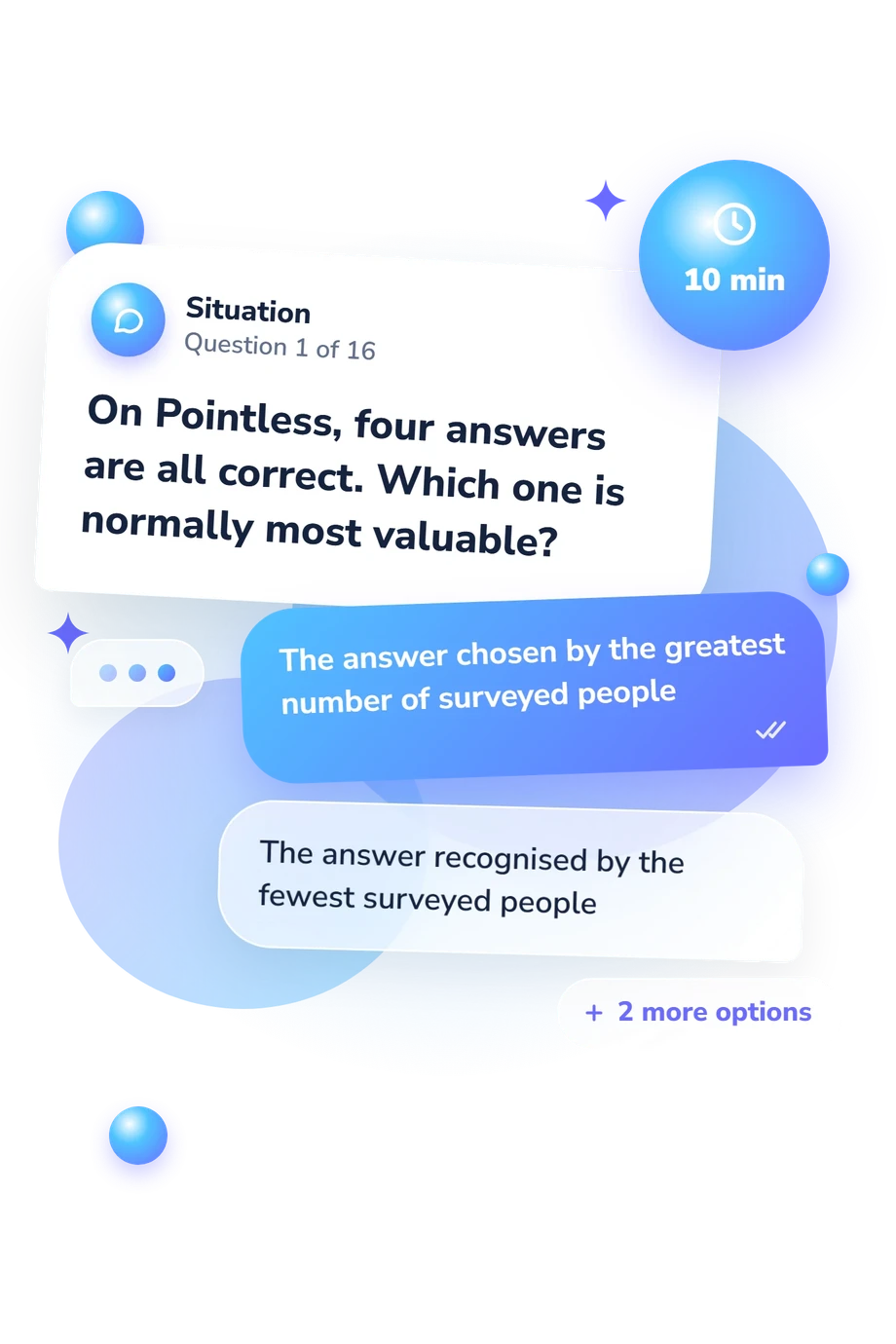
- The answer chosen by the greatest number of surveyed people
- The answer recognised by the fewest surveyed people
- The answer given fastest by the contestant
- The answer with the greatest number of letters
- Tipping Point
- Pointless
- The Chase
- Blockbusters
- The contestant must leave the game immediately
- The entire round is restarted with a new question
- The answer is accepted if the studio audience agrees
- A klaxon may sound and points may be deducted
British Quiz Shows - Description and methodology of the test
Designed for viewers who enjoy identifying formats rather than merely recalling host names, the British Quiz Shows test helps you distinguish the rules, rounds, and distinctive mechanics of television competitions. It suits casual fans, regular viewers, and anyone exploring UK quiz shows who wants a clearer picture of their familiarity without turning entertainment knowledge into a formal academic exercise.
What This Assessment Explores
These questions test programme literacy: recognising formats, matching rounds to shows, and identifying rules or lifelines. They suit viewers who follow UK TV quiz shows, from casual fans to dedicated competitors.
Three item themes are:
- Format recognition shows whether you connect programmes with specialist subjects, survey answers, or board-based chases.
- Rule knowledge indicates whether you understand answer removal, lives, deductions, and voting.
- Signature-round recognition reveals whether Connecting Wall or Answer Smash identifies a programme.
The test's Knowledge scale spans 0-16 correct answers: Getting Started (0-6) means you recognise some British quiz-show ideas but may mix up their rules and signature rounds; Well Tuned In (7-12) means you have solid knowledge across several formats, with some room to revisit less familiar programmes; Quiz-Show Expert (13-16) means you can accurately distinguish a wide range of shows, rules, and recurring features.
Methodology and Evidence Base
Each item presents one programme-related question with four answer choices. The displayed result is a 0-16 total reported in correct answers, so it describes performance on this set rather than an inferred personality trait.
Holmes (2008) provides a conceptual reference for understanding the quiz show as a format organised around questions, rules, performance, and audience knowledge. Holmes's 2007 study adds context for how quiz knowledge circulates in British television, while Osman and Connor provide a reference for games and recurring features associated with House of Games. This online content-based knowledge quiz is not a standardized or psychometrically validated instrument; these sources offer context, not evidence of validation.
Results are best read as a snapshot of familiarity. Exposure to particular broadcasters, eras, hosts, and programme schedules can affect performance, while guessing can raise or lower the total. If your interest is comparing the best of Britain's quiz shows, treat the result as a broad familiarity signal, not a ranking or programme-specific recommendation.
- Holmes, Su. The Quiz Show. Edinburgh University Press, 2008. 10.3366/edinburgh/9780748627523.001.0001; ISBN 9780748627523.
- Osman, Richard, and Alan Connor. Richard Osman's House of Games: 101 New and Classic Games from the Hit BBC Series. BBC Books, 2019. ISBN 9781785944635.
- Holmes, Su. “The Question Is - Is It All Worth Knowing?” The Cultural Circulation of the Early British Quiz Show. Media, Culture & Society, 2007, 29(1), 53-74. 10.1177/0163443706071999.
Updated: