
Mothers in the Bible Quiz
How the Scales are Structured
Who Usually Takes This Test?
See How You Compare
Below is a preview of how scores are typically distributed across each scale.
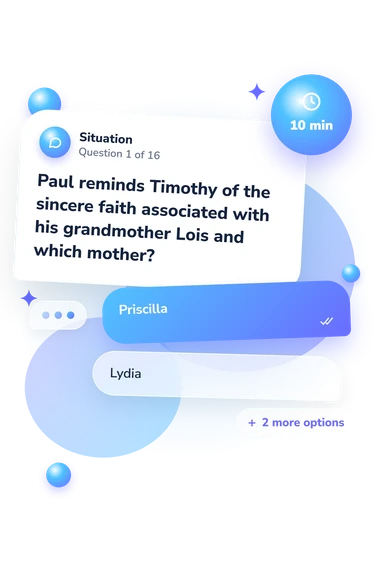
Example Questions From the Test
- Priscilla
- Lydia
- Eunice
- Dorcas
- Abishag
- Maacah
- Bathsheba
- Abigail
- Naomi is Ruth's aunt
- Naomi is Ruth's older sister
- Naomi is Ruth's adoptive mother
- Naomi is Ruth's mother-in-law
Mothers in the Bible Quiz - Description and methodology of the test
Readers who want to place biblical women in their family and narrative contexts can use the mothers in the bible quiz to review key figures, relationships, and turning points. It suits personal study, church learning, and a mothers day bible quiz activity focused on familiar passages. The result highlights areas of knowledge and stories that may deserve another reading.
What This Assessment Explores
The questions test recognition of mothers, children, relationships, statements, and actions in biblical episodes. They ask readers to distinguish family roles, identify speakers or actions, and connect children with mothers or stories. The material suits a mothers of the bible quiz because it emphasizes narrative context rather than belief.
The main themes are:
- Family relationships show whether the result distinguishes mothers, daughters-in-law, servants, and descendants.
- Maternal choices show how protection, dedication, persistence, and care shape events.
- Birth and lineage questions connect children with promises, deaths, and succession.
- New Testament scenes link mothers with Jesus, John the Baptist, and early Christian narratives.
This helps learners who remember familiar names but want to place them in the right passages and relationships. A result indicates stories and connections that may benefit from review; it does not rank spiritual commitment.
Methodology and Evidence Base
Each item offers a scriptural prompt with four choices about identification, relationships, motives, quotations, or consequences. This is structured content recall, not a personality inventory. Results use Mothers in the Bible Knowledge (0-16), with three bands: Foundations to build (0-6), Developing knowledge (7-12), and Strong knowledge (13-16). It summarizes knowledge of biblical mothers, relationships, and roles in scriptural events, not faith or spiritual standing.
Roncace and Whitehead (2009) offer the closest conceptual reference for social and relational roles of motherhood. The questionnaire is consistent with that discussion, not an adaptation of their chapter. Duke-Barton (2008) adds Hebrew Bible context, Myers (2017) adds New Testament context, and the NRSV Updated Edition (2021) supports passage identification.
The format can support a lesson, study group, or independent review. In a mothers day bible quiz activity, each item keeps attention on a named episode. Short sessions make it easy to revisit. The content can also function as a printable mothers of the bible quiz for guided review. Without reported standardization or established norms, results may vary with prior exposure, memory, translation familiarity, and attention.
- Mark Roncace and Deborah Whitehead. "Reading the Religious Romance: Sexuality, Spirituality, and Motherhood in the Bible and Today." In Mother Goose, Mother Jones, Mommie Dearest: Biblical Mothers and Their Children, edited by Cheryl A. Kirk-Duggan and Tina Pippin, 113-128. Semeia Studies 61. Atlanta: Society of Biblical Literature, 2009. ISBN 978-1-58983-441-5.
- Rebecca E. Duke-Barton. The Social Construction of Motherhood in the Hebrew Bible. M.A. thesis, Emory University, 2008.
- Alicia D. Myers. Blessed Among Women? Mothers and Motherhood in the New Testament. New York: Oxford University Press, 2017. 10.1093/oso/9780190677084.001.0001
- National Council of the Churches of Christ in the United States of America. New Revised Standard Version Updated Edition. 2021.