
Glow Up Quiz
How the Scales are Structured
Who Usually Takes This Test?
See How You Compare
Below is a preview of how scores are typically distributed across each scale.
Example Questions From the Test
- On the wrist under colorful indoor lighting
- On the darkest area of the face in a dim room
- On the palm after applying setting powder
- Along the jawline, checking the shades in natural-looking light
- It provides protection against both UVA and UVB radiation
- It is suitable for every skin type without irritation
- It remains effective all day without reapplication
- It primarily protects against visible and blue light
- Sunscreen, cleanser, moisturizer
- Cleanser, moisturizer, sunscreen
- Moisturizer, sunscreen, cleanser
- Cleanser, sunscreen, moisturizer
Glow Up Quiz - Description and methodology of the test
Readers who want a practical check of everyday beauty and self-care knowledge can use the glow up quiz to examine choices without turning appearance into a score. It suits people refining a routine, learning safer habits, or separating useful guidance from popular myths. Instead of asking whether you have had a glow-up, the result frames the topic as knowledge, not a verdict on looks.
What This Assessment Explores
The questionnaire examines practical knowledge across everyday skincare, haircare, makeup, hygiene, styling, and sustainable self-care. Its situations ask the respondent to recognize safer choices, avoid common myths, and select habits that are realistic rather than extreme. The focus is applied understanding, not attractiveness, trend status, or personal worth.
Questions about when you will glow up point toward prediction, but this result describes what you know now and which routines may need clearer guidance.
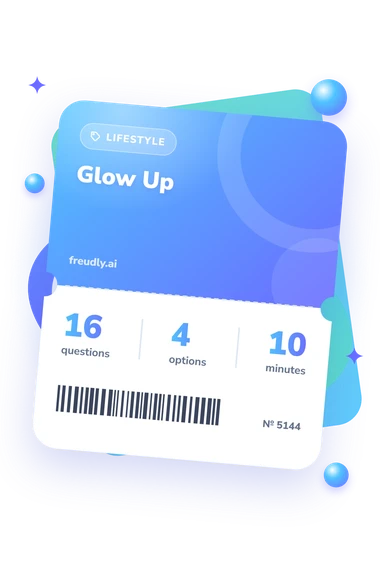
The result is organized as one educational scale:
- Glow Up Knowledge (0-16) shows whether your answers reflect safe, sustainable beauty and self-care principles. Foundations to Build (0-6) indicates foundational gaps; Developing Know-How (7-12) reflects useful essentials with room to refine; Well-Rounded Knowledge (13-16) indicates a strong practical grasp.
This profile can help you choose what to learn next, from product safety and routine order to heat protection, hygiene, and comfortable styling.
Methodology and Evidence Base
Each item presents an everyday situation with four answer choices. The alternatives distinguish safer, evidence-aligned actions from shortcuts, myths, or appearance-driven assumptions. The displayed result summarizes selected answers as educational knowledge; it is not a standardized clinical score with published weighting or cutoffs.
The question of when you will get your glow-up concerns timing, not scoring; the result instead clarifies which decisions you understand and what to learn next.
Llanos et al. (2023) is the closest comparison because it examines personal-care product use and perceptions. That subject is conceptually consistent with this questionnaire’s focus on routines and beliefs, but this test is not an adaptation of the study. Agarwal et al. (2018) adds context for sunscreen knowledge, while Lee et al. (2011) supports limiting avoidable heat-related hair damage.
Similarly, asking when you will have your glow-up seeks a forecast, while the result cannot predict future appearance change. These studies provide conceptual context, not validation, population norms, or a scoring manual. Current habits, memory, confidence, and self-report bias may affect answers, so the result is a snapshot of selected knowledge rather than a diagnosis or forecast.
- Llanos AAM, Rockson A, Getz K, Greenberg P, Portillo E, McDonald JA, Teteh DK, Villasenor J, Lozada C, Franklin J, More V, Rivera-Nunez Z, Kinkade CW, Barrett ES. Assessment of personal care product use and perceptions of use in a sample of US adults affiliated with a university in the Northeast. Environmental Research. 2023;236(Pt 1):116719. 10.1016/j.envres.2023.116719
- Agarwal SB, Godse K, Patil S, Nadkarni N. Knowledge and Attitude of General Population toward Effects of Sun Exposure and Use of Sunscreens. Indian Journal of Dermatology. 2018;63(4):285-291. 10.4103/ijd.IJD_609_17
- Lee Y, Kim YD, Hyun HJ, Pi LQ, Jin X, Lee WS. Hair shaft damage from heat and drying time of hair dryer. Annals of Dermatology. 2011;23(4):455-462. 10.5021/ad.2011.23.4.455