
Executive Dysfunction Test
How the Scales are Structured
Who Usually Takes This Test?
See How You Compare
Below is a preview of how scores are typically distributed across each scale.
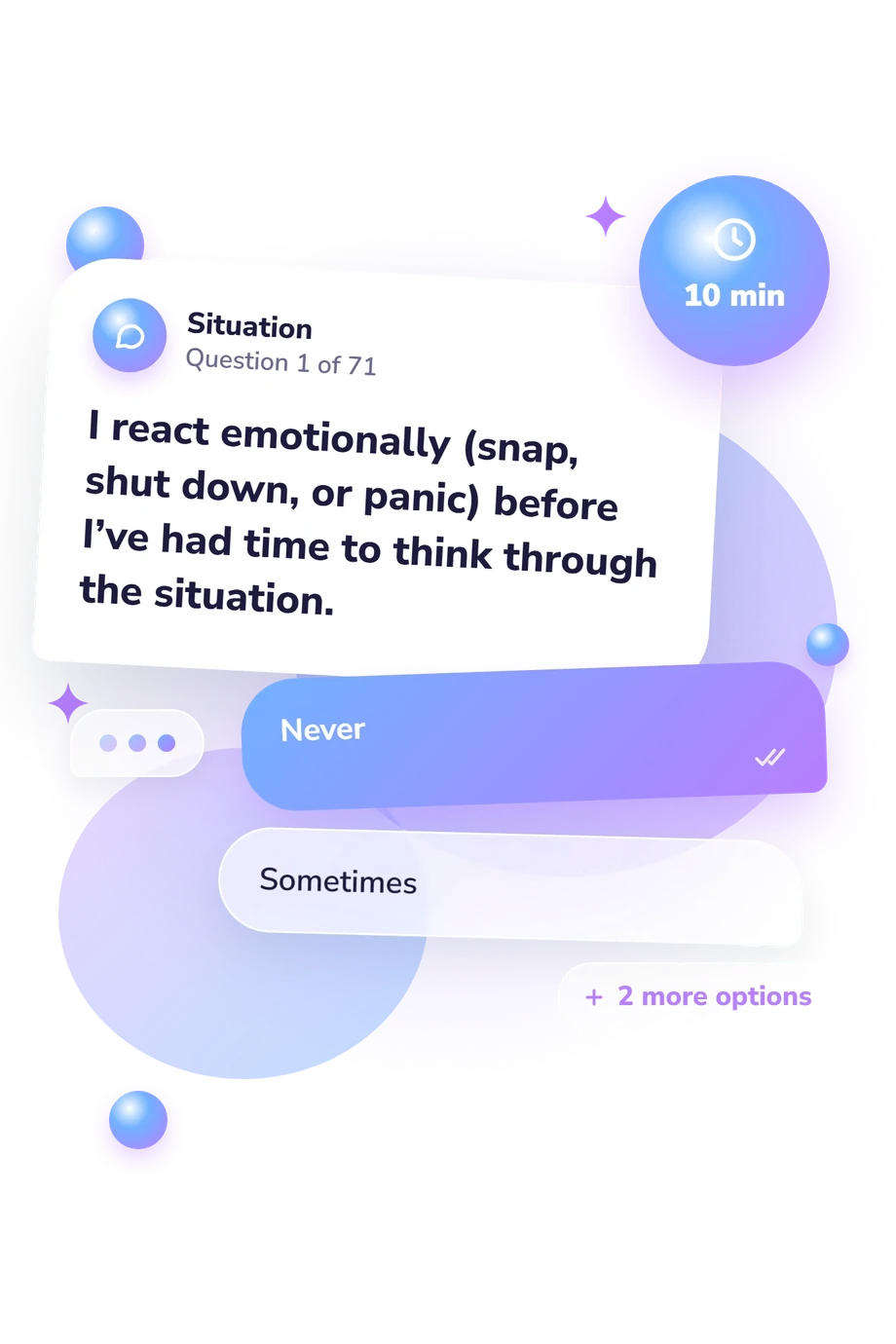
Example Questions From the Test
- Never
- Sometimes
- Often
- Very often
- Never
- Sometimes
- Often
- Very often
- Never
- Sometimes
- Often
- Almost always
Executive Dysfunction Test - Description and methodology of the test
People who lose track of information, misjudge time, react before thinking, or leave tasks unfinished may use this executive dysfunction test to organize those experiences into clearer patterns. It is designed for people seeking self-reflection about everyday demands and task organization. This executive functioning test can offer a focused starting point for noticing difficulties and considering practical changes or questions to discuss with a professional.
What This Assessment Explores
The questionnaire looks at executive functioning in ordinary activities. Its items cover attention drifting, forgetting information or intended actions, missed details, emotional reactions, clutter, time estimation, procrastination, restarting, and unfinished work.
The results group these experiences into three areas:
- Attention, Working Memory & Emotional Regulation (0-40) measures attention lapses, losing track of information, and regulation difficulties; Low 0-13, Moderate 14-26, and High 27-40 show increasing frequency and interference.
- Planning, Organization & Time Management (0-40) measures prioritizing, organizing, estimating time, and meeting deadlines; Low difficulty 0-13, Moderate difficulty 14-26, and High difficulty 27-40 show increasing difficulty.
- Task Initiation & Follow-Through (0-40) measures starting, sustaining, restarting, and finishing tasks; Low difficulty 0-13, Moderate difficulty 14-26, and High difficulty 27-40 show increasing difficulty.
This executive dysfunction questionnaire shows the reported difficulty level for each scale without ranking them.
Methodology and Scientific Basis
In the sample, questions use four-point frequency choices, from Never to Very often or Almost always; others use agreement choices from Strongly disagree to Agree, with Not sure included. Responses should reflect the usual pattern rather than one exceptional day.
Results are displayed across the three scales, with higher scores reflecting more frequent or interfering difficulties within the relevant definition. Because point assignments and any reverse-scoring procedure are not documented, a range alone cannot show how much an individual answer contributes.
The structure is conceptually consistent with BRIEF-A (Roth et al., 2005), and Roth et al. (2013) examined that instrument’s factor structure. It is not presented as an adaptation of BRIEF-A or BDEFS (Barkley, 2011); those published works are comparison frameworks, not evidence that this self-check inherits their norms or validation.
As an online executive dysfunction self-check, it can highlight patterns worth examining, but it has no stated standardization, reliability estimates, or clinical cutoffs of its own. Current stress, memory, self-awareness, and response style can influence self-report, so results describe reported tendencies and do not establish a diagnosis.
- Roth, Robert M., Charles E. Lance, Peter K. Isquith, Adina S. Fischer, and Peter R. Giancola. (2013). Confirmatory Factor Analysis of the Behavior Rating Inventory of Executive Function-Adult Version in Healthy Adults and Application to Attention-Deficit/Hyperactivity Disorder. Archives of Clinical Neuropsychology, 28(5), 425-434. DOI 10.1093/arclin/act031.
- Roth, Robert M., Peter K. Isquith, and Gerard A. Gioia. (2005). BRIEF-A: Behavior Rating Inventory of Executive Function-Adult Version: Professional Manual. Lutz, FL: Psychological Assessment Resources.
- Barkley, Russell A. (2011). Barkley Deficits in Executive Functioning Scale (BDEFS). New York, NY: Guilford Press.
Updated: