
Electromagnetic Spectrum Quiz
How the Scales are Structured
Who Usually Takes This Test?
See How You Compare
Below is a preview of how scores are typically distributed across each scale.
Example Questions From the Test
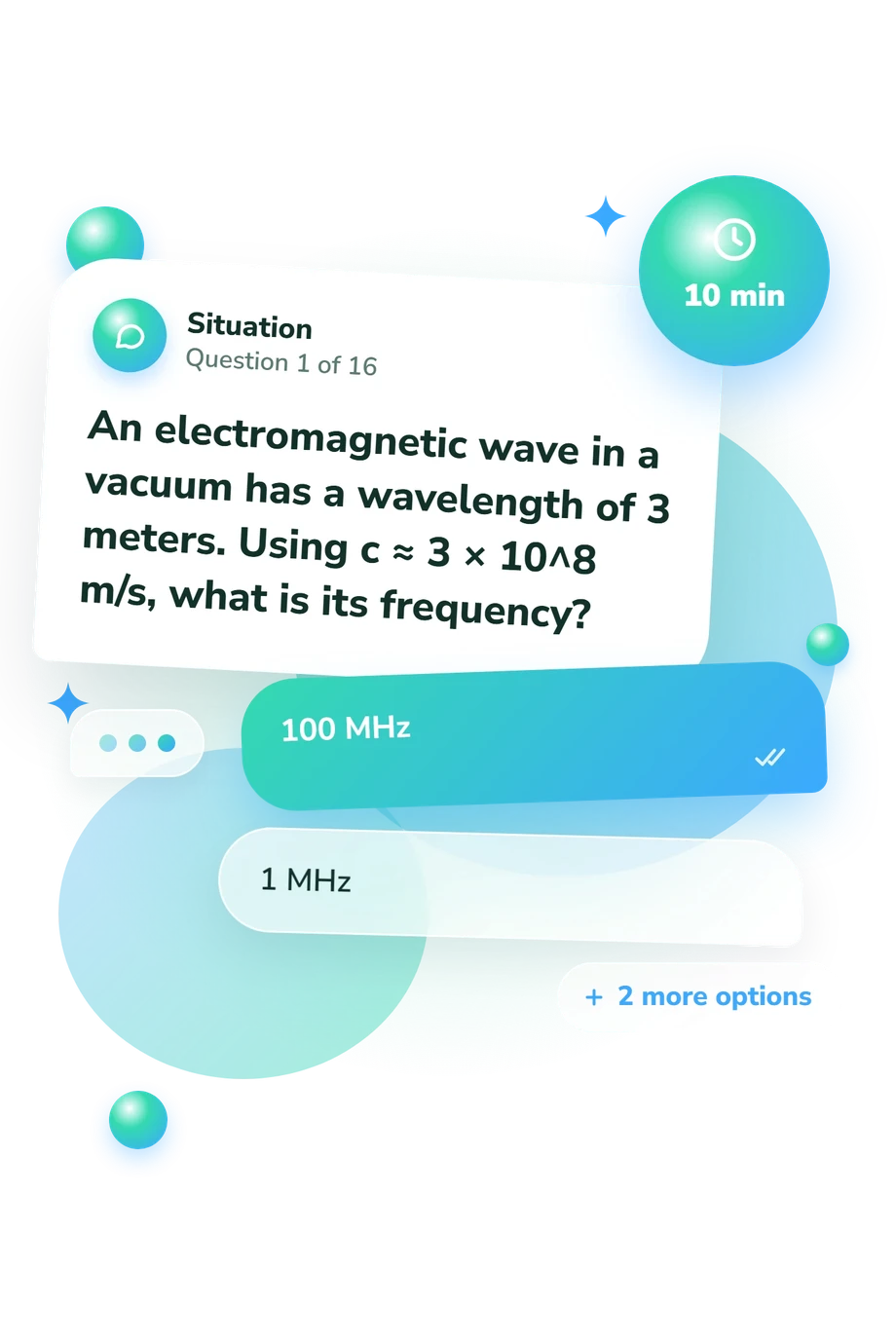
- 100 MHz
- 1 MHz
- 300 MHz
- 900 MHz
- They travel at the same speed
- The radio wave travels faster because it has a longer wavelength
- Their speeds depend on their frequencies even in a vacuum
- The gamma ray travels faster because it has more energy
- Microwaves
- Visible light
- Infrared
- Ultraviolet
Electromagnetic Spectrum Quiz - Description and methodology of the test
Readers who want to check their grasp of basic physics can use the electromagnetic spectrum quiz as a focused learning review rather than a broad science exam. The quiz questions cover the electromagnetic spectrum, moving from core definitions to calculations, comparisons, and practical applications. It suits students revisiting classroom material, educators seeking a discussion starter, and curious adults connecting formulas with familiar technologies.
What This Assessment Explores
This assessment checks whether you can organize the spectrum and apply links among wavelength, frequency, and photon energy. It also examines wave behavior, interactions with matter, and uses including thermal imaging, remote controls, communications, X-ray scanning, sunscreen, and ozone protection.
The questions cover electromagnetic radiation and help learners review its main relationships. The result gives an overall indication of electromagnetic spectrum knowledge rather than separate scores for individual topics.
The question set covers these thematic areas:
- Spectrum order shows whether you can arrange regions from lower to higher frequency.
- Wave relationships show how speed, wavelength, frequency, and energy connect.
- Physical properties test understanding of diffraction, field orientation, ionization, and classification.
- Applications link radiation regions with technologies and safety contexts.
One scale is Electromagnetic Spectrum Knowledge (0-16): Foundations to build (0-6), Developing knowledge (7-12), and Strong command (13-16).
Methodology and Scientific Basis
Each item presents one best answer from four choices. The set combines a frequency calculation with conceptual comparisons, sequence ordering, wave relationships, and applications involving sunlight, imaging, communications, and household devices. This multiple-choice approach checks both recall and transfer by asking you to apply a principle to a concrete situation.
A useful conceptual comparison is Quebedeaux (2007), a study of electromagnetic-spectrum understanding that examines how learners organize regions and relate their properties. Urone and Hinrichs (2020) provide underlying physics relationships, while Shilmurzayev and colleagues (2026) support attention to how learners reason about electromagnetic waves across different contexts.
The questionnaire provides practice with the electromagnetic spectrum, while its result summarizes performance for instructional interpretation. The bands are descriptive levels for performance on this questionnaire. Prior teaching, language, concentration, and current confidence can affect performance, making follow-up study useful for checking whether the understanding is durable.
- Quebedeaux, James Edward. Improving high school physical science students' understanding of the electromagnetic spectrum: a modified diagram approach. PhD diss., Louisiana State University and Agricultural and Mechanical College, 2007. 10.31390/gradschool_dissertations.743
- Shilmurzayev, Nurzhan, Aman Shakirov, Bayan Ualikhanova, and Nuri Balta. A resources-oriented analysis of students’ reasoning about electromagnetic waves across contexts. European Journal of Science and Mathematics Education 14, no. 4 (2026): 547-563. 10.30935/scimath/19090
- Urone, Paul Peter, and Roger Hinrichs. Physics. Houston, TX: OpenStax, 2020. Section 15.1, The Electromagnetic Spectrum.
Updated: