
Eco Quiz
How the Scales are Structured
Who Usually Takes This Test?
See How You Compare
Below is a preview of how scores are typically distributed across each scale.
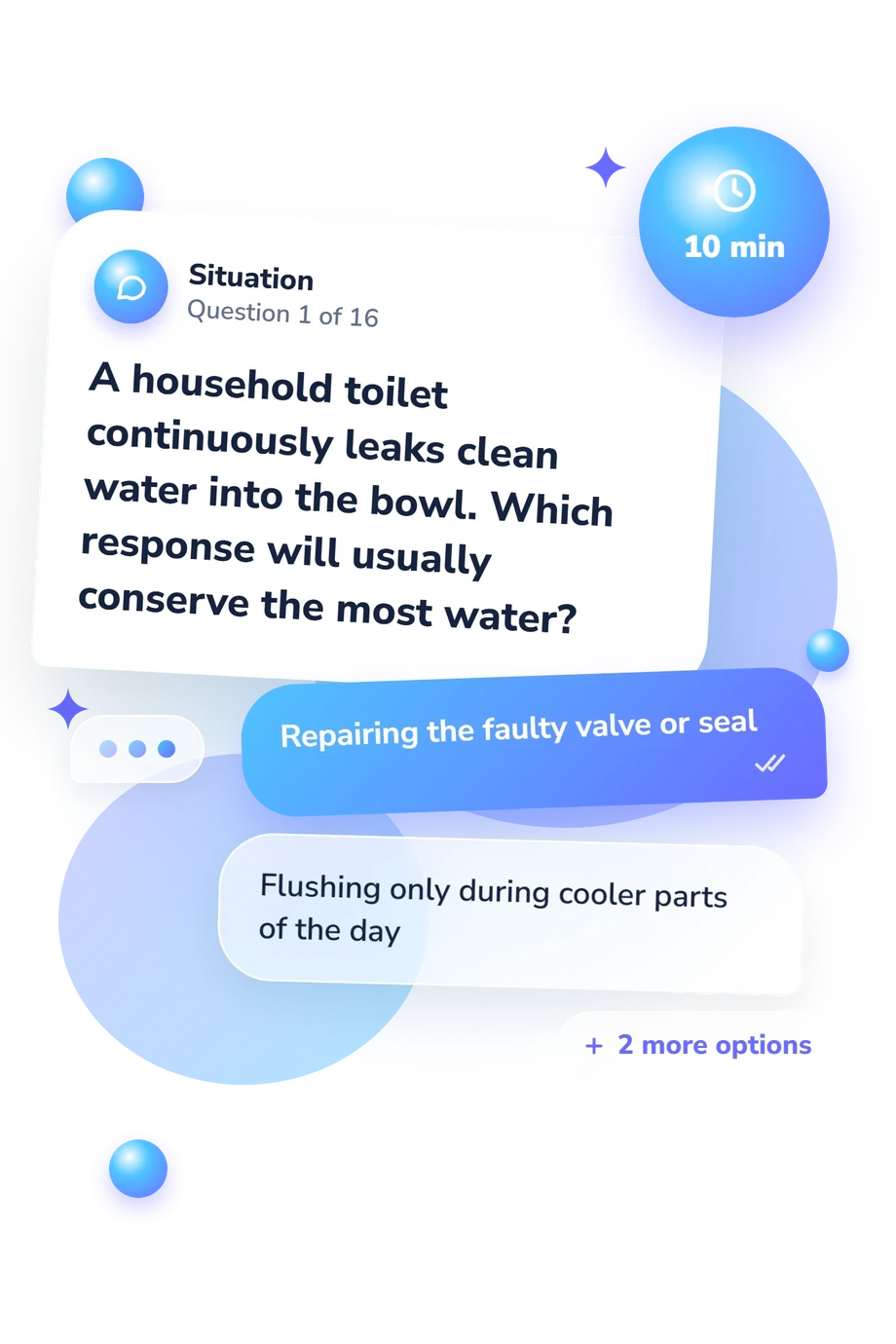
Example Questions From the Test
- Repairing the faulty valve or seal
- Flushing only during cooler parts of the day
- Cleaning the bowl with less detergent
- Opening a bathroom window after each use
- Ozone
- Methane
- Helium
- Hydrogen
- Nutrient pollution in freshwater lakes
- Depletion of the stratospheric ozone layer
- Soil erosion caused by intensive farming
- Plastic accumulation on beaches
Eco Quiz - Description and methodology of the test
For readers who want a focused way to check their environmental understanding, this assessment turns everyday scenarios into a structured learning exercise. The eco quiz questions test how well core principles can be applied, rather than asking for a broad inventory of personal habits or environmental behavior. This Eco Quiz presents four-choice scenarios, making it a quiz on environment with answers for curious learners, students, and anyone reviewing essential concepts.
What This Assessment Explores
Environmental knowledge and application of principles are the focus, not definition recall. Scenarios connect causes with consequences, such as nutrient runoff and algal growth, habitat fragmentation and wildlife movement, or insulation and heat transfer. These quiz questions on environment with answers use four answer choices to check whether concepts can be recognized and applied.
The question themes include:
- Ecosystems and biodiversity show how species relationships, pollination, invasions, and habitat connections shape living systems.
- Pollution and climate link contaminants, greenhouse gases, carbon, weather, and long-term trends with environmental change.
- Energy, resources, and waste cover conservation, renewable electricity, insulation, transport, life-cycle choices, prevention, and recycling.
Eco Knowledge (0-16) reports the overall result: Building Foundations (0-6) indicates that core ideas are emerging; Developing Knowledge (7-12) indicates understanding of many concepts; Strong Eco Knowledge (13-16) indicates a well-rounded grasp of environmental principles and practical implications.
Methodology and Evidence Base
Each item presents a short environmental situation with four answer choices. You select the option that best explains the process or action, so the format tests recognition and application rather than agreement with statements. The environmental quiz questions with answers present four answer choices for each scenario.
The questionnaire displays a range and three bands for the overall result, but does not document how responses are weighted or how the total is calculated. The bands describe performance on these topics, not universal thresholds for environmental competence. Completing this quiz about environment with answers gives an overall performance band, not topic-level feedback or a measure of practical behavior.
The evidence base is conceptually consistent with EKT-19 (Player et al., 2023), a concise environmental knowledge measure, and with Geiger et al. (2014), a diagnostic environmental knowledge scale. Published findings from those instruments provide conceptual and psychometric context, but do not establish standardization, norms, or validation for this online questionnaire. Guessing, attention, education, and familiarity with examples can influence performance; interpret the result as a current learning snapshot.
- Player, Lois; Hanel, Paul H.P.; Whitmarsh, Lorraine; Shah, Punit. The 19-Item Environmental Knowledge Test (EKT-19): A short, psychometrically robust measure of environmental knowledge. Heliyon. 2023;9(8):e17862. 10.1016/j.heliyon.2023.e17862
- Geiger, Sonja M.; Otto, Siegmar; Diaz-Marin, Johann S. A diagnostic Environmental Knowledge Scale for Latin America. PsyEcology: Bilingual Journal of Environmental Psychology. 2014;5(1):1-36. 10.1080/21711976.2014.881664
Updated: