
Do My Parents Love Me Quiz
How the Scales are Structured
Who Usually Takes This Test?
See How You Compare
Below is a preview of how scores are typically distributed across each scale.
Example Questions From the Test
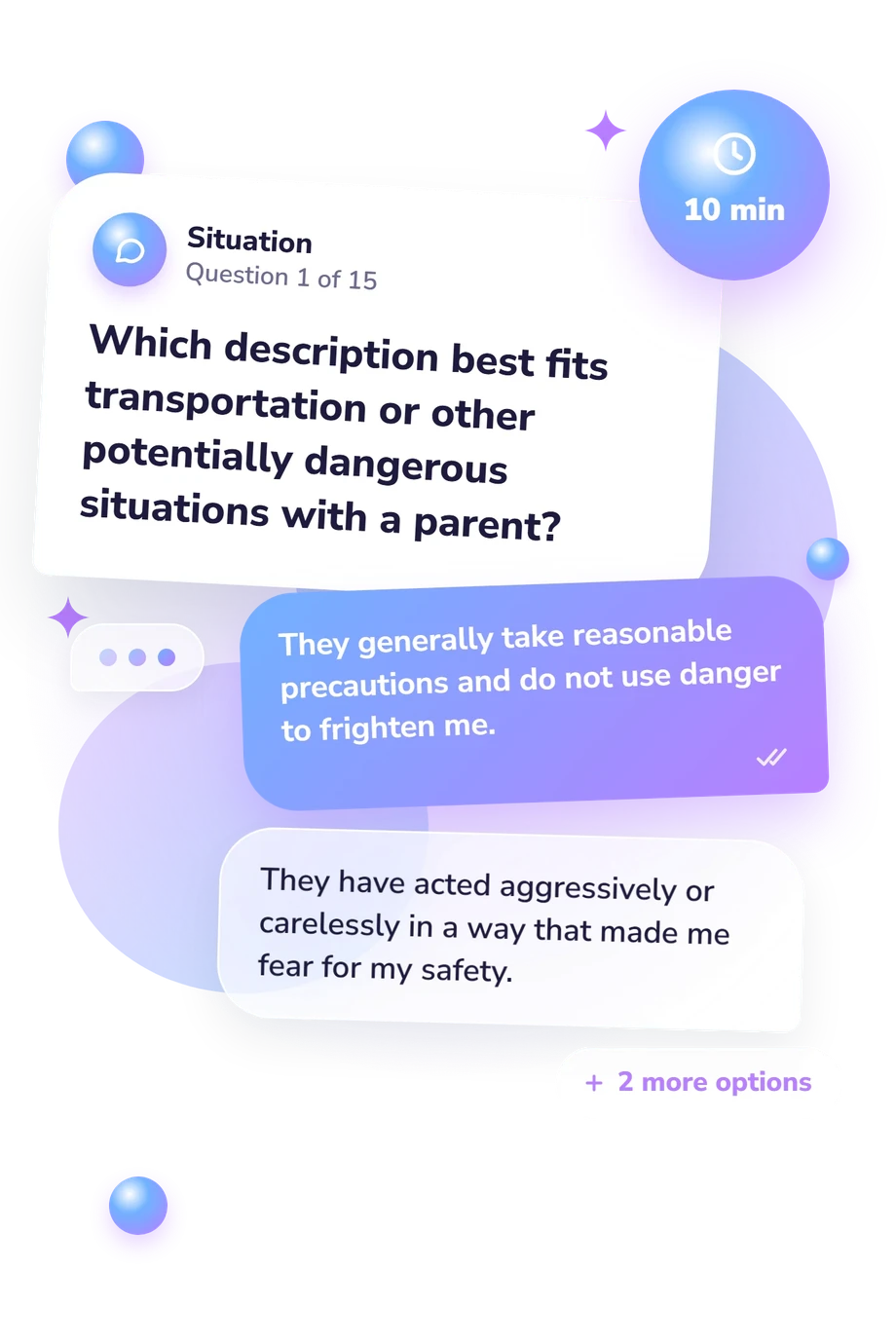
- They generally take reasonable precautions and do not use danger to frighten me.
- They have acted aggressively or carelessly in a way that made me fear for my safety.
- They repeatedly transport or supervise me while seriously impaired or behave recklessly despite my fear.
- They deliberately threaten a crash, abandon me in a dangerous place, or use an immediate hazard to force compliance.
- I can usually step away, possibly after explaining where I am going.
- A parent may follow me, shout, or briefly stand in the way, but I can ultimately leave.
- A parent repeatedly blocks exits, takes away access to communication, or locks me in a space.
- A parent physically restrains or confines me, or prevents me from reaching emergency help.
- They listen or make a reasonable effort to comfort me, even if they need a little time.
- They are sometimes distracted or awkward, but they usually return to the conversation.
- They often dismiss, ridicule, or turn my feelings into a criticism of me.
- They threaten or punish me for seeking comfort or showing distress.
Do My Parents Love Me Quiz - Description and methodology of the test
People who feel uncertain about a parent’s care, control, or respect for boundaries may use the do my parents love me quiz to organize experiences that are difficult to name. It is intended for personal reflection about home life, especially when warmth is mixed with fear, pressure, neglect, or unsafe behavior. As a parental emotional neglect test, it focuses attention on patterns rather than one isolated argument.
What This Assessment Explores
The questions examine care, conflict, discipline, privacy, emotional needs, isolation, family responsibilities, intimidation, physical force, sexualized behavior, unwanted touch, and secrecy. It is intended for anyone trying to understand troubling experiences with a parent or caregiver.
The three result dimensions mean:
- Emotional Care, Control, and Neglect (0-15) covers comfort, criticism, basic needs, isolation, and coercive responsibility; bands are No scored indicator (0), Something to notice (1-2), and Action warranted (3-15).
- Physical Force and Safety (0-15) covers threats, restraint, punishment, violence, and dangerous conduct; bands are No scored indicator (0-0), Something to notice (1-2), and Action warranted (3-15).
- Sexual and Personal Boundaries (0-15) covers privacy violations, sexualized behavior, unwanted contact, exposure, recording, coercion, and secrecy; bands are No scored indicator (0), Something to notice (1-2), and Action warranted (3-15).
Used thoughtfully, a family boundary self-check can reveal patterns without proving intent or safety.
Methodology and Evidence Base
Each item presents a concrete home situation with four ordered choices, from respectful or safe conduct to more concerning behavior. This parent-child safety questionnaire lets respondents select the description that best matches their experience without first applying a label such as abuse or neglect.
The result is a structured self-report summary across three dimensions. A 0-15 range does not show how many points each choice adds, so interpretation should follow the displayed bands rather than an assumed formula. A serious response can matter independently of the total.
Its content is conceptually consistent with ICAST-C (Zolotor et al., 2009), which surveys multiple maltreatment forms from a child’s perspective. It also overlaps with the work of Straus et al. (1998) and MACE (Teicher and Parigger, 2015). This is not a standardized adaptation, validation, or normed administration of those instruments.
Memory, self-awareness, willingness to disclose, and current circumstances can make self-report understate or overstate events. Poverty, disability, crisis, or unavailable care may affect unmet-needs experiences without making them unimportant. The bands are unvalidated reflective summaries, not diagnostic or legal findings; immediate danger calls for urgent help.
- Zolotor, Adam J., Desmond K. Runyan, Michael P. Dunne, Dipty Jain, Helga R. Péturs, Clemencia Ramirez, Elena Volkova, Sibnath Deb, Victoria Lidchi, Tufail Muhammad, and Oksana Isaeva. “ISPCAN Child Abuse Screening Tool Children’s Version (ICAST-C): Instrument Development and Multi-National Pilot Testing.” Child Abuse & Neglect 33, no. 11 (2009): 833-841. 10.1016/j.chiabu.2009.09.004
- Straus, Murray A., Sherry L. Hamby, David Finkelhor, David W. Moore, and Desmond Runyan. “Identification of Child Maltreatment with the Parent-Child Conflict Tactics Scales: Development and Psychometric Data for a National Sample of American Parents.” Child Abuse & Neglect 22, no. 4 (1998): 249-270. 10.1016/S0145-2134(97)00174-9
- Teicher, Martin H., and Angelika Parigger. “The ‘Maltreatment and Abuse Chronology of Exposure’ (MACE) Scale for the Retrospective Assessment of Abuse and Neglect During Development.” PLOS ONE 10, no. 2 (2015): e0117423. 10.1371/journal.pone.0117423
Updated: