
Cyber Security Quiz
How the Scales are Structured
Who Usually Takes This Test?
See How You Compare
Below is a preview of how scores are typically distributed across each scale.
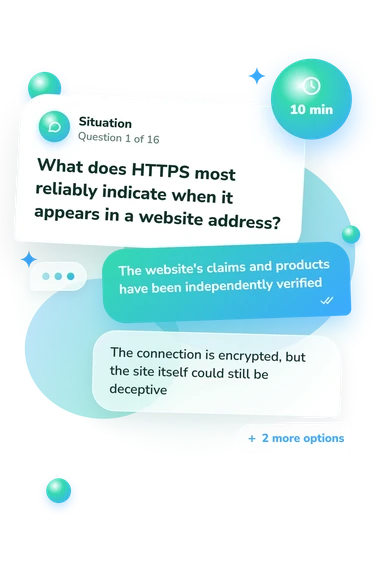
Example Questions From the Test
- Maintain tested, versioned backups, including a copy isolated from the main device
- Keep one backup continuously connected and overwrite it every hour
- Copy important files into another folder on the same drive
- Rely on the device's recycle bin to retain encrypted originals
- Port forwarding
- DNS caching
- Credential stuffing
- Fileless encryption
- Updates make phishing messages impossible to deliver
- Updates guarantee that stored files cannot be stolen
- Updates prevent every third-party app from collecting data
- Updates can fix vulnerabilities that attackers may exploit
Cyber Security Quiz - Description and methodology of the test
People seeking a practical check of everyday digital judgment can use this cyber security quiz to examine how they recognize common threats and choose protective actions. It suits learners, staff members, and anyone responsible for accounts, messages, files, or devices. A cybersecurity quiz can also help teams turn uncertain answers into focused review priorities without treating confidence as proof of safe behavior.
What This Assessment Measures
The questionnaire measures practical cybersecurity knowledge rather than personality or expertise. Its scenarios ask respondents to distinguish threats, assess suspicious requests, and choose protective steps for accounts, email, files, devices, and workplace access. The cybersecurity-quiz questions focus on recognition and action rather than obscure terminology.
The result is Cyber Security Knowledge: 0-16. It summarizes correct answers across common cyberthreats and protective practices, then places performance in three bands:
- Foundations to build (0-6) means threat recognition, account protection, or safe response habits need review.
- Developing knowledge (7-12) means many essentials are understood, although applied distinctions or response steps may still be missed.
- Strong knowledge (13-16) means common threats and appropriate protections are identified consistently.
This educational result describes questionnaire performance, not professional certification or guaranteed security. In workplace settings, this cyber-security quiz for employees can identify topics for training or discussion.
Methodology and Scientific Basis
Each item presents a workplace or everyday digital scenario with four answer choices. The best option identifies the threat or safest action, so scoring reflects knowledge of established practices rather than observed behavior. The cyber-security quiz with answers format supports review after completion, but a correct choice does not prove the same action will be taken under pressure.
The methodology is conceptually consistent with CAIN (Tempestini et al., 2023), which assesses cybersecurity knowledge in relation to ISO/IEC 27032, and with HAIS-Q (Parsons et al., 2014), which examines employee information-security awareness. Later reliability and validity research on CAIN (Di Nocera et al., 2025) adds context for the construct. This questionnaire is not a standardized translation, adaptation, or validated administration of either instrument.
Interpret the result as a snapshot of current knowledge. Terminology, attention, guessing, recent training, and uneven digital experience can affect performance, while real-world decisions may differ during a live incident. The score is most useful for targeting review, practice, and workplace discussion.
- Giorgia Tempestini, Ericka Rovira, Aryn Pyke, and Francesco Di Nocera. "The Cybersecurity Awareness INventory (CAIN): Early Phases of Development of a Tool for Assessing Cybersecurity Knowledge Based on the ISO/IEC 27032." Journal of Cybersecurity and Privacy, 3(1), 61-75, 2023. 10.3390/jcp3010005
- Francesco Di Nocera, Giorgia Tempestini, and Fabio Presaghi. "Reliability and validity of the Cybersecurity Awareness INventory (CAIN)." Behaviour & Information Technology, 44(7), 1417-1428, 2025. 10.1080/0144929X.2024.2355362
- Kathryn Parsons, Agata McCormac, Marcus A. Butavicius, Malcolm Robert Pattinson, and Cate Jerram. "Determining employee awareness using the Human Aspects of Information Security Questionnaire (HAIS-Q)." Computers & Security, 42, 165-176, 2014. 10.1016/j.cose.2013.12.003