
Ancient Greece Quiz
How the Scales are Structured
Who Usually Takes This Test?
See How You Compare
Below is a preview of how scores are typically distributed across each scale.
Example Questions From the Test
- Corinth and Thebes
- Miletus and Syracuse
- Argos and Delphi
- Athens and Sparta
- Alexander the Great
- Pericles
- Leonidas
- Solon
- Artemis
- Aphrodite
- Athena
- Demeter
Ancient Greece Quiz - Description and methodology of the test
For learners who want to place famous names and events in context, the Ancient Greece Quiz offers a focused check of historical understanding rather than simple recall. An ancient Greek quiz can help students, curious readers, and returning learners connect political institutions, geography, religion, warfare, philosophy, and cultural change. The result places overall performance in a descriptive knowledge band and can indicate whether broader review is useful.
What This Assessment Explores
The questionnaire covers political organization, conflict, religion, philosophy, visual culture, colonization, geography, and the Hellenistic world. It suits anyone checking general historical knowledge or choosing topics for revision.
Connections between evidence and context become clearer when you review questions and answers from this quiz on ancient Greece: pottery can illuminate funerary customs, landscapes can explain city-state development, and public procedures can clarify citizenship and exclusion.
The result is reported on the Ancient Greece Knowledge scale (0-16), with three descriptive bands. This broad profile shows how widely you connect historical information, not just whether you recognize isolated names.
- Foundation (0-6) shows familiarity with some features, alongside gaps in key people, institutions, or relationships.
- Developing (7-12) reflects working knowledge across several periods and some interpretation of historical situations.
- Strong Command (13-16) reflects accurate connections among major events, ideas, societies, and evidence.
Methodology and Evidence Base
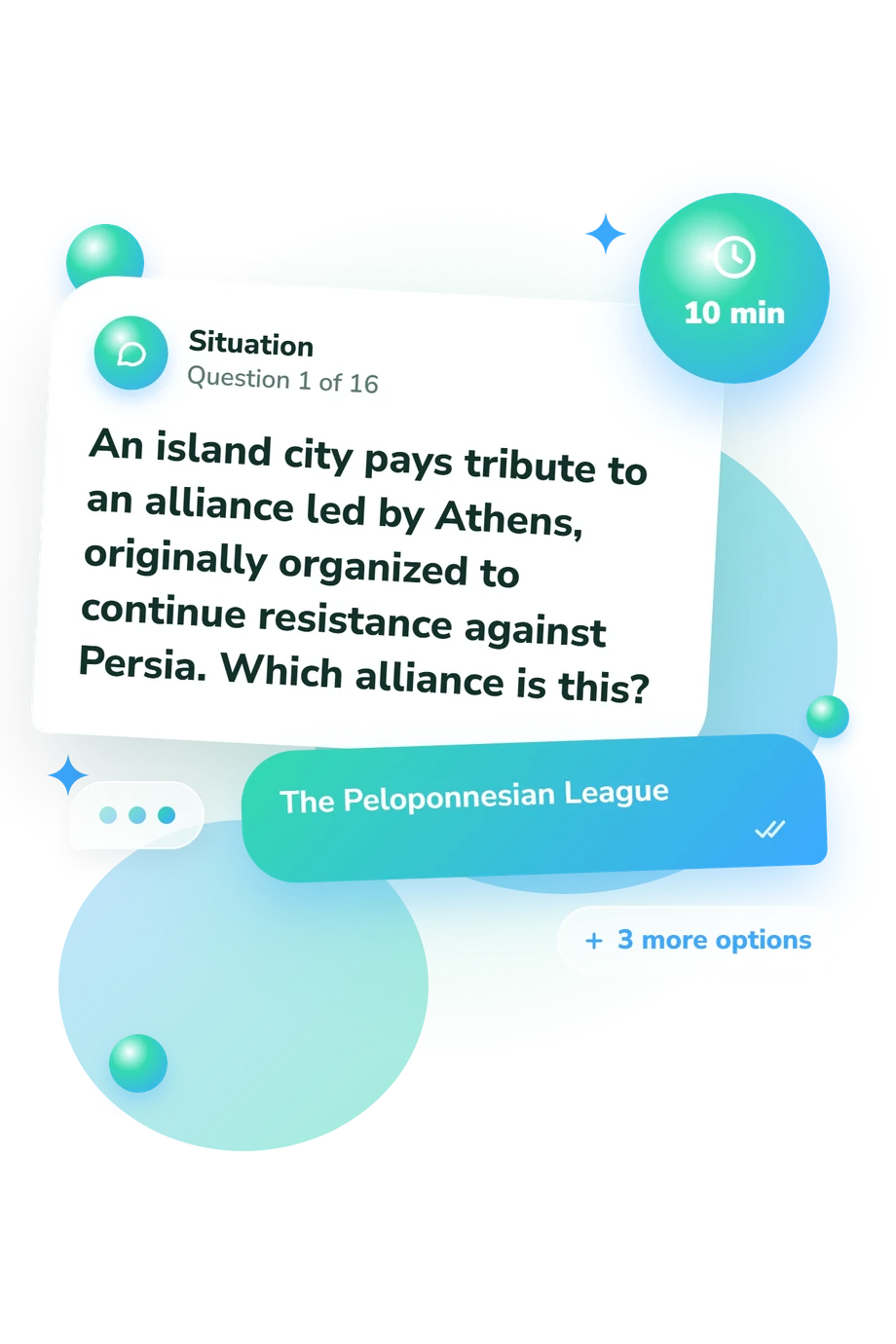
Each item uses a single-best-answer format with four response options. Some prompts present a short historical situation; others ask about a term, person, event, institution, or object. Several ancient Greek quiz questions test recognition and contextual reasoning alongside factual knowledge.
Its method is a content-based knowledge check, not a psychological-trait measure. The scoring is presented as one displayed aggregate result, reflecting questions about historical people, places, institutions, events, and cultural developments. As a quiz about the world of ancient Greece, its themes align conceptually with Pomeroy and colleagues' 2017 historical account and Rhodes's 2007 work on Greek city-state structures and civic life. Herodotus and Thucydides contribute primary historical narratives relevant to Persian conflict, Athenian power, and the Peloponnesian War. The questionnaire is not an adaptation of any one of these works.
Those books and source texts provide historical context, not population norms for this online questionnaire. Prior study, interpretation of wording, and current concentration can influence performance. A strong result indicates command of the tested material, not complete mastery of every period, community, source, or debate in ancient Greek history.
- Pomeroy, Sarah B., Stanley M. Burstein, Walter Donlan, Jennifer Tolbert Roberts, David W. Tandy, and Georgia Tsouvala. Ancient Greece: A Political, Social, and Cultural History. 4th ed. Oxford University Press, 2018. ISBN 9780190686918.
- Rhodes, P. J. The Greek City States: A Source Book. 2nd ed. Cambridge University Press, 2007. 10.1017/CBO9780511818035.
- Herodotus. The Histories. Translated by Robin Waterfield, with an introduction and notes by Carolyn Dewald. Oxford University Press, 1998. ISBN 0191589551.
- Thucydides. The History of the Peloponnesian War. Translated by Rex Warner, with an introduction and notes by M. I. Finley. Penguin Classics, 1954. ISBN 9780140440393.
Updated: