
Am I Flirting Without Realizing It Quiz
How the Scales are Structured
Who Usually Takes This Test?
See How You Compare
Below is a preview of how scores are typically distributed across each scale.
Example Questions From the Test
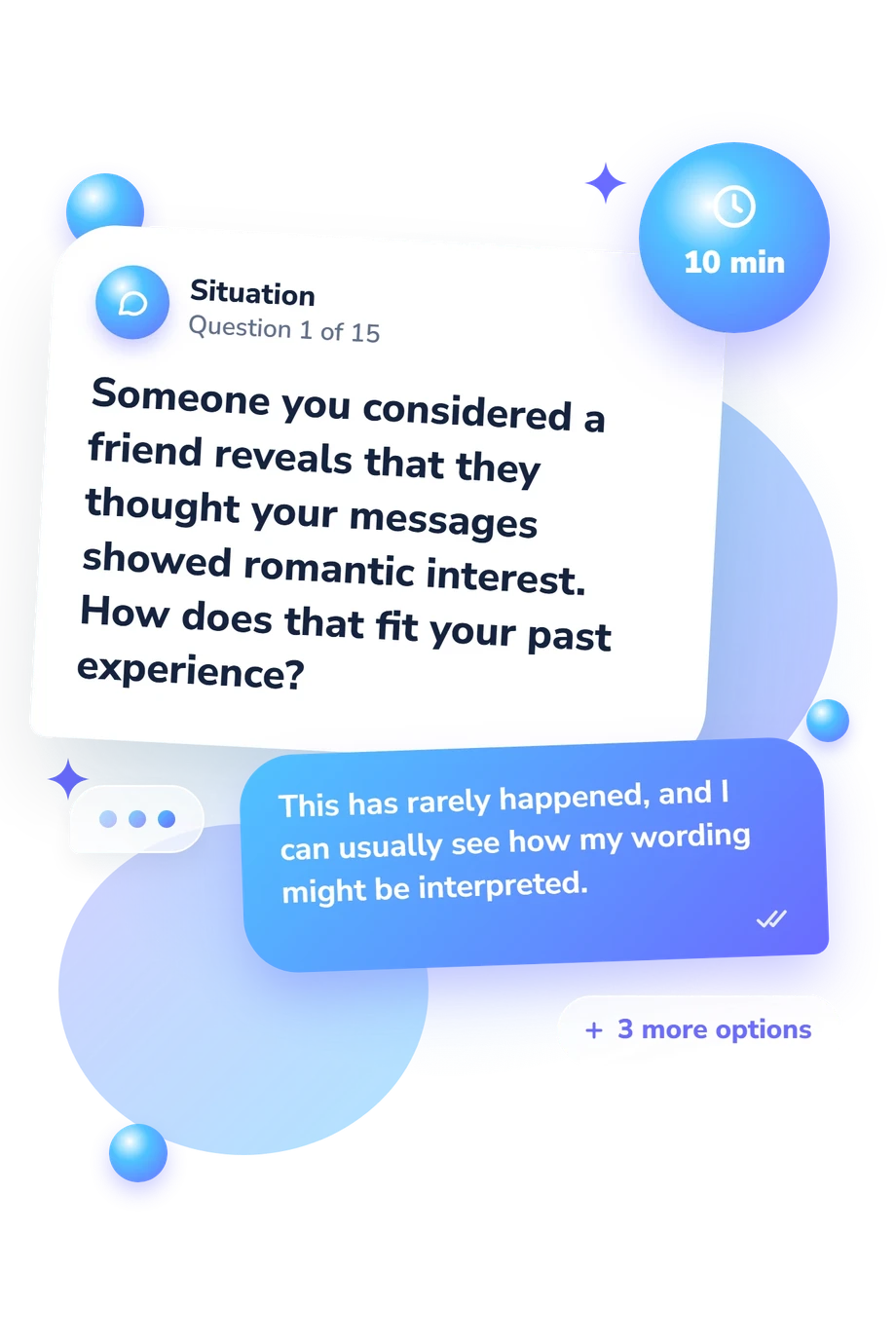
- This has rarely happened, and I can usually see how my wording might be interpreted.
- It has happened once or twice, though the interpretation was not entirely unexpected.
- It has happened several times and usually catches me off guard.
- It is a recurring pattern, and I often cannot identify what seemed flirtatious.
- Follow whichever thread the group collectively picks up.
- Give the person a brief chance to finish before returning to the group.
- Stay focused on that person and encourage them to continue.
- Tune out the competing conversation and create a sustained one-on-one exchange with them.
- I tend to remember and follow up mainly when we are already discussing it again.
- I rarely retain small scheduling details unless they affect shared plans.
- I often remember and send that person a thoughtful message afterward.
- I remember the detail, check in before and after, and look for another reason to continue talking.
Am I Flirting Without Realizing It Quiz - Description and methodology of the test
People who wonder whether warmth, attention, or playful communication is read romantically can use the Am I Flirting Without Realizing It Quiz to examine that question in a structured way. The result clarifies patterns in your behavior and your awareness of other people's interpretations. It can help you explore unintentional flirting: friendly behavior may be read as romantic without your intending it.
What This Assessment Explores
Questions cover messages, compliments, eye contact, joking, proximity, follow-up, online attention, and seeking someone out. They examine cues, recognition, and concentrated attention; that focus may reflect friendship, trust, admiration, or shared interests rather than romantic intent. The Do I Flirt Without Knowing It Quiz frames these patterns.
The three displayed dimensions are:
- Awareness Gap (0-15) measures distance between intended behavior and awareness of romantic readings; Signals tracked (0-5), Occasional mismatch (6-10), and Recurring surprise (11-15) are bands.
- Expressive Signals (0-15) measures communication's flirtatious cues regardless of intent; Subtle signals (0-5), Mixed signals (6-10), and Strong signals (11-15) mark cue levels.
- Selective Attention (0-15) measures focused attention toward one person; Broadly distributed (0-5), Noticeably focused (6-10), and Highly focused (11-15) show concentration that may reflect friendship, trust, admiration, or shared interests; it does not by itself establish flirting or romantic motive.
Methodology and Evidence Base
Each item presents a social situation with four response options. The scenarios ask about behavior, flirting cues, and reactions to others' interpretations, combining self-observation with interpersonal meaning. The result reports three separate scores, but the online questionnaire does not document an item-by-item weighting rule or normative cutoff.
Methodologically, it is a self-report questionnaire conceptually consistent with the Flirting Styles Inventory, but these results are not scores from that published inventory. The Inventory treats flirting as an individual communication style. Henningsen's research explains how one cue can carry different meanings for sender and receiver, while Hall, Xing, and Brooks' error-management research on detecting flirting shows why context can lead observers to mistake warmth for romantic interest or miss a signal.
Read the profile as a pattern map: if you flirt without knowing it, higher scores reflect the named tendency-a larger awareness mismatch, more expressive cues, or more focused attention-not certainty about another person's thoughts. Memory, current relationships, cultural norms, and honest self-report can shape answers, so this self-report questionnaire cannot establish motive or diagnosis; direct, respectful conversation is more reliable when ambiguity matters.
- Hall, Jeffrey A., Steve Carter, Michael J. Cody, and Julie M. Albright (2010). Individual Differences in the Communication of Romantic Interest: Development of the Flirting Styles Inventory. Communication Quarterly, 58(4), 365-393. 10.1080/01463373.2010.524874
- Henningsen, David Dryden (2004). Flirting with Meaning: An Examination of Miscommunication in Flirting Interactions. Sex Roles, 50(7-8), 481-489. 10.1023/B:SERS.0000023068.49352.4b
- Hall, Jeffrey A., Chong Xing, and Seth Brooks (2015). Accurately Detecting Flirting: Error Management Theory, the Traditional Sexual Script, and Flirting Base Rate. Communication Research, 42(7), 939-958. 10.1177/0093650214534972
Updated: