
Africa Cities Quiz
How the Scales are Structured
Who Usually Takes This Test?
See How You Compare
Below is a preview of how scores are typically distributed across each scale.
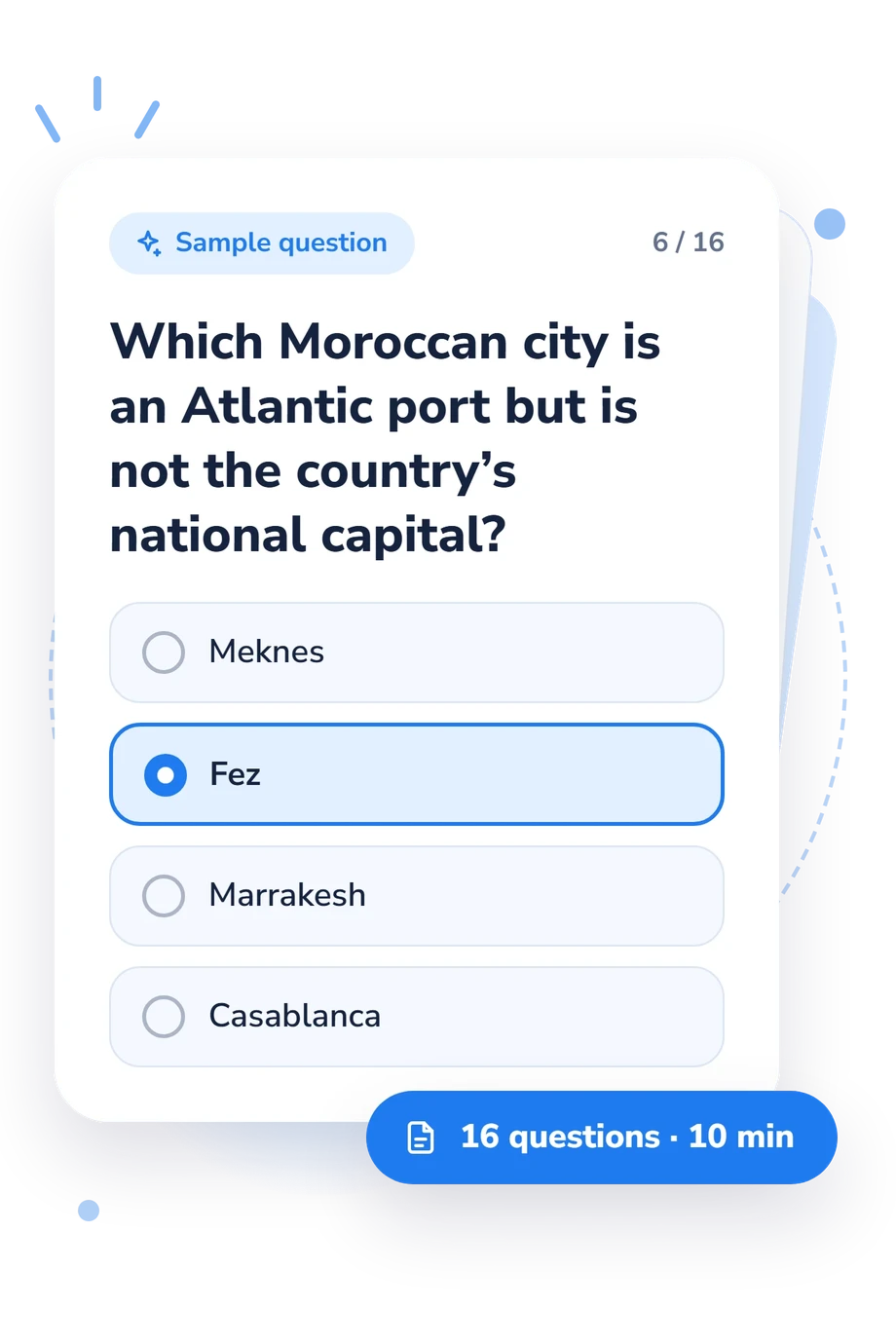
Example Questions From the Test
- Dakar
- Banjul
- Nouakchott
- Conakry
- Gaborone
- Mbabane
- Maseru
- Lusaka
- Nairobi
- Addis Ababa
- Kigali
- Lusaka
Africa Cities Quiz - Description and methodology of the test
People who want to check their knowledge of African capitals and major urban centres can use Africa Cities Quiz as a focused geography exercise. It is useful for travellers, students, readers of African history, and anyone testing how well city-country connections hold up beyond familiar examples. With location-focused clues about coastlines, rivers, and regional settings, this exercise works as an Africa cities map quiz with practical context, not just a list of names.
What This Assessment Explores
This assessment checks practical geographic knowledge rather than opinions or personality. Its clues ask you to identify national capitals, distinguish administrative centres from former or commercial capitals, and connect cities with coasts, rivers, bays, neighbouring countries, and regional institutions. That makes city-country knowledge more contextual than simple memorization.
The result uses the Africa Cities Knowledge scale, which runs from 0-16 and describes how accurately you connect cities with countries, physical settings, and regional roles. The displayed bands are:
- Foundations 0-6 indicates that cities and country-capital pairs still need review.
- Developing 7-12 indicates a useful grasp of many African cities with some geographic gaps.
- Strong 13-16 indicates accurate connections between cities, countries, settings, and regional roles.
The result can reveal whether to use this African cities map quiz to review country-capital pairs, regional locations, or coastal and inland city roles.
Methodology and Evidence Base
Each prompt presents a travel, civic, news, or geographic scenario with four answer choices. The groups cover government seats, former and current capitals, coastal cities, river settings, and links between neighbouring capitals or regional institutions.
These four-choice prompts lead to a displayed knowledge result and performance bands; the questionnaire does not specify individual answer contributions. The method combines recall with contextual recognition rather than open-ended writing. Several questions test African capital-city relationships, making the exercise an African capital cities quiz that guides further study of national capitals, maps, and urban histories.
The approach is conceptually consistent with Capital Cities in Africa (Bekker & Therborn, 2012), which presents capitals as political centres whose roles may differ from economic or historic cities. It is also compatible with Freund (2007), whose urban history explains why location, port functions, changing political roles, and regional connections matter.
The bands describe performance on these items rather than overall knowledge of Africa. Results may reflect study, familiarity, or interpretation of brief clues, so use them to guide learning about capitals, locations, and regional roles.
- Bekker, Simon, and Göran Therborn, eds. 2012. Capital Cities in Africa: Power and Powerlessness. Cape Town and Dakar: HSRC Press and CODESRIA. 220 pp. ISBN 9780796923509.
- Freund, Bill. 2007. The African City: A History. Cambridge: Cambridge University Press. 224 pp. 10.1017/CBO9780511618307
Updated: