
Concealer Quiz
How the Scales are Structured
Who Usually Takes This Test?
See How You Compare
Below is a preview of how scores are typically distributed across each scale.
Example Questions From the Test
- Green
- Peach
- Orange
- Lavender
- Use suitable moisturizing preparation and allow it to absorb
- Scrub the area immediately before reapplying
- Apply extra powder to smooth down the flakes
- Switch to a lighter shade of the same formula
- The lightest point of the face
- The skin immediately surrounding the spot
- The color of the setting powder
- A shade visibly warmer than the neck
Concealer Quiz - Description and methodology of the test
People refining everyday makeup can use this assessment to check practical decisions about coverage, color, texture, and hygiene, while the concealer quiz turns those choices into an overall knowledge result. It suits learners, makeup clients, and anyone reviewing a routine, especially those using this concealer match quiz to check how well they match concealer to skin tone and concern.
What This Assessment Explores
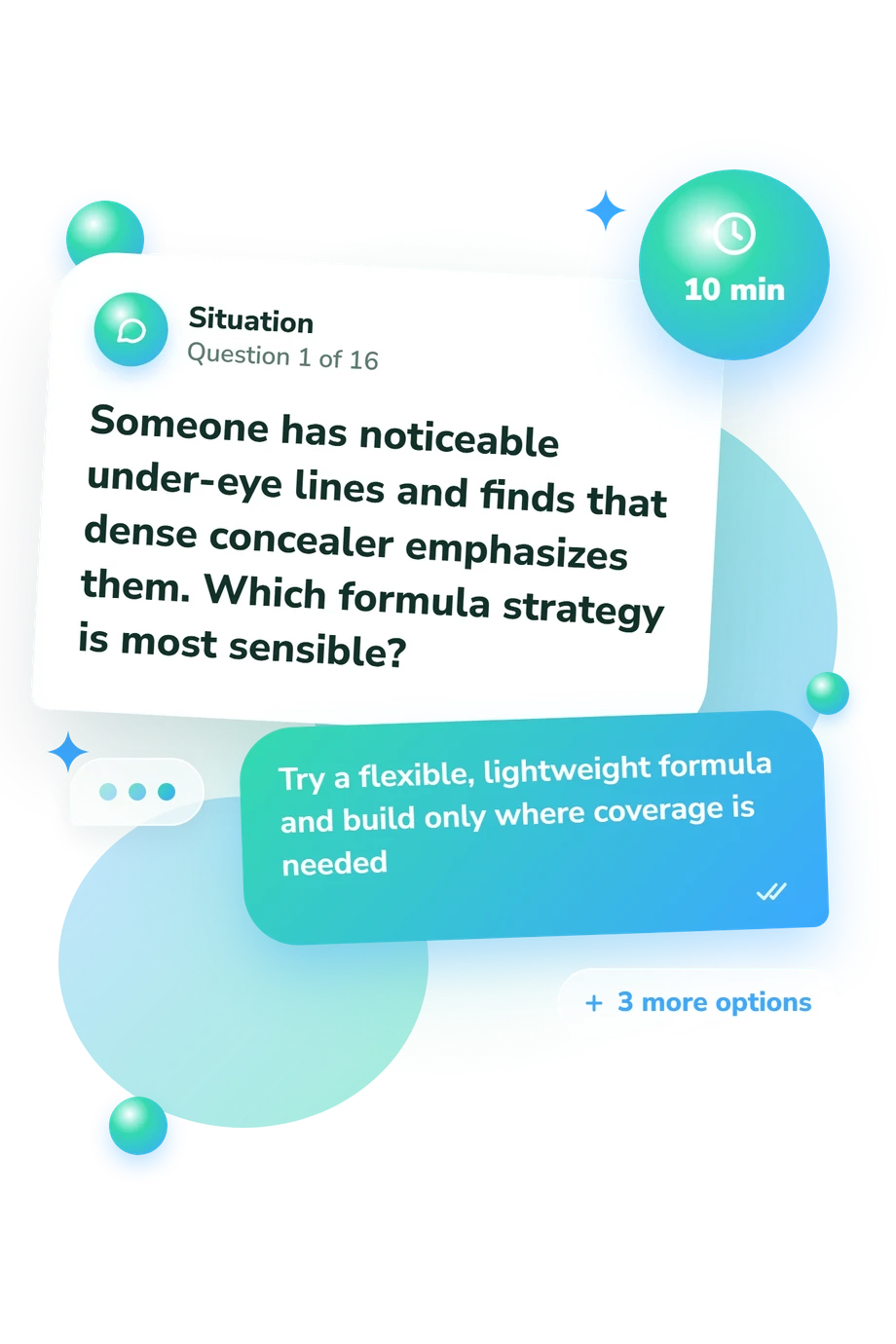
The questionnaire measures practical concealer knowledge, not artistic style or attractiveness. Its scenarios cover under-eye lines, dryness, blemishes, discoloration, color correction, layering, setting, and hygiene. The result suits learners and anyone checking whether familiar habits follow sound application principles.
The items group this content into four practical areas, all contributing to the overall knowledge score:
- Questions about shade and undertone choices test matching coverage to nearby skin without creating a stark patch.
- Questions about color correction test balancing redness or blue-purple shadows before adding skin-toned concealer.
- Questions about preparation and formula choices test responses to dryness, texture, fine lines, and heavy coverage.
- Questions about application and hygiene test precise placement, softened edges, contamination control, and lasting wear.
The shade-related items make this a practical concealer shade quiz, weighing undertone, concern, and context rather than seeking one universal color.
Methodology and Evidence Base
Each item presents one makeup situation with four answer choices, and the respondent selects the best fit. The displayed scale awards one point for each correct answer. Questions here make it a practical how to find your concealer shade quiz, testing applied judgment about tone, formula, placement, and hygiene rather than personality.
Kim and Kim (2013) provide the closest subject-specific evidence for questions about concealer and dark under-eye areas. This questionnaire is conceptually consistent with that work, but is not presented as its adaptation. Its practical emphasis also aligns with Place, Campbell, and Madry’s professional makeup framework and FDA eye-cosmetic safety guidance.
The displayed result uses Concealer Knowledge, 0-16: Foundation Stage 0-6, Developing Technique 7-12, and Concealer Confident 13-16. These bands classify performance on this quiz’s knowledge score and should not be treated as proof of practical mastery.
As an online, self-administered knowledge assessment, the result can be affected by memory, interpretation, and current context, and it cannot cover every formula, skin condition, lighting situation, or technique. Practical use still requires adjustment to the individual.
- Kim Min Jung and Jeong-Hee Kim. The Application Effects of Concealers as Affected by Skin Color Types on Dark Circle Site. Journal of the Korean Society of Cosmetology, 2013, 19(5), 815-821.
- Nonni J. Makeup Therapy for Scars. In: Téot L, Mustoe TA, Middelkoop E, et al., editors. Textbook on Scar Management: State of the Art Management and Emerging Technologies. Springer, Cham, 2020, chapter 49. 10.1007/978-3-030-44766-3_49
- Place, Stan Campbell, and Bobbi Ray Madry. The Art and Science of Professional Makeup. Milady Publishing Company, 1989. ISBN 9780873503617.
- U.S. Food and Drug Administration. Eye Cosmetic Safety. Updated December 18, 2006.
Updated: