
Flashback Quiz
How the Scales are Structured
Who Usually Takes This Test?
See How You Compare
Below is a preview of how scores are typically distributed across each scale.
Example Questions From the Test
- The sealing of Magna Carta
- Columbus's first voyage to the Americas
- The beginning of the Protestant Reformation
- The development of Gutenberg's printing press
- The permanent restoration of rule by regional samurai lords
- The rejection of industrial technology and foreign trade
- Rapid state-led modernization and military reform
- Japan's incorporation into the Chinese Empire
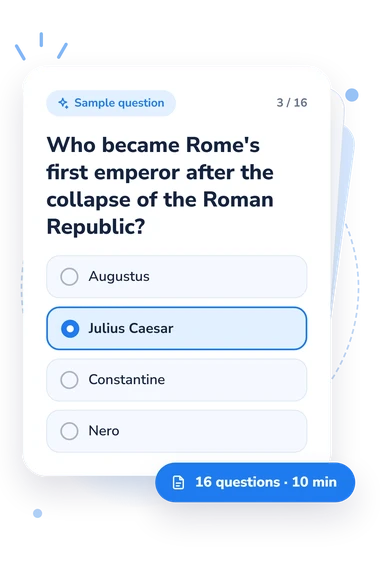
- Augustus
- Julius Caesar
- Constantine
- Nero
Flashback Quiz - Description and methodology of the test
Independent learners who are revising or deciding which historical periods deserve attention can use this flashback quiz as a focused study tool. As a historical knowledge quiz, this assessment helps learners plan revision by showing where a review schedule may need more time, whether they are revising independently or pursuing personal curiosity. Its practical value lies in turning study decisions into clear next steps.
What This Test Measures
The questionnaire measures historical knowledge across periods rather than one national story. Prompts ask respondents to place events in time, identify causes and consequences, recognize turning points, connect developments, and distinguish firsthand evidence from later summaries. Some test whether events fit wider political, social, or economic settings.
Across ancient through contemporary history, this flashback history quiz samples empire, revolution, industrialization, war, civil rights, decolonization, and international cooperation. The result shows breadth: how securely events and context are recognized across periods.
The result is reported on the Historical Events Knowledge scale (0-16), with three descriptive bands:
- Historical Starter (0-6) indicates some familiarity but room to review connections.
- Developing Historian (7-12) shows a solid foundation with gaps across periods or regions.
- Flashback Expert (13-16) reflects broad knowledge and accurate historical connections.
Methodology and Evidence Base
Each item presents a historical prompt with four answer choices and asks for the best-supported response. Groups cover chronology, change, causes and consequences, source evaluation, and regional or global connections. Some questions use recognition; others require an inference from a description, context, or firsthand source.
The questionnaire reports one overall result for historical events knowledge. It summarizes demonstrated knowledge but cannot show every step of reasoning or separate a lucky choice from well-supported understanding. The bands are descriptive, not population norms or a standardized diagnostic classification.
Reich (2013) explains why multiple-choice history tests can show patterns yet yield imperfect conclusions when recognition is treated as deeper understanding. Reich (2009) connects question design with standards and student reasoning, while Smith, Breakstone, and Wineburg (2019) distinguish historical thinking from simple recall. This questionnaire is conceptually consistent with those works, not an adaptation of any cited instrument.
Interpretation should allow for guessing, prior exposure, wording familiarity, concentration, and confidence with historical evidence. This world history assessment can identify study targets, while historical judgment also involves evaluating sources, weighing explanations, and building sustained arguments.
- Reich, Gabriel A. (2013). Imperfect models, imperfect conclusions: An exploratory study of multiple-choice tests and historical knowledge. The Journal of Social Studies Research, 37(1), 3-16. 10.1016/j.jssr.2012.12.004
- Reich, Gabriel A. (2009). Testing historical knowledge: Standards, multiple-choice questions and student reasoning. Theory & Research in Social Education, 37(3), 325-360. 10.1080/00933104.2009.10473401
- Smith, Mark, Joel Breakstone, and Sam Wineburg. (2019). History Assessments of Thinking: A Validity Study. Cognition and Instruction, 37(1), 118-144. 10.1080/07370008.2018.1499646