
Parts of Speech Quiz
How the Scales are Structured
Who Usually Takes This Test?
See How You Compare
Below is a preview of how scores are typically distributed across each scale.
Example Questions From the Test
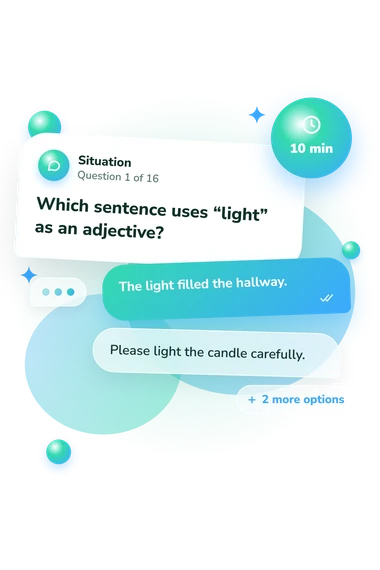
- The light filled the hallway.
- Please light the candle carefully.
- Nora carried a light suitcase.
- We switched on the light.
- It names an event.
- It joins two contrasting clauses.
- It shows the position of one thing relative to another.
- It modifies the verb “wanted.”
- It replaces the name of a person or thing.
- It expresses a sudden reaction as an interjection.
- It connects two clauses.
- It describes the umbrella.
Parts of Speech Quiz - Description and methodology of the test
Readers checking how accurately they recognize grammatical roles can use this parts of speech quiz as a focused review of sentence structure. It suits students, teachers preparing revision, and anyone refreshing everyday English grammar. As a grammar quiz on parts of speech, it helps a learner notice where familiar labels become difficult when a word’s function depends on surrounding words.
What This Assessment Explores
The quiz for identifying parts of speech measures the grammatical job a word performs in context. It checks whether you can distinguish categories that look similar in isolation, including words whose function changes with use. Context is central when identifying parts of speech because light, record, and before can take different roles. The result shows how consistently you identify conventional functions in tested examples, not a separate score for each category.
The question themes cover these areas:
- Nouns and pronouns show whether you recognize naming words and substitutes.
- Verbs and adjectives separate actions or states from words describing nouns.
- Adverbs show whether you identify modifiers that explain how actions occur.
- Conjunctions and prepositions reveal clause links and relationships.
- Interjections show whether you spot brief reactions.
Methodology and Evidence Base
Each item presents a sentence or sentence pair and offers four choices. You classify a word in context, identify clause links, recognize modifiers, or resolve pronoun reference. The quiz covers all 8 parts of speech, making it useful for guided review.
Scoring is direct: each correct answer adds one point to the Parts of Speech Knowledge scale, which runs from 0-16. The bands are Foundational 0-6, Developing 7-12, and Strong command 13-16. They describe levels for this questionnaire, not population norms; no separate weighting is specified.
The framework is conceptually consistent with Huddleston, Pullum, and Reynolds (2022), which presents categories through form, function, and distribution. It aligns with Huddleston and Pullum (2002), while Denison (2014) addresses flexibility in usage. These works are reference points for the items, not claims that the questionnaire adapts or validates their instruments.
Used as a parts of speech practice quiz, it provides a focused learning snapshot. Results may shift with guessing, attention, prior instruction, and familiarity with examples, so the interpretation describes performance on these sentence-based tasks rather than general mastery of English grammar.
- Huddleston, Rodney, Geoffrey K. Pullum, and Brett Reynolds. A Student's Introduction to English Grammar. 2nd ed., Cambridge University Press, 2022. 10.1017/9781009085748
- Huddleston, Rodney, and Geoffrey K. Pullum. The Cambridge Grammar of the English Language. Cambridge University Press, 2002. 10.1017/9781316423530
- Denison, David. "Parts of Speech: Solid Citizens or Slippery Customers?" In British Academy Lectures 2012-13: Published in the Online Journal of the British Academy, pp. 133-168. Oxford University Press, 2014. 10.5871/bacad/9780197265666.003.0007